
There’s something about the first genuinely cool morning that makes your summer makeup suddenly feel a little off.
The ultra-glossy skin that looked gorgeous in July can feel too shiny under an oversized knit. Bright coral blush starts competing with the rust, chocolate, burgundy, olive, and camel shades creeping back into your wardrobe. Even your favourite barely-there summer lip gloss might leave you wanting something warmer and slightly moodier.
But that doesn’t mean fall makeup needs to become heavy.
Actually, a natural fall makeup look can be surprisingly simple.
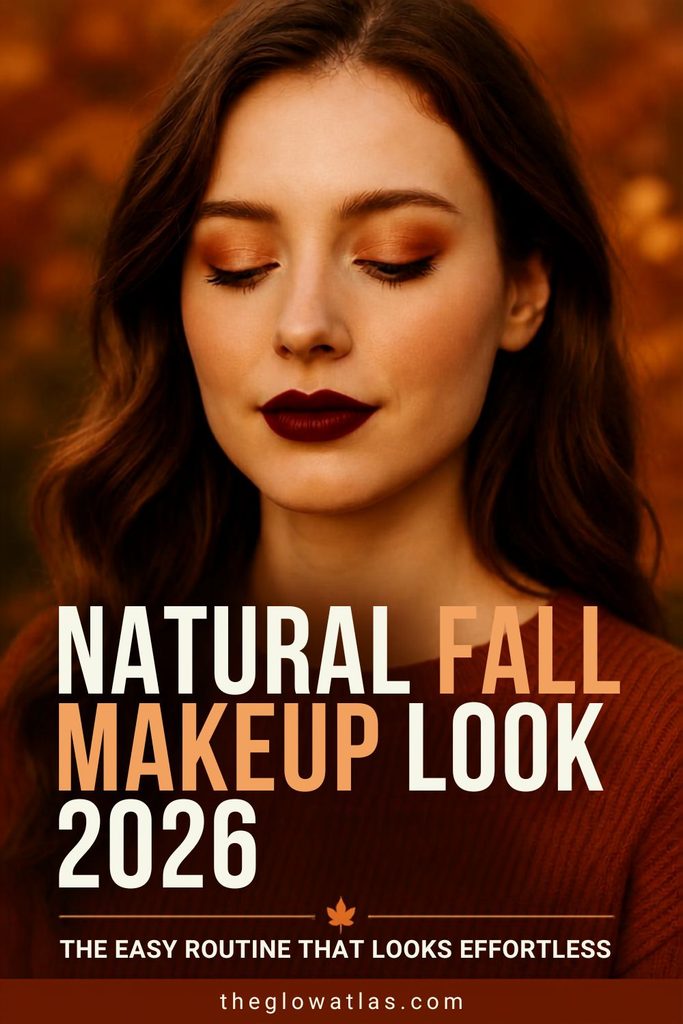
Think fresh skin that still looks like skin. Softly groomed brows. Warm cheeks. Brown or softly defined lashes. Maybe a whisper of taupe around the eyes. Then finish everything with a rose-brown, berry, caramel, terracotta, or muted nude lip.
Nothing needs to look perfectly carved out.
And that’s rather nice, isn’t it?
The beauty mood of 2026 is making this approach especially timely. Soft-focus and blurred finishes have become a major direction in makeup, replacing some of the extremely glossy complexions of recent years with skin that sits somewhere between matte and dewy. Brown mascara is also having a moment because it defines the lashes without giving them the sharper effect of traditional black mascara.
So, if you want an everyday fall makeup routine that looks polished enough for work, cute enough for brunch, and realistic enough to finish before your coffee gets cold, this is it.
What Does a Natural Fall Makeup Look Actually Look Like?
Let’s clear something up first.
“Natural” doesn’t have to mean wearing almost no makeup.
It means the makeup works with your features instead of sitting on top of them.
You might still use foundation, concealer, blush, mascara, brow pencil, and lipstick. The difference is in the amount, placement, texture, and colour.
A natural autumn look usually combines:
- Lightweight, skin-like coverage
- Soft or satin finishes
- Warm or neutral blush
- Subtle bronzer rather than dramatic contour
- Taupe, cocoa, caramel, bronze, or muted brown around the eyes
- Natural-looking brows
- Brown, brown-black, or softly applied black mascara
- Muted rose, berry, terracotta, caramel, plum, or brown-toned lips
The goal isn’t “I woke up like this.”
It’s more like, “I had enough time this morning to pull myself together.”
Even if you absolutely did not.
Fall Makeup Starts Before Foundation
Here’s the thing: sometimes what looks like a foundation problem is actually a skincare problem.
As temperatures drop and indoor heating comes back on, skin can start feeling tighter or less comfortable. If you put your normal foundation straight over dehydrated patches, suddenly the product you loved all summer looks cakey.
Then you blame the foundation.
Poor foundation.
Before applying makeup, start with a simple skincare routine that suits your skin type.
You generally don’t need seven layers. A comfortable base might include a gentle cleanse, moisturiser, and sunscreen during the day.
If your skin feels particularly dry, give moisturiser a few minutes to settle before applying makeup.
And don’t forget your lips.
A little lip balm at the beginning of your routine gives it time to soften dry areas before you reach the lipstick stage.
Should You Use Primer?
Maybe.
Primer isn’t compulsory.
If your makeup already sits nicely over your skincare, you don’t need another layer just because someone on TikTok told you that you do.
But primer can help when you have a specific issue.
If your T-zone becomes oily during the day, try a smoothing or oil-controlling primer only there. If your cheeks become dry, use a hydrating formula where you need it.
Think strategically rather than covering your entire face in product.
That philosophy will come up again and again.
Step 1: Keep Your Base Light
Natural fall makeup shouldn’t begin with trying to erase your entire complexion.
Start small.
Apply a skin tint, tinted moisturiser, light foundation, or your regular foundation in a thin layer. Concentrate coverage around the centre of the face, where redness and uneven tone often show most.
Then blend outward.
You don’t necessarily need equal amounts of foundation everywhere.
That’s one of those tiny changes that makes a surprisingly big difference.
If your forehead already looks even, why cover it heavily?
If your cheeks look good, let them show.
Modern blurred makeup follows a similar philosophy. The current soft-focus complexion trend isn’t about the thick, flat matte foundation many people remember from years ago. It’s about creating diffusion while keeping the base lightweight and flexible.
Use a damp sponge for a sheer finish or a foundation brush if you want slightly more coverage.
Then look at your skin before adding anything else.
Not from two inches away from the mirror.
Step back.
Does it actually need more coverage?
Often, it doesn’t.
Step 2: Conceal Only Where You Need It
Now take your concealer and target specific areas.
That might mean:
under the eyes,
around the nose,
over a healing blemish,
or on a little discolouration around the chin.
You don’t have to paint enormous triangles underneath both eyes.
Place a small amount of concealer where darkness is strongest and blend outward.
For blemishes, try using a small brush and tapping concealer directly onto the spot. Let it sit for several seconds before gently blending the edges.
The result looks far more natural than applying another full layer of foundation.
And yes, your skin texture will still exist.
That’s normal.
Natural makeup looks more convincing when we stop expecting actual skin to resemble a phone filter.
Step 3: Powder With a Light Hand
This is where fall makeup can go wrong quickly.
Because we’re moving toward softer finishes, it’s tempting to powder everything.
Don’t.
Instead, press a small amount of translucent or skin-toned powder onto areas where makeup tends to move.
For many people, that’s:
- Around the nose
- Between the brows
- The centre of the forehead
- The chin
- Under the eyes
Leave other areas alone if they don’t need powder.
You want your complexion to look softly polished rather than dusty.
There’s a sweet spot between glassy and completely matte. That’s exactly where a natural autumn complexion looks beautiful.
Step 4: Add Warmth Without Creating a Full Contour
Bronzer and contour aren’t the same thing.
Contour creates shadow.
Bronzer adds warmth.
For an easy natural fall makeup look, bronzer is often all you need.
Choose something that complements your skin rather than turning dramatically orange.
Apply a small amount around the temples and upper cheek area, then blend thoroughly.
You can also sweep whatever remains on your brush lightly across the bridge of the nose.
Don’t create obvious bronze stripes.
The effect should feel like warmth returning to the face after foundation slightly flattened everything.
Cream bronzers work beautifully if you enjoy a softer, more seamless finish. Powders are great too, particularly if your skin becomes oily during the day.
Use whatever behaves well on your skin.
That’s more important than following a rigid rule about cream versus powder.
Step 5: This Is Where Fall Really Arrives — Blush
Blush changes the whole mood.
Summer tends to make us reach for watermelon, bright pink, peach, coral, and sunburn-style blush.
Fall can go quieter and richer.
Try shades like:
dusty rose,
muted berry,
warm mauve,
terracotta,
soft cinnamon,
brick rose,
caramel rose,
or deep plum.
Your ideal shade depends heavily on your complexion and undertone, of course.
Fair skin can look beautiful in soft rose, muted peach, and gentle mauve.
Medium and olive complexions often suit warm rose, terracotta, cinnamon, berry, and tawny peach.
Deeper complexions can carry rich berry, burnt coral, brick, plum, wine, warm raisin, and deep terracotta beautifully.
But these aren’t laws.
Makeup isn’t tax paperwork.
Experiment.
Where Should Fall Blush Go?
For a lifted everyday effect, apply blush to the upper part of the cheeks and blend toward the temples.
For something softer and more youthful, place a little more colour on the apples of the cheeks and diffuse the edges.
The important word here is diffuse.
One of 2026’s noticeable beauty directions is blurred colour rather than sharply defined placement. Soft blush, softly blended complexion products, and feathered lip edges all fit into that wider shift.
That happens to work perfectly for natural fall makeup.
Step 6: Keep Your Brows Looking Like Brows
Remember when brows had to be extremely sculpted, dark, carved underneath with concealer, and visible from across a parking lot?
We’ve learned things since then.
For everyday makeup, brush your brows upward and outward.
Then assess what you actually need.
Maybe that’s a few pencil strokes through sparse areas.
Maybe it’s tinted brow gel.
Maybe your brows are already full, and clear gel is enough.
Use light, hair-like strokes rather than filling the entire brow with one solid block of colour.
Pay particular attention to the front.
Keeping that area softer makes the whole face look more natural.
You can create more definition toward the arch and tail while leaving the beginning slightly airy.
Small detail. Huge difference.
Step 7: Create a Soft Autumn Eye
Now we get to the cosy bit.
You don’t need an enormous fall eyeshadow palette.
Seriously.
One or two shades can create a beautiful everyday autumn eye.
Try:
- Taupe
- Soft cocoa
- Caramel
- Muted bronze
- Warm beige
- Cinnamon brown
- Soft plum
- Olive-brown
- Chocolate
Take a fluffy brush and sweep your chosen shade through the crease.
Blend.
Then blend whatever remains around the outer corner.
Done.
If you want slightly more definition, take a deeper brown and press it close to the upper lash line.
You can even use bronzer as eyeshadow.
It’s quick, makes the face feel cohesive, and means one fewer product rolling around the bottom of your makeup bag.
For evenings, add a satin bronze, champagne, copper, or soft gold shade to the centre of the lid.
Nothing too complicated.
Fall eye makeup doesn’t always need to become a smoky-eye project requiring six brushes and emotional resilience.
Step 8: Swap Harsh Black Eyeliner for Brown
Black eyeliner isn’t banned from autumn.
Obviously.
But if you’re trying to create a genuinely natural fall makeup look, brown can be easier.
Chocolate, espresso, bronze-brown, and deep taupe define the lash line without creating quite as much contrast.
Run your pencil along the upper lashes.
Then smudge it immediately with a small brush or fingertip.
Don’t worry about making the line perfect.
Actually, slightly imperfect is better.
You want shadow rather than “eyeliner.”
For a subtle lifting effect, concentrate more product on the outer third of the eye and blend it slightly upward.
It’s quick.
It’s forgiving.
And it doesn’t require attempting matching liquid wings at 7:13 a.m.
A win.
Step 9: Try Brown Mascara
This might be one of the easiest ways to make your makeup look softer.
Brown mascara has become increasingly popular for exactly that reason. Vogue and Allure have both highlighted the renewed interest in brown mascara for subtle eye definition, with makeup artists pointing to its ability to make a look feel less obviously “makeup-y.”
Brown mascara can look especially pretty with taupe, caramel, bronze, terracotta, olive, and muted rose eye makeup.
But that doesn’t mean everyone needs pale brown lashes.
If your hair, brows, or complexion need stronger contrast, try deep brown, espresso, brown-black, or your usual black mascara applied lightly.
One coat may be enough.
Concentrate on separating and defining your lashes instead of building dramatic volume.
The eyes should look awake rather than ready for a nightclub.
Unless you’re going to a nightclub after work.
Then add another coat.
Step 10: Don’t Forget the Lower Lash Line
This is optional, but it can make the whole look feel more finished.
Take whatever brown or taupe shade you used on the eyelid and lightly blend a tiny amount underneath the outer portion of the lower lashes.
Tiny.
We’re not recreating the raccoon eyeliner phase many of us survived.
Keeping most of the definition near the outer corner helps frame the eye without making it appear heavy.
You can skip lower mascara entirely for an even cleaner effect.
Step 11: Choose a Lip That Feels Like Autumn
This is where you can change the personality of the entire look.
Keep everything else identical and swap your lip colour.
Suddenly you have five different versions of natural fall makeup.
For a very understated look, choose a shade close to your natural lip colour but slightly richer.
Think:
rose-brown,
pink-brown,
caramel nude,
warm beige,
soft mauve,
muted terracotta,
berry nude,
plum-brown,
or cocoa.
The exact “nude” varies enormously across skin tones.
A pale beige marketed as universal nude may look chalky on deeper skin. Meanwhile, rich caramel, cocoa, chestnut, berry-brown, and rose-brown tones can create a much more believable natural lip.
Look at your actual lip pigmentation rather than relying solely on a shade name.
And Don’t Make the Edges Too Perfect
One of the biggest makeup stories of 2026 has been the blurred lip.
Rather than drawing a sharply defined outline, colour is concentrated toward the lips and softly diffused around the edges. Vogue has documented the look repeatedly this year, including versions worn by Naomi Watts and Amal Clooney.
It’s almost suspiciously perfect for busy people because precision isn’t the point.
Apply lipstick or tint toward the centre of your lips.
Tap outward with your finger.
Then gently blur the edges.
That’s it.
A soft berry version looks particularly gorgeous in fall.
The 5-Minute Natural Fall Makeup Routine
Some mornings, the full routine isn’t happening.
Your alarm didn’t cooperate. Someone can’t find their shoes. You have an early lecture. Your commute is waiting. Your child has suddenly decided the blue cup is unacceptable despite loving the blue cup yesterday.
Life.
On those mornings, forget perfection.
You need five things:
1. Concealer or skin tint
Even out only the areas that need help.
2. Cream blush
Tap it onto your cheeks and blend with your fingers.
3. Brow gel
Brush everything into place.
4. Mascara
One quick coat.
5. Tinted lip balm or lipstick
Choose a muted rose, berry, caramel, or terracotta shade.
You’re done.
If you have another 30 seconds, dab your blush or bronzer lightly across the eyelids.
Suddenly the whole face looks coordinated.
No one needs to know it took five minutes.
Want an Even Easier Trick? Go Monochromatic
Monochromatic makeup is one of my favourite shortcuts for fall.
Instead of trying to coordinate several colours, choose one colour family and repeat it.
For example:
Rose: dusty rose cheeks + rose-brown lips + soft rosy-brown eyes.
Terracotta: warm terracotta cheeks + cinnamon eyes + burnt nude lips.
Berry: muted berry cheeks + soft plum eyes + berry-stained lips.
Caramel: caramel bronzer + warm brown eyes + caramel nude lips.
The result feels intentional even when the routine is simple.
Warm, earthy monochromatic makeup has already shown staying power in recent beauty trends, including the popularity of toffee-like shades across eyes, cheeks, and lips.
And that’s the secret.
You don’t necessarily need more makeup to look put together.
Sometimes you simply need the colours to make sense together.
How to Make Natural Fall Makeup Work for Oily Skin
Natural makeup and oily skin can absolutely coexist.
You simply need to be selective about where you add glow.
Use lightweight skincare underneath makeup and avoid piling several rich products beneath your base if your skin doesn’t need them.
Then apply foundation sparingly.
Set the areas that become oily first, often the forehead, nose, and chin—with powder.
You can keep the outer cheeks slightly more luminous.
This creates dimension without turning your entire face into one reflective surface by lunchtime.
A setting spray can also help everything settle together and reduce an overly powdery finish.
Keep blotting papers in your bag if you’re prone to midday shine.
Blot first.
Then powder if necessary.
Putting more and more powder directly over oil is how makeup starts turning into birthday cake.
What If Your Skin Gets Dry in Fall?
Take the opposite approach.
Prioritise comfortable skincare and avoid using too much powder.
Choose flexible, skin-like complexion products rather than extremely dry matte formulas.
Apply foundation in thin layers.
Cream blush and bronzer can also sit beautifully on dry skin because they tend to melt into the complexion.
And if foundation starts clinging to flaky areas halfway through the day, resist the urge to pile more foundation on top.
That usually makes things worse.
Instead, gently press the area with clean fingers or a damp sponge and work with what’s already there.
Your makeup doesn’t have to look identical at 6 p.m. to how it looked at 8 a.m.
Faces move.
Skin produces oil.
We eat lunch.
We laugh.
We touch our faces even though we promised ourselves we wouldn’t.
Makeup lives on a person, not a mannequin.
The Biggest Mistake: Making “Natural” Makeup Too Complicated
Natural makeup can become oddly exhausting.
First there’s primer.
Then colour corrector.
Then foundation.
Then concealer.
Then cream contour.
Cream bronzer.
Cream blush.
Powder.
Powder bronzer.
Powder blush.
Highlighter.
Setting spray.
Suddenly your “no-makeup makeup” has seventeen products involved.
You don’t need to prove anything.
If one blush works, use one blush.
If your foundation gives enough coverage, skip concealer.
If you like your brows without product, leave them alone.
If lipstick makes the whole face work, make lipstick the star.
Even recent beginner makeup guidance has moved toward a curated approach: while a makeup bag may contain many categories, an everyday face doesn’t necessarily require using all of them simultaneously.
Makeup should fit your morning.
Your morning shouldn’t have to fit your makeup.
Natural Fall Makeup for Work or University
For everyday professional or campus makeup, keep the base lightweight and put most of your effort into three areas:
brows,
lashes,
and cheeks.
These features frame the face quickly.
Try a soft rose or terracotta blush, brushed brows, mascara, and a tinted lip balm.
If you want eye definition, add taupe or brown shadow close to the lashes.
It’s polished without looking overdone.
And more importantly, it can survive a long day without requiring a makeup bag the size of carry-on luggage.
Taking the Same Makeup Into the Evening
Don’t start over.
This is one of those habits that saves an absurd amount of time.
Instead, build onto what you’re already wearing.
Deepen your outer lash line with chocolate or espresso pencil.
Add a touch of bronze or copper shadow.
Apply another coat of mascara.
Strengthen your blush slightly.
Then change your lip.
A berry, wine, brick rose, deep terracotta, or plum-brown lip immediately makes natural daytime makeup feel more autumnal and evening-ready.
If you want something bolder, blurred red is another option. The softly diffused technique has even been used with classic red lipstick, showing that blurred doesn’t necessarily mean neutral.
Add earrings.
Fluff your hair.
You’re going.
A Few Natural Fall Makeup Mistakes Worth Avoiding
Wearing too much foundation
You can still see skin through natural makeup.
That’s a feature, not a failure.
Using a nude lipstick that’s too pale
Your ideal nude should work with your natural colouring rather than erase your mouth.
Powdering the entire face automatically
Powder where you need longevity or oil control.
Making every feature equally strong
If the lips are richer, keep the eyes softer.
If you’re wearing a smoky brown eye, try a quieter lip.
Give the face somewhere to rest.
Ignoring your undertone
Warm autumn colours aren’t limited to orange.
If traditional warm shades make you look tired, try cooler taupes, mauves, muted berries, rosy browns, and plums.
Fall has room for cool tones too.
Copying trends literally
Trends are ideas.
They’re not instructions.
Brown mascara might look gorgeous on your friend while black-brown works better for you. Terracotta might make one complexion glow while another looks incredible in berry.
Take the part that works.
Leave the rest.
What Makeup Colours Look Best for Fall?
There’s no official autumn makeup rulebook, thankfully.
But certain shades naturally complement the deeper colours we tend to wear as temperatures drop.
Try experimenting with:
Eyes: taupe, chocolate, espresso, bronze, caramel, copper, cinnamon, muted plum, olive, champagne.
Cheeks: dusty rose, warm mauve, berry, terracotta, cinnamon, burnt peach, brick.
Lips: rose-brown, caramel nude, cocoa, berry, wine, brick red, plum-brown, muted terracotta.
Interestingly, current makeup interest isn’t centred entirely around one must-have colour. Texture has become just as important. Soft matte lipstick, blurred finishes, terracotta shades, and softer mascara colours have all attracted attention recently.
That gives you more freedom.
You can wear a glossy berry lip.
Or a blurred berry lip.
Same general colour. Completely different mood.
Do You Need to Buy New Makeup for Fall?
Probably not.
Look through your existing makeup first.
That bronzer you already own?
Try it on your eyelids.
Your berry lipstick?
Tap the tiniest amount onto your cheeks before foundation or use it as a softly blurred lip stain.
That dark brown eyeshadow hiding in the back of your palette?
Use it as liner.
A natural fall makeup routine doesn’t require replacing your entire beauty drawer every September.
Sometimes seasonal makeup is simply about changing how you use what you own.
That’s especially helpful if you’re a student watching your budget, a young professional building a practical makeup collection, or a busy parent who doesn’t particularly fancy buying twelve nearly identical brown products.
Use what earns its place.
Frequently Asked Questions About Natural Fall Makeup
What is a good natural makeup look for fall?
Try a lightweight complexion, softly defined brows, muted rose or terracotta blush, brown or black-brown mascara, subtle taupe eyeshadow, and a rose-brown or berry lip.
Keep the edges soft rather than creating strong lines.
Is matte makeup coming back?
Soft matte and blurred finishes are having a strong moment in 2026, but this isn’t necessarily a return to the heavy, flat matte makeup of the past. Current blurred complexion products focus more on lightweight diffusion and comfortable texture.
What lipstick looks natural in fall?
Look for a shade that resembles your natural lip pigmentation but is slightly deeper or warmer.
Rose-brown, berry nude, muted mauve, terracotta nude, caramel, cocoa, and plum-brown are good places to start.
Is brown mascara better for natural makeup?
It can be.
Brown mascara generally creates softer contrast than jet black, which is one reason it has become popular for minimalist makeup.
If brown doesn’t create enough definition for you, try espresso, brown-black, or black.
Can I wear natural fall makeup without foundation?
Absolutely.
Use concealer only where you want coverage, then add blush, brows, mascara, and lip colour.
You don’t need foundation for makeup to look finished.
How can I make my fall makeup last all day?
Start with skincare that suits your skin, apply thin makeup layers, powder areas prone to oiliness, and consider finishing with setting spray.
Carry your lip product for touch-ups.
That’s usually more useful than trying to make every product completely indestructible.
Fall Makeup Doesn’t Need to Be Dramatic
Maybe that’s the part worth remembering.
You don’t have to wake up on September 1 and suddenly start wearing burgundy lipstick, carved cheekbones, and a smoky eye to prove you understand autumn.
A seasonal shift can be subtle.
Swap coral blush for dusty rose.
Try brown mascara instead of black.
Trade a glassy complexion for something softer and more diffused.
Tap berry lipstick onto your lips instead of applying a thick opaque coat.
Brush a little bronzer across your eyelids.
Five tiny changes can make your entire makeup routine feel different.
And that’s what makes a natural fall makeup look so useful.
It works with real mornings.
The rushing-to-class mornings. The daycare-drop-off mornings. The 8:30 meeting mornings. The mornings when you’re somehow standing in front of the mirror with one earring on and absolutely no idea where the other one went.
You don’t need perfection.
You need comfortable skin, a little warmth, soft definition, and colours that make you feel like autumn has arrived.
Keep it simple.
Keep it soft.
And most importantly, keep enough of your real face showing through that you still look like you.
Just you, in fall.