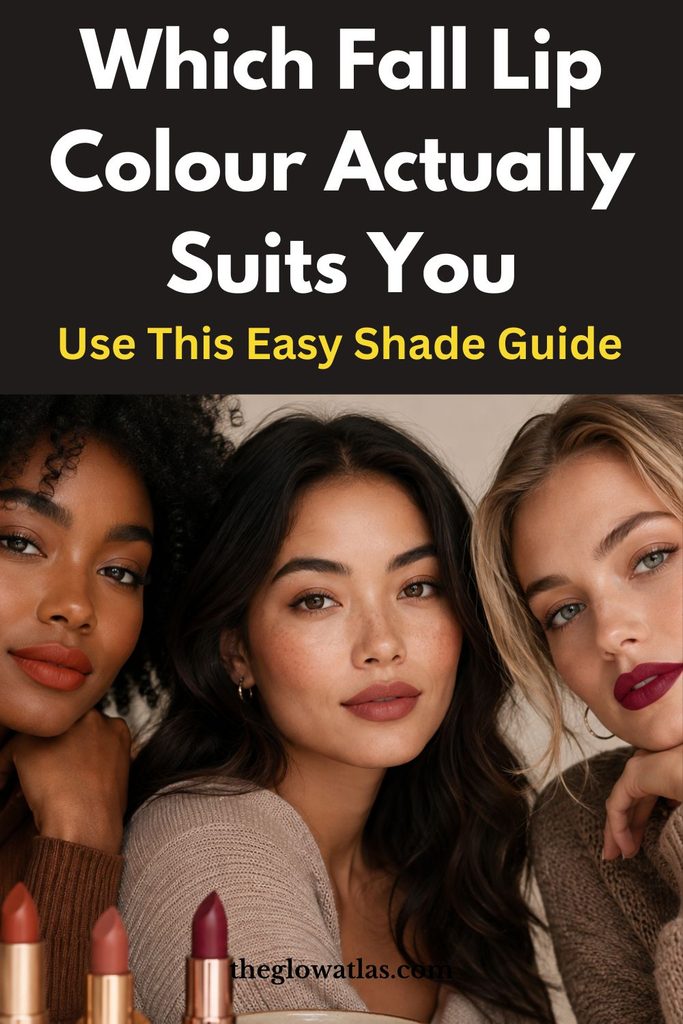
There’s something about the first cool morning of fall that makes bright summer makeup feel slightly out of place.
The coral gloss you wore through July? Still pretty. That candy-pink lipstick living at the bottom of your bag? Keep it. But once sweaters, boots, deeper nail colours, and warm coffee start making their way back into your routine, richer lip colours suddenly make sense.
Then comes the difficult part: which fall lip colour should you actually wear?
Because “wear burgundy in fall” sounds simple until you’re standing in a beauty aisle looking at six burgundies. One pulls purple. Another looks almost brown. One looks gorgeous in the tube and somehow turns fluorescent against your skin.
Been there.
Choosing the right fall lipstick is less about following a strict colour chart and more about understanding three things: your undertone, your skin depth, and how intense you want the finished look to feel.
And fall 2026 gives us plenty of room to play.
This year’s lip trends aren’t locked into one dramatic shade. Texture is becoming just as important as colour. Vogue has highlighted softly blurred lips, juicy finishes, sheer formulas, and natural-looking tones as major 2026 directions, while fall runways have brought strong reds and deeper berry shades back into focus.
So yes, you can wear the full wine-red lipstick.
But you can also wear a sheer berry balm on the school run, a cinnamon nude to the office, or a softly blurred brick red for dinner.
The trick is finding your version of the colour.
First, Forget the Idea That Fall Lips Have to Be Dark
Fall lipstick often gets reduced to one picture: deep burgundy, sharp lip liner, flawless foundation, maybe a camel coat thrown over the shoulders for good measure.
Beautiful? Absolutely.
Necessary? Not at all.
A fall lip colour simply needs enough depth, warmth, coolness, or muted richness to feel connected to the season. That could mean dark cherry. It could also mean rosewood, caramel nude, warm terracotta, soft plum, muted cranberry, cinnamon, or a sheer raspberry stain.
In fact, one of the more interesting beauty shifts in 2026 is the move away from rigidly perfect lipstick. Soft, diffused edges and sheer washes of colour are having a strong moment. Vogue has noted both the popularity of blurred lips and the return of sheer lipstick formulas with a distinctly ’90s feel.
That’s good news if you’re rushing out the door at 7:40 a.m.
You don’t need twenty minutes, three brushes, and the concentration of a surgeon to make fall lipstick work.
Sometimes one swipe and a finger tap will do.
The Real Starting Point: Know Your Undertone
You’ll hear the word undertone a lot when people talk about lipstick.
It sounds technical. It isn’t.
Your skin tone describes how light or deep your complexion appears. Your undertone refers to the subtle colour underneath it.
The most common categories are warm, cool, neutral, and olive.
Warm skin often has golden, peach, or yellow tones. Cool skin tends to show pink, red, or bluish tones. Neutral skin contains a balance of warm and cool characteristics. Olive skin usually has a green, golden, or slightly muted cast.
This matters because two lipsticks labelled “red” can behave completely differently.
A tomato red contains more orange or warmth.
A cherry or crimson red may lean blue.
Put each one against the same face, and you can get two completely different effects.
L’Oréal’s current shade guidance follows the same basic colour principle: terracotta, brick, and warmer reds tend to harmonise well with warm undertones, while blue-reds and deeper berries tend to suit cooler undertones. Neutral undertones have more freedom between the two families.
Still not sure about your undertone?
Look at several clues instead of trusting one internet trick.
Check your skin in daylight. Think about whether gold or silver jewellery feels more natural against you. Notice whether warm ivory or crisp white clothing makes your face look fresher. You can also look at the veins around your wrist; blue or purple can suggest cool colouring, while greener-looking veins may point toward warmth. A mix may indicate neutral colouring. Maybelline and L’Oréal both use variations of these cues in their undertone guidance.
None of these tests is perfect on its own.
That’s particularly true for deeper and olive complexions, where vein-colour tests can be hard to read.
So use them as clues, not commandments.
Warm Undertone? Fall Was Basically Made for You
Warm autumn lip colours can look delicious against golden, peachy, or yellow undertones.
Think roasted cinnamon rather than bubblegum pink.
Brick red is one of the easiest places to start. It gives you the impact of a red lip but tends to feel softer and earthier than a classic blue-red. Terracotta does something similar, especially if you love warm blush, bronzer, gold jewellery, camel coats, or brown eye makeup.
Then there are the browns.
Chocolate brown, cinnamon brown, caramel, chestnut, and warm mocha can all work beautifully in fall. The key is making sure there is enough contrast between the lipstick and your natural complexion.
On deeper warm skin, rich cocoa, mahogany, warm burgundy, and brown-red shades can look striking.
On medium warm skin, cinnamon, burnt rose, brick, and terracotta are easy territory.
On lighter warm complexions, muted peach-brown, warm rose, rust, and softer brick shades often give that autumn mood without overwhelming the face.
A little unexpected? Try warm red.
Fall 2026 isn’t only about muted colours. Harper’s Bazaar spotted crimson lips across Fall/Winter 2026 collections, including both deeper berry interpretations and brighter tomato-red versions.
So your autumn lipstick doesn’t need to whisper.
Sometimes it can walk into the room first.
Cool Undertone? Bring On Berry, Plum, and Cherry
Cool undertones and fall berries are a very happy pairing.
Raspberry.
Cranberry.
Wine.
Plum.
Black cherry.
Blue-based red.
These shades contain enough cool pigment to echo pink or bluish tones in the skin rather than fighting them.
A classic cool red is especially useful because it works well beyond fall. Wear it with a white shirt and jeans in September, a charcoal knit in November, and a black dress in December. One lipstick, several personalities.
If you prefer something less bold, dusty mauve is worth trying.
Mauve gets a slightly unfair reputation because the wrong one can look grey or flat. The right mauve, though? Very elegant. Look for a shade that retains enough rose, berry, or plum pigment to keep your complexion alive.
For deeper cool complexions, rich blackberry, blue-red, deep wine, cool chocolate, and plum can look particularly polished.
Medium cool complexions can experiment with cranberry, berry rose, raspberry, mauve, and cherry red.
Fairer cool skin often works beautifully with rosewood, soft berry, blue-red, muted raspberry, and pink-plum.
And if purple makes you nervous, don’t jump straight to grape.
Start with a berry that has a whisper of plum.
Much easier.
Neutral Undertones Get More Freedom. But There’s Still a Catch
People with neutral undertones often hear, “You can wear anything.”
Technically, you have more flexibility.
Practically, there are still lipsticks that may look odd.
Neutral colouring sits between warm and cool, so you may be able to wear brick red on Monday and cranberry on Friday without either feeling wildly disconnected from your skin.
That makes rosewood, balanced reds, neutral browns, muted berry shades, pink-browns, and soft plums especially useful.
But skin depth still matters.
Imagine someone with deep neutral skin choosing a very pale beige lipstick.
The undertone might technically match.
The depth doesn’t.
That’s why lipstick selection needs two conversations happening at once: Is the undertone right? And is the shade deep enough to work with my complexion?
L’Oréal makes a similar point in its lipstick guidance, noting that neutral undertones can handle both warmer and cooler shades while still needing a flattering level of depth.
So don’t let the “neutral people can wear everything” rule bully you into buying a nude that makes you look like you misplaced your lips.
And What About Olive Skin?
Olive undertones deserve their own conversation because they don’t always fit neatly into warm-versus-cool charts.
Some olive complexions lean warm.
Others lean neutral.
Some have enough green in the skin that certain beige or grey lipsticks suddenly look much duller than expected.
If this sounds familiar, look for lip colours with richness.
Brick reds, brown-reds, caramel browns, deep rose, muted berry, warm burgundy, raisin, and terracotta can be excellent starting points.
Very pale chalky nudes are often harder to wear because they can erase the natural contrast in the face.
And when a pink lipstick looks strangely neon on you even though it looked calm in the tube? That may be your olive undertone shifting how the pigment reads.
Lipstick is funny like that.
The shade in the tube is only half the story.
Your skin and natural lip pigment finish the colour.
Skin Depth Matters More Than People Think
This is where many “perfect lipstick shade” guides become too simplistic.
Someone tells you cool skin should wear berry lipstick.
Fine.
But which berry?
A pale raspberry stain and an almost-black blackberry lipstick technically live in the same family. Their visual weight could not be more different.
As skin depth increases, you can usually carry greater pigment depth without the colour dominating your face.
That doesn’t mean fair skin cannot wear dark lipstick. Of course it can. The contrast will simply be stronger.
Likewise, deep skin can wear light lipstick, but the shade often needs enough brown, rose, peach, or liner support to prevent an ashy effect.
This is why a “nude” should never be treated as one universal beige.
Your best nude may be pink-brown.
Someone else’s may be caramel.
Another person may need deep cocoa.
For everyday fall makeup, a useful shortcut is to choose a lip colour slightly deeper than your natural lip tone.
Want drama?
Go several levels deeper.
Want that “I put myself together in five minutes” effect?
Stay closer to your natural lip depth and change the undertone rather than making a huge jump in darkness.
The Fall Lip Colour Families Worth Knowing
Now we get to the fun part.
Burgundy: The Autumn Classic
Burgundy keeps returning because it sits right between red, berry, brown, and wine.
One burgundy may look almost black-red.
Another may lean purple.
Another feels surprisingly warm.
That versatility is exactly why it works on so many complexions.
Fall 2026 fashion itself is also leaning into burgundy, alongside strong reds and royal purples, so the shade connects naturally with the wider seasonal palette.
Warm undertone? Try a red-brown burgundy.
Cool undertone? Look toward wine or berry burgundy.
Neutral? Lucky you. Start somewhere in the middle and move according to your mood.
Brick Red: Red Without the Pressure
Classic red lipstick can feel like an event.
Brick red feels like you could wear it while answering emails.
It has enough brown or orange mixed into the red to soften the drama, making it especially easy for daytime wear.
Pair it with softly defined brows, mascara, and warm blush, and you’re basically done.
Berry: The Shade That Can Do Almost Anything
Berry deserves more attention.
Sheer berry can be casual.
Satin berry feels polished.
Deep matte berry looks dramatic.
Blurred berry looks modern and slightly romantic.
That flexibility makes berry one of the easiest colours to carry from September into winter.
The continued popularity of sheer and blurred lip textures in 2026 makes berry especially wearable right now because you don’t have to commit to full pigment.
If a full berry lipstick scares you, tap the colour onto the centre of your lips and blend it outward.
Same shade. Half the drama.
Brown: Welcome Back, Again
Brown lipstick has returned so many times that perhaps we should stop calling it a comeback.
Chocolate.
Mocha.
Espresso.
Caramel.
Cinnamon.
Pink-brown.
Brown lipstick can be soft or dramatic depending on depth, and it plays beautifully with fall fabrics and colours.
There’s also something pleasantly practical about brown-based lip shades. They tend to sit comfortably beside bronze eyeshadow, soft black liner, taupe, cream knits, denim, camel, olive green, burgundy clothing, and gold accessories.
A good brown lipstick earns its place in your makeup bag.
Plum: Moody Without Going Full Goth
Plum is the shade you choose when berry feels too predictable.
It carries more purple, which gives it depth and character.
Cool complexions usually have an easier time with true plum. Warm complexions can look for red-plum or brown-plum versions.
And remember: lipstick does not need to be opaque.
A sheer plum balm can look surprisingly natural.
Clinique’s Black Honey is a famous example of how a dark-looking berry-plum shade can become far softer once applied in a sheer formula. Vogue recently pointed to its history while discussing the renewed interest in sheer lipstick for 2026.
Rosewood: The Quiet Workhorse
If you want one lipstick that can survive a lecture, office meeting, coffee date, supermarket run, parent-teacher conversation, and dinner without feeling inappropriate anywhere, try rosewood.
It lives somewhere between rose, nude, mauve, and brown.
Not exciting enough for a dramatic Saturday night?
Maybe.
But that’s almost the point.
Every makeup bag needs one shade that doesn’t demand a strategy.
Matte, Satin, Glossy, or Blurred? The Finish Changes Everything
Two lipsticks can be the same colour and still look completely different because of the finish.
A matte burgundy feels bold and graphic.
A glossy burgundy feels richer and more dimensional.
A sheer burgundy reads almost like a berry tint.
A blurred burgundy can look soft and romantic.
So when you think you “can’t wear” a certain colour, you may simply dislike it in the finish you tried.
Matte formulas offer strong colour payoff and often better staying power, which makes them useful for long workdays or events where constant touch-ups become annoying. Satin sits between matte and gloss, giving you noticeable pigment with a softer finish. Glossy formulas bring shine and dimension but normally need more maintenance. L’Oréal similarly notes that matte and liquid formulas tend to have stronger longevity, while satin gives a middle ground and glossy products typically need more touching up.
Then there’s blurred lipstick.
This is probably one of the easiest ways to make a dramatic fall colour less intimidating.
Apply the shade toward the centre of your lips, then soften the border with a fingertip or small brush rather than creating a hard outline.
Vogue has highlighted this diffused finish throughout 2026, including on red carpets and runway-inspired looks.
It feels polished without looking painfully precise.
And, frankly, that is useful when you have six minutes before leaving home.
Your Natural Lip Colour Can Change the Lipstick
This tiny detail explains so many disappointing lipstick purchases.
You see a muted brown-pink online.
You buy it.
You apply it.
Suddenly it’s purple.
Your natural lips already contain pigment. Some are rosy. Some are brown. Some are mauve. Some have areas of deeper pigmentation.
That base mixes visually with lipstick.
Sheer formulas show this most clearly because your lip colour remains visible underneath.
Before judging a shade, try it directly on your lips rather than relying only on a wrist swatch.
A wrist swatch can show undertone and pigment.
It cannot perfectly predict the final colour.
If your natural lip pigmentation is uneven, a lip liner can also help create a more consistent base.
And no, the liner doesn’t have to match exactly.
More on that in a second.
Lip Liner Can Rescue a Shade You Almost Gave Up On
You buy a nude.
It’s too pale.
Don’t throw it away yet.
Try a deeper brown or rose-brown liner.
Line the lips, soften the pencil inward, then apply the lighter lipstick through the centre.
Suddenly the colour has structure.
The same trick works with fall shades.
A chocolate liner can deepen warm nudes.
A berry liner can give dimension to pinks and plums.
A red-brown liner can make bright red feel more autumnal.
This is particularly useful for medium-deep and deep complexions because liners can restore the depth that some lighter lipstick formulas remove.
You can also use liner to shift undertone slightly.
Too orange?
Try a cooler brown liner.
Too purple?
Introduce a warmer red-brown edge.
Makeup isn’t chemistry class. You’re allowed to mix things.
Choosing a Fall Lip for Work, Class, and Busy Mornings
Not every Tuesday morning needs merlot lipstick.
For university, work, errands, Zoom calls, school drop-off, or the sort of morning when you’re eating toast while looking for your keys, choose colours that tolerate imperfect application.
Rosewood is excellent.
So are pink-brown, soft berry, caramel nude, muted brick, and sheer plum.
Balms, stains, satins, and soft matte formulas tend to work particularly well because you can apply them quickly.
For office settings, think about visual balance.
If your eye makeup is already defined and polished, a quieter lip may make the entire look feel more professional.
If your face makeup is minimal, however, a stronger lip can actually make getting ready faster.
Concealer. Brows. Mascara. Red lipstick.
Done.
That’s one reason lipstick has always been such an efficient beauty tool. Even Bobbi Brown described lipstick in a 2026 Vogue interview as something that can quickly make a person appear more polished, with formula playing a major role in how flattering and wearable it feels.
Sometimes the five-minute makeup routine really is the smarter one.
What About Date Night or Evening Makeup?
Now you can turn the volume up.
Deep cherry, merlot, blackberry, chocolate, burgundy, and rich crimson all feel right once the light gets lower.
But avoid making every feature compete.
A dramatic lipstick with dramatic shadow, heavy blush, strong contour, large lashes, and very defined brows can work, but it requires more control.
For an easier evening look, choose your focal point.
Deep berry lips? Keep the eyes soft.
Smoky eyes? Try a cinnamon nude or rose-brown lip.
Classic red lipstick? Let clean skin and mascara carry the rest.
Makeup needs somewhere for the eye to rest.
Think of it like getting dressed. If the coat, shoes, handbag, earrings, scarf, and trousers are all shouting, nobody gets heard.
Should Your Lipstick Match Your Clothes?
Not exactly.
In fact, perfect matching can sometimes feel a little stiff.
Instead, think in colour families.
A rust sweater can look great with brick lipstick because both contain warmth.
A burgundy dress works beautifully with rosewood, berry, brown-red, or even a contrasting nude.
Navy can handle a blue-red lip.
Olive green loves terracotta, brown, and muted berry.
Cream and camel give you room for almost anything, which is one reason autumn neutrals are so convenient.
And if you’re wearing one of fall 2026’s stronger fashion colours, burgundy, purple, or vibrant red, you don’t necessarily need the same shade on your mouth.
Sometimes contrast looks more current.
A plum sweater with a warm nude lip can be gorgeous.
So can a neutral outfit with a bright crimson mouth.
Don’t Forget Your Blush
This is the quiet detail that can make a lipstick look “wrong” even when the shade itself suits you.
Suppose you’re wearing warm terracotta lipstick with icy pink blush.
Neither colour is bad.
Together, they may feel disconnected.
Try keeping your blush and lipstick somewhere in the same temperature family.
Warm brick lip? Peach, bronze-rose, or terracotta blush can help.
Cool berry lip? Rose, mauve, or cool pink makes sense.
Neutral brown lip? You have more room to move.
They don’t need to match.
They simply need to look like they belong to the same face.
The Fall Lip Mistakes That Make Shopping Harder Than It Needs to Be
The biggest mistake is buying lipstick because it looks beautiful on someone else without considering their colouring.
Their skin depth may be different.
Their undertone may be different.
Their natural lip pigment may be different.
Their lighting is almost certainly different.
And if you saw the lipstick on social media, there may be colour correction happening too.
Another mistake is judging a shade only by the tube.
Dark lipstick can apply sheer.
A boring-looking brown can become a beautiful rose once it hits the lips.
A sophisticated mauve in the package can turn purple against warm skin.
Test whenever you can.
Then walk toward natural light.
Store lighting can do strange things to makeup.
One more mistake? Assuming your fall lipstick must be extremely dark.
If you feel uncomfortable wearing it, you probably won’t reach for it.
A lipstick you wear three times a week is more useful than the dramatic burgundy you admire every time you open the drawer.
A Simple Shade Guide You Can Actually Remember
| If your colouring leans… | Start with these fall shades |
|---|---|
| Warm | Brick, terracotta, cinnamon, caramel, warm red, warm burgundy |
| Cool | Berry, cranberry, plum, blue-red, mauve, wine |
| Neutral | Rosewood, balanced red, pink-brown, berry, soft plum, neutral brown |
| Olive | Brick red, raisin, terracotta, brown-red, caramel, muted berry |
| Light complexion | Soft berry, rosewood, muted red, gentle plum, pink-brown |
| Medium complexion | Brick, cranberry, cinnamon, mauve, terracotta, berry |
| Deep complexion | Chocolate, wine, blackberry, rich red, mahogany, deep berry |
Treat this as a starting point.
Not a rulebook.
If you have warm skin and love a blue-red lipstick, wear it.
Sometimes contrast is exactly what makes makeup interesting.
Colour theory can guide you. It doesn’t get the final vote.
You do.
Before You Buy Another Fall Lipstick, Try This
Start by deciding what role the lipstick needs to play.
Do you want an everyday shade?
Something for work?
One bold evening lipstick?
A comfortable balm?
A long-wear formula for twelve-hour days?
That question saves you from buying six beautiful products that all solve the same problem.
Then choose a colour family.
Maybe berry.
Now narrow it by undertone.
Warm berry? Cool berry? Neutral berry?
Next, decide how deep you want it.
Finally, choose the finish.
That turns “I need a fall lipstick” into something much easier:
“I want a medium-depth, cool berry in a satin finish for everyday wear.”
Now you can shop.
That little bit of clarity makes a huge difference.
If You Only Buy Three Fall Lip Colours
You really don’t need a drawer full.
A small fall lip wardrobe can cover almost everything.
Start with an everyday lip close to your natural colouring. Rosewood, pink-brown, cinnamon nude, or muted berry works well.
Then choose a classic statement shade. Red, brick, cranberry, or burgundy will give you that instant dressed-up effect.
Finally, add a deep evening colour if you enjoy drama. Chocolate, wine, plum, blackberry, or deep cherry can carry you through dinners, parties, weddings, and the holiday season.
Change the texture, and those three shades feel like even more.
Wear your berry full-strength on Friday night.
Blot it down on Monday morning.
Add balm on Sunday.
Blur the edges for brunch.
Same lipstick. Different mood.
The Best Fall Lip Colour Is the One You’ll Actually Wear
Fall makeup should be fun.
Not another beauty rule to memorise.
Yes, undertones help. Skin depth matters. Finish matters. And current trends can give you fresh ideas.
But none of that means you need permission to wear a colour you love.
Fall 2026 is actually a good season for that freedom. Runways are showing confident reds, fashion palettes are moving through burgundy and rich purple, and beauty trends are balancing bold pigment with sheer, glossy, and blurred finishes.
So maybe your fall lip is a deep wine.
Maybe it’s chocolate brown.
Maybe it’s a barely-there berry balm you can apply without a mirror while sitting in the car before work.
All three count.
Find the colour that makes your complexion look alive, choose a formula that fits your actual day, and give yourself enough room to experiment.
Because the right fall lip colour shouldn’t make you feel like you’re wearing somebody else’s makeup.
It should still look like you.
Just with a little more autumn in the picture.