
You step out of the shower, reach for something to moisturise your skin, and suddenly there are choices everywhere.
Body lotion. Body cream. Body butter. Dry oil. Body oil. Moisturising oil. Shimmer oil.
And somehow a task that should take two minutes starts feeling like a tiny skincare exam.
If you’ve ever wondered whether body oil is basically a fancier version of lotion, or whether you’re supposed to use both, you’re not alone. They can leave the skin feeling soft, smooth, and cared for, but they don’t work in quite the same way.
The short version?
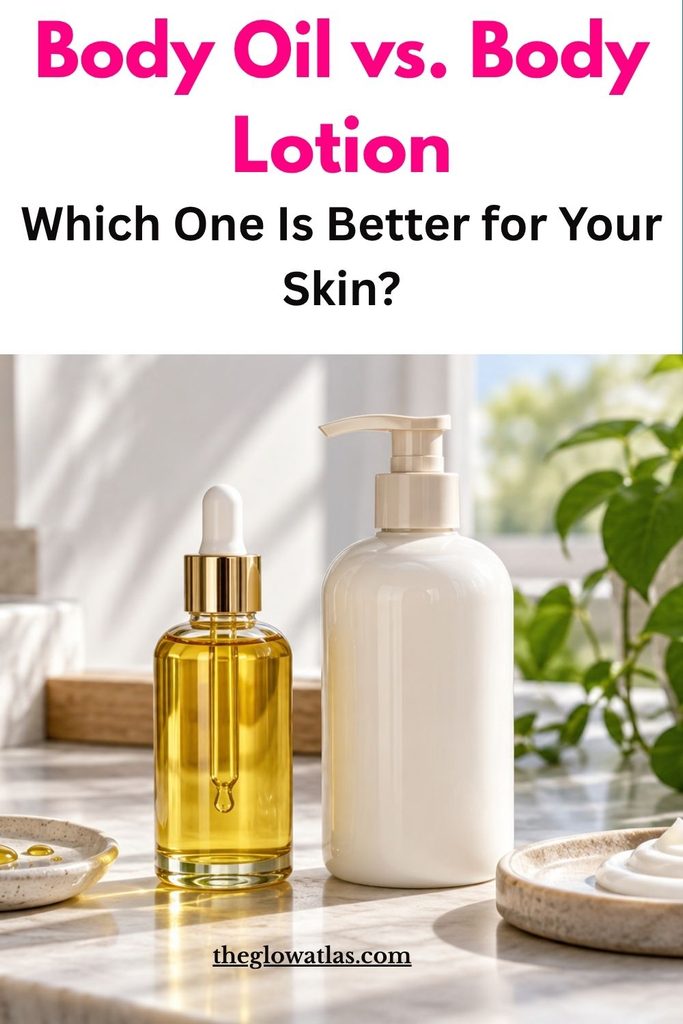
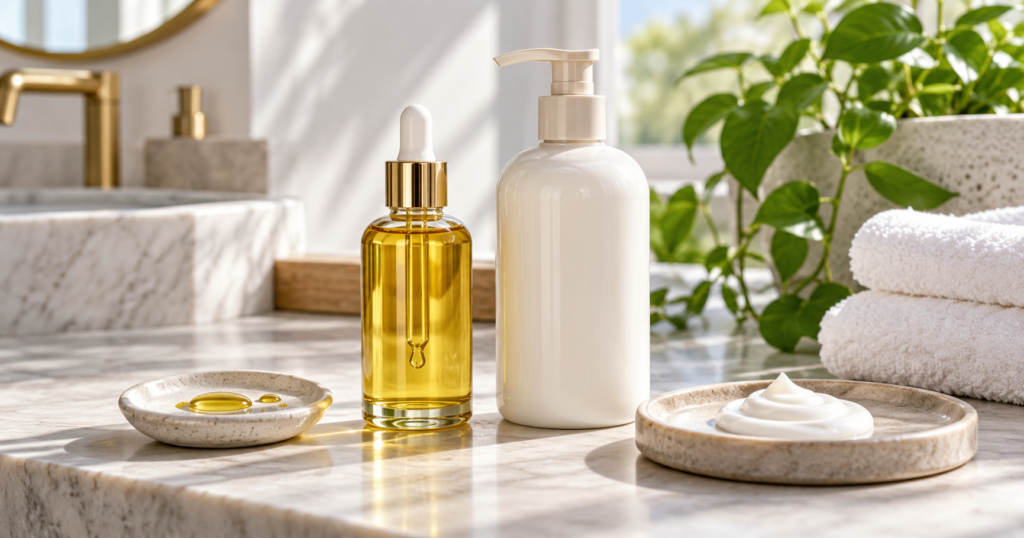
Body lotion adds water and moisturising ingredients to the skin, while body oil mainly softens the skin and helps reduce moisture loss.
That one difference explains a lot.
It explains why your lightweight lotion can feel perfect on a warm morning but not quite enough when your legs are dry and ashy. It also explains why a luxurious body oil can leave your skin glowing yet somehow still fail to fix that tight, thirsty feeling underneath.
So, body oil vs. body lotion: which one should you actually use?
Maybe lotion. Maybe oil.
And, yes, sometimes both.
Let’s make it much simpler.
First, What Actually Makes Body Oil and Body Lotion Different?
Body lotion is usually an emulsion, meaning it combines water with oils or other moisturising ingredients.
That water content matters.
A well-formulated lotion may contain ingredients such as glycerin, hyaluronic acid, ceramides, shea butter, dimethicone, or plant oils. Some attract water to the outer layer of your skin. Others smooth rough areas or help slow moisture from escaping.
Body oil is different.
Most traditional body oils contain little or no water. Instead, they’re made primarily from oils and oil-soluble ingredients. Think jojoba oil, sunflower seed oil, squalane, almond oil, coconut oil, mineral oil, or blends of several oils.
DermNet explains that moisturisers can contain three main types of ingredients: humectants, emollients, and occlusives. Humectants help attract and hold water, emollients smooth the skin, and occlusive ingredients form a protective layer that reduces water loss.
That gives us an easy way to think about the difference.
Lotion can hydrate and soften. Oil is especially good at softening and sealing.
It sounds like a small distinction, but your skin notices.
Think of Your Skin Like a Slightly Leaky Water Bottle
Odd comparison, I know. Stay with me.
Imagine your skin already contains water. Throughout the day, some of that water naturally escapes into the air through a process called transepidermal water loss, or TEWL.
When your skin barrier isn’t doing its job well, or the weather is dry, you’ve been taking very hot showers, or you’re cleansing too aggressively, more water may escape.
Your skin can start feeling rough, tight, flaky, or itchy.
A lotion helps replenish moisture while also adding ingredients that make it harder for that moisture to disappear.
Oil acts more like a lid.
It doesn’t necessarily pour a fresh glass of water into thirsty skin. Instead, it helps hold on to moisture that’s already there.
That’s why applying body oil to slightly damp skin often works much better than rubbing it onto completely dry skin and hoping for magic.
So, What Does Body Lotion Actually Do?
Body lotion is the everyday workhorse of body care.
It’s usually thinner than body cream or body butter, spreads quickly, and tends to sink into the skin without leaving much residue.
That’s exactly why it works so well for people with busy mornings.
Shower. Lotion. Clothes. Coffee. Out the door.
No standing around waiting for your legs to stop feeling like you’ve greased a baking tray.
Because lotions contain water, they’re particularly useful when your skin needs hydration rather than simply more oil.
Many lotions also include humectants.
Common ones include:
- Glycerin
- Hyaluronic acid
- Urea
- Lactic acid
Humectants attract and retain water in the outer layer of skin. DermNet lists glycerin, urea, and alpha hydroxy acids such as lactic acid among common humectant ingredients used in moisturisers.
Then you’ll often see emollients and barrier-supporting ingredients mixed in too.
This gives lotion its greatest strength: it can address several parts of dryness at once without necessarily feeling heavy.
What Does Body Oil Do, Then?
Body oil is more about sealing, smoothing, and adding slip.
You know that silky feeling when light catches your shoulders, and your skin suddenly looks healthier?
That’s where oils shine, quite literally.
Oil fills some of the tiny spaces between dry surface skin cells, which helps rough skin feel smoother. Oils can also create a hydrophobic layer over the skin that slows water evaporation.
Body oils are particularly nice for:
- Dry legs and arms
- Rough-feeling skin
- Post-shower moisturising
- Massage
- Adding sheen before an event
- Layering over another moisturiser
- Areas that lose moisture quickly
But here’s the catch.
Oil isn’t automatically more hydrating just because it’s richer.
This is one of those skincare ideas that sounds wrong until you understand the chemistry.
Your skin can feel oily and still lack water.
If you apply oil over severely dehydrated skin without first giving the skin much moisture to hold onto, you might get beautiful shine without fixing the underlying dryness.
It’s a bit like putting cling film over an empty bowl.
Very effective seal.
Not much inside.
Body Oil vs. Body Lotion at a Glance
Here’s the practical comparison.
| Body Lotion | Body Oil |
|---|---|
| Usually contains water and oil | Usually contains mostly oils |
| Adds hydration | Helps seal existing moisture |
| Often contains humectants | Primarily works as an emollient/occlusive |
| Lightweight to medium texture | Silky to rich texture |
| Absorbs fairly quickly | May leave some slip or shine |
| Easy for daytime use | Excellent after showers or at night |
| Works well alone for mild dryness | Often works best on damp skin or over lotion |
| Easier under clothing | Can feel heavier under tight clothing |
| Good year-round for many skin types | Especially useful during dry weather |
| Usually needs preservatives because it contains water | Water-free oils may need fewer conventional preservatives |
Of course, formulas vary.
A feather-light “dry oil” may disappear faster than a thick lotion containing petrolatum or shea butter. Product names don’t tell you everything.
The ingredient list matters too.
Is Body Lotion Better for Dry Skin?
For mild dryness, lotion can be excellent.
For very dry skin, however, you may need something richer.
The American Academy of Dermatology notes that creams and ointments generally hold more moisture in the skin than lotions and can therefore be more effective for extremely dry skin.
That distinction is important.
If your skin becomes seriously dry every winter, switching from lotion to oil isn’t necessarily the most effective move.
You might actually need to move up in moisturiser richness:
Lotion → cream → ointment.
Then, if you love body oil, add it over the top.
This is particularly helpful on areas such as:
- Shins
- Knees
- Elbows
- Heels
- Hands
Those spots seem to have a talent for becoming dry before the rest of the body catches up.
Is Body Oil Better for Dry Skin?
It can be very useful—but timing matters.
Apply oil after showering while your skin still has a little moisture on it, and the oil can help reduce how much of that water evaporates.
Apply it over lotion, and it can help reinforce the moisturising effect.
Apply oil alone to bone-dry, flaky skin?
It may soften the surface but sometimes won’t give you that deep, comfortable feeling you’re chasing.
The National Eczema Association makes a similar point about moisturization: keeping water in the skin is an important part of protecting the skin barrier, and applying moisturiser soon after bathing helps trap that moisture.
So if you’re dealing with persistent dryness, don’t just ask, “Which oil should I buy?”
Ask:
“Where’s the water in my routine?”
That’s often the missing piece.
What About Normal Skin?
Normal skin gives you plenty of freedom.
If your skin doesn’t feel particularly dry, itchy, tight, or greasy, a lightweight body lotion may be all you need.
You could use lotion most days and save body oil for:
- Nighttime
- Weekends
- Colder months
- Special occasions
- Days when your skin looks dull
You don’t need a 12-step body routine because TikTok made someone else’s bathroom shelf look appealing.
If one product works, that’s fine.
Really.
Skincare doesn’t become more effective simply because the routine becomes longer.
What If You Have Oily Body Skin?
Yes, body skin can feel oily too.
This is especially common across the chest, upper back, and shoulders, the same areas where some people develop body acne.
A heavy body oil may not be your first choice here.
A lighter lotion can feel more comfortable because you get moisture without as much surface residue.
Look for labels such as lightweight, oil-free, or non-comedogenic if body breakouts are a concern.
And pay attention to where you’re applying products.
Your dry shins don’t necessarily need the same thing as your acne-prone upper back.
Body care doesn’t have to be all-or-nothing.
You can use lotion on your torso and oil on your legs.
Your skin isn’t one uniform piece of fabric.
And Acne-Prone Skin?
This is where ingredient choice becomes more important than whether the bottle says “oil” or “lotion.”
Some people tolerate body oils beautifully.
Others notice more clogged pores, follicular bumps, or breakouts when they use rich products across acne-prone areas.
If you’re prone to body acne, you may prefer a lightweight, fragrance-free moisturiser that doesn’t leave a heavy film.
You may also want to keep rich oils away from areas where you regularly break out.
And if you exercise?
Change out of sweaty clothes sooner rather than later. A perfect moisturiser can’t do much when it’s trapped beneath yesterday’s gym leggings, sweat, friction, and a full day’s commute.
A little unglamorous, perhaps.
Very real, though.
What About Sensitive Skin?
Sensitive skin tends to care less about whether you chose oil or lotion and more about what else came along for the ride.
Fragrance is a big one.
That beautiful vanilla-coconut-amber body oil may smell like a holiday, but fragrance can irritate some sensitive skin.
Essential oils can also cause problems for certain people.
Natural doesn’t automatically mean gentle.
If your skin frequently reacts, stings, becomes itchy, or turns red, consider products with shorter ingredient lists and little or no fragrance.
The AAD recommends fragrance-free moisturisers for dry, sensitive skin and advises applying moisturiser soon after bathing.
And yes, “fragrance-free” and “unscented” can mean different things.
An unscented product may still contain ingredients designed to mask odours. If sensitivity is an issue, fragrance-free is usually the clearer label to look for.
Body Oil vs. Body Lotion for Eczema
If you have eczema, this becomes more than a beauty question.
Eczema involves a weakened skin barrier, which makes it harder for skin to retain moisture and easier for irritants to cause problems.
The National Eczema Association recommends regular moisturising and notes that richer creams and ointments are generally more effective at sealing moisture into very dry eczema-prone skin than lighter lotions.
So body oil alone may not be enough.
You may need a fragrance-free cream or ointment rather than a standard cosmetic body lotion.
Prescription treatments also need to be used according to your clinician’s instructions.
If you’re dealing with persistent itching, cracking, weeping skin, pain, or repeated flare-ups, that’s the moment to move beyond skincare experimentation and talk with a dermatologist or other qualified healthcare professional.
Sometimes dry skin is just dry skin.
Sometimes it isn’t.
Which One Feels Better in Hot Weather?
For many people, lotion wins.
Imagine a humid Monday morning.
You’ve showered, you’re trying to get dressed, your phone is buzzing, somebody needs breakfast, and the idea of waiting for a thick oil to settle before pulling on trousers sounds deeply unnecessary.
That’s exactly where a lightweight lotion earns its place.
Warm or humid weather can make heavy products feel sticky, even if your skin technically likes them.
Choose something fluid and fast-absorbing.
You can always use a little oil at night on areas that need extra care.
And During Cold or Dry Weather?
That’s when oil starts looking much more appealing.
Cold air, indoor heating, wind, and lower humidity can leave skin feeling rougher and tighter.
The AAD notes that low humidity and winter conditions can contribute to dry skin.
Your summer lotion might suddenly feel like it’s clocking out halfway through its shift.
You could switch to a richer cream.
Or layer an oil over your existing lotion.
Sometimes you don’t need to rebuild your whole routine when the seasons change. You simply need to make the final moisturising layer a little stronger.
Lotion First or Body Oil First?
Usually:
Lotion first. Oil second.
This is probably the easiest rule to remember in this entire article.
Lotion provides water and water-based ingredients.
Oil then sits over the top and helps slow moisture loss.
Going oil first can create a more water-resistant layer that makes it harder for a water-based lotion applied afterwards to spread and absorb evenly.
There are exceptions because formulations differ, but for a typical lotion-and-oil combination:
- Shower.
- Gently pat the skin until it’s damp rather than dripping wet.
- Apply body lotion.
- Give it a moment to spread and settle.
- Press or massage a small amount of body oil over dry areas.
That’s it.
No laboratory coat required.
Can You Mix Body Oil Into Lotion?
Yes.
And this can be a nice shortcut.
Place your lotion in your palm, add a drop or two of oil, mix them between your hands, and apply.
This gives you a richer feel without creating two completely separate steps.
It’s particularly handy if you’re rushing.
Just avoid mixing products directly inside their original bottles. Water-based products are carefully preserved and formulated, and introducing other products into the container can affect stability or hygiene.
Palm mixing immediately before application is the simpler approach.
Should You Apply Body Oil to Wet or Dry Skin?
Slightly damp skin is usually ideal.
Right after your shower, gently pat off excess water rather than rubbing yourself completely dry.
Then apply your moisturiser.
Dermatology guidance consistently recommends applying leave-on moisturisers soon after bathing because it helps retain water that has entered the outer layer of skin.
Body oil can then go over damp skin or over lotion.
There’s another benefit here: damp skin helps oil spread.
A few drops can cover far more skin, which means you don’t need half the bottle every night.
Your bathroom floor will also thank you.
Body oil and tile floors are an unnecessarily dramatic combination.
Ingredients to Look for in Body Lotion
A good formula doesn’t need to sound exotic.
Some of the least glamorous ingredients are extremely useful.
Glycerin
Glycerin is a humectant that helps attract and retain water in the outer layer of the skin.
Simple. Effective. Widely used.
Ceramides
Ceramides are lipids naturally found in the skin barrier.
They’re common in barrier-supporting moisturisers and can be useful for dry or compromised skin.
Hyaluronic Acid
Hyaluronic acid is another humectant.
It helps bind water and can work nicely in lightweight lotions.
Urea
At lower concentrations, urea can act as a moisturiser.
At higher concentrations, it can also help soften thick, rough, scaly skin.
Be aware that products containing urea or acids may sting cracked or irritated skin. DermNet notes that urea and acidic preparations can sting on scratched or fissured skin.
Lactic Acid
Great for rough texture and dry, bumpy skin because it combines humectant and exfoliating properties.
Again, sensitive skin may prefer something simpler.
Dimethicone
Dimethicone forms a lightweight protective layer on the skin and can reduce water loss without necessarily producing the heavy sensation associated with some rich oils.
Ingredients to Look for in Body Oil
The “best” oil depends on what texture your skin likes.
Jojoba Oil
Technically a wax ester rather than a traditional triglyceride oil, jojoba has a silky texture and is widely used in cosmetic products.
It’s often a nice choice for people who dislike very heavy oils.
Squalane
Squalane is lightweight, smooth, and popular in both face and body care.
It tends to spread easily without creating a very greasy finish.
Sunflower Seed Oil
Sunflower seed oil is often used as a skin-conditioning emollient and contains fatty acids that contribute to its softening properties.
Mineral Oil
Mineral oil doesn’t have the trendy reputation of botanical oils, but it’s an effective occlusive ingredient used to help reduce water loss.
DermNet lists mineral oil among common occlusive ingredients used in moisturisers.
Sometimes skincare marketing makes an ingredient sound less interesting precisely because it has been around forever.
That doesn’t make it ineffective.
Coconut Oil
Coconut oil feels rich and can soften dry skin.
However, people prone to body breakouts may find heavier oils less comfortable on acne-prone areas.
How your skin responds matters more than whether an ingredient is currently fashionable.
Body Lotion vs. Body Oil for Glowing Skin
Oil wins the immediate glow contest.
No question.
It reflects light beautifully and can make legs, shoulders, and collarbones look smooth almost instantly.
This is why oils are so popular before events, holidays, photos, and evenings out.
But long-term healthy-looking skin isn’t just about shine.
Skin that’s properly moisturised tends to look smoother because dry surface cells are less obvious.
So for lasting softness plus an immediate glow?
Use lotion first.
Then apply a small amount of oil to areas where you want more sheen.
You get the hydration.
You get the finish.
Everybody wins.
What About “Body Slugging”?
Body slugging has had its social-media moments.
The idea is essentially to place a strong occlusive layer over moisturiser to reduce water loss.
Usually, the classic slugging product is petrolatum-based ointment rather than body oil.
And there’s a reason it feels so effective on very dry skin.
Ointments are more occlusive than lotions and creams. The AAD specifically recommends creams or ointments over lotion for severely dry skin.
Does that mean you need to coat your whole body in petroleum jelly every evening?
No.
For most people, concentrating richer products on stubborn areas such as heels, elbows, knees, or cracked hands makes much more practical sense.
Unless you enjoy laundering greasy bedsheets.
No judgment.
But there are easier hobbies.
Common Body Moisturising Mistakes
Sometimes neither your lotion nor your oil is the problem.
It’s the routine around them.
Taking Very Hot Showers
That long, steaming shower feels wonderful after a stressful day.
Your skin may have a different opinion.
Hot water and harsh cleansing can strip oils from the skin and worsen dryness.
Try warm rather than scorching water, especially if your skin is already tight or itchy.
Waiting Until Skin Is Completely Dry
Applying moisturiser while skin is still slightly damp gives you moisture to hold onto.
Don’t spend 20 minutes answering messages after your shower and then wonder why your legs feel like parchment.
Using Too Little Product
A tiny decorative dab isn’t enough for two entire legs.
Use enough to cover the skin comfortably.
Only Moisturising When Skin Looks Ashy
Dryness often starts before visible flaking appears.
A consistent routine is much easier than repeatedly trying to rescue your skin after it has become uncomfortable.
Chasing Fragrance Instead of Formula
A moisturiser can smell incredible and still do very little for your skin.
Choose the formula first.
Perfume is a bonus, assuming your skin tolerates it.
Exfoliating Every Sign of Dryness
Flaky skin doesn’t automatically mean “scrub harder.”
Sometimes it means your barrier needs moisture and less irritation.
Aggressive body scrubs, exfoliating gloves, acids, dry brushing, and strong cleansers all stacked together can make dry skin worse.
Smooth skin doesn’t need to be sanded into submission.
A Simple Body Routine for Busy Mornings
You don’t need another routine that requires waking up at 5:15 a.m.
Try this:
Step 1: Take a short warm shower.
Step 2: Gently pat your skin so it stays slightly damp.
Step 3: Apply a lightweight body lotion from neck to feet.
Step 4: Apply sunscreen to exposed areas when needed.
Done.
Two or three minutes.
If your legs are particularly dry, press one or two drops of body oil over them before getting dressed.
A Better Night Routine for Very Dry Skin
Evenings give you more room for richer textures because you don’t immediately have to squeeze into jeans or rush for a bus.
Try:
Cleanse → damp skin → lotion or cream → body oil on dry areas.
For extremely dry patches, a cream or ointment may work better than lotion alone.
Pay special attention to:
- Hands
- Feet
- Elbows
- Knees
- Lower legs
Put socks over moisturised feet if that feels comfortable.
Very glamorous? Maybe not.
Effective? Often, yes.
Body Oil or Lotion During Pregnancy?
Pregnancy can change how skin feels as the body stretches and hormones shift.
Both lotion and oil can help keep skin comfortable and soft.
What they cannot reliably do is guarantee that stretch marks won’t appear.
Stretch marks are influenced by factors including genetics, skin stretching, hormonal changes, and individual biology.
Moisturiser can still be worthwhile because itchy, stretching skin often feels much better when well moisturised.
If you’re pregnant and using body products containing active ingredients, check with your healthcare professional when you’re unsure about ingredient safety.
A basic fragrance-free moisturiser is often the least complicated place to start.
Is One Better for Mature Skin?
As skin ages, it may hold moisture less efficiently and produce fewer natural lipids.
That often makes richer moisturisers more appealing.
The AAD notes that skin’s moisturising needs can increase with age and that creams are richer than lotions.
For mature or increasingly dry body skin, you might prefer:
Cream + oil
rather than:
Light lotion alone.
Still, texture matters.
The “best” moisturiser is useless if you hate the feel so much that it stays untouched on your bathroom shelf.
Consistency beats theoretical perfection.
Do You Really Need Both?
No.
This part deserves emphasis.
You don’t need body lotion and body oil simply because both exist.
If lotion keeps your skin comfortable all day, use lotion.
If your skin feels great with oil applied to damp skin, use oil.
If you’re very dry and layering gives you the best results, use both.
Your skin isn’t keeping score based on how many bottles you own.
The useful question isn’t:
“Which product is better?”
It’s:
“What does my skin need right now?”
That answer can change with your climate, age, routine, hormones, clothing, shower habits, and even how aggressively you’ve been exfoliating lately.
Body Oil vs. Body Lotion: Which Should You Choose?
Choose body lotion if you:
- Want lightweight everyday moisture
- Need something fast before work or class
- Live in warm or humid weather
- Don’t like greasy textures
- Have normal to mildly dry skin
- Want humectants such as glycerin in your routine
Choose body oil if you:
- Want extra softness and shine
- Enjoy richer textures
- Need help sealing moisture into dry areas
- Prefer applying products after showering
- Want something for massage
- Already use lotion but still feel dry
Use both if you:
- Have persistently dry skin
- Notice lotion seems to disappear too quickly
- Experience more dryness during cold weather
- Want hydration plus a glossy finish
- Have especially dry legs, elbows, knees, or feet
And consider cream or ointment rather than relying on either one if your skin is severely dry, cracked, itchy, or eczema-prone.
Frequently Asked Questions
Can I use body oil every day?
Yes, provided your skin tolerates it.
Daily use can be especially comfortable after showering. Apply it to slightly damp skin or over lotion if you need more moisture retention.
Can body oil replace lotion?
For some people, yes.
If your skin isn’t especially dry and feels comfortable using oil alone, there’s no rule saying lotion must be included.
However, people with dehydrated skin may benefit more from a water-containing moisturiser underneath.
Is body oil more moisturising than lotion?
Not necessarily.
Oil can be excellent at reducing water loss, but lotions contain water and may include humectants that help hydrate the outer layer of skin.
The richer feel of oil doesn’t automatically mean greater hydration.
Can I use lotion and oil together?
Yes.
Apply lotion first, then oil.
You can also mix a few drops of oil with lotion in your palm immediately before applying.
Should body oil go before sunscreen?
Moisturising products generally go before sunscreen.
Allow your body moisturiser to settle, then apply a broad-spectrum sunscreen to exposed skin according to the sunscreen’s directions.
The AAD recommends broad-spectrum, water-resistant sunscreen with SPF 30 or higher as part of protecting dry skin from sun exposure.
Does body oil help with stretch marks?
Body oil can make skin feel softer and more comfortable, but it can’t guarantee the prevention or removal of stretch marks.
Be cautious of products promising dramatic results.
What should I use for very dry legs?
Start with a rich fragrance-free lotion or cream immediately after showering.
If your legs still feel dry, layer body oil over it.
For severe or persistent dryness, a cream or ointment may work better than a standard lotion.
Can I put body oil on dry skin?
You can.
It simply tends to work better when applied to slightly damp skin or layered over a water-containing moisturiser.
Which lasts longer, oil or lotion?
Oil often leaves a longer-lasting film on the skin because it contains fewer volatile water-based ingredients.
But longevity varies dramatically between formulas.
A rich barrier lotion may outperform a very lightweight dry oil.
The Final Verdict: Body Oil vs. Body Lotion
Body oil and body lotion aren’t rivals.
They’re different tools.
Body lotion is usually better at bringing water and moisturising ingredients to the skin. Body oil is particularly good at smoothing the surface and reducing moisture loss.
For normal or mildly dry skin, lotion may be all you need.
For dry skin, try applying lotion immediately after showering.
For very dry skin, move toward a richer cream or ointment and use oil as an extra sealing layer if you enjoy it.
And if you want both hydration and that expensive-looking, light-catching glow?
Lotion first.
Oil second.
Simple.
The biggest mistake isn’t choosing the “wrong” side of the body oil vs. body lotion debate. It’s buying increasingly elaborate products while ignoring the basics, gentler showers, regular moisturising, damp-skin application, and a formula you’ll actually use.
Because the best body-care routine isn’t the one with the prettiest shelf.
It’s the one that keeps your skin comfortable enough that you stop thinking about it.