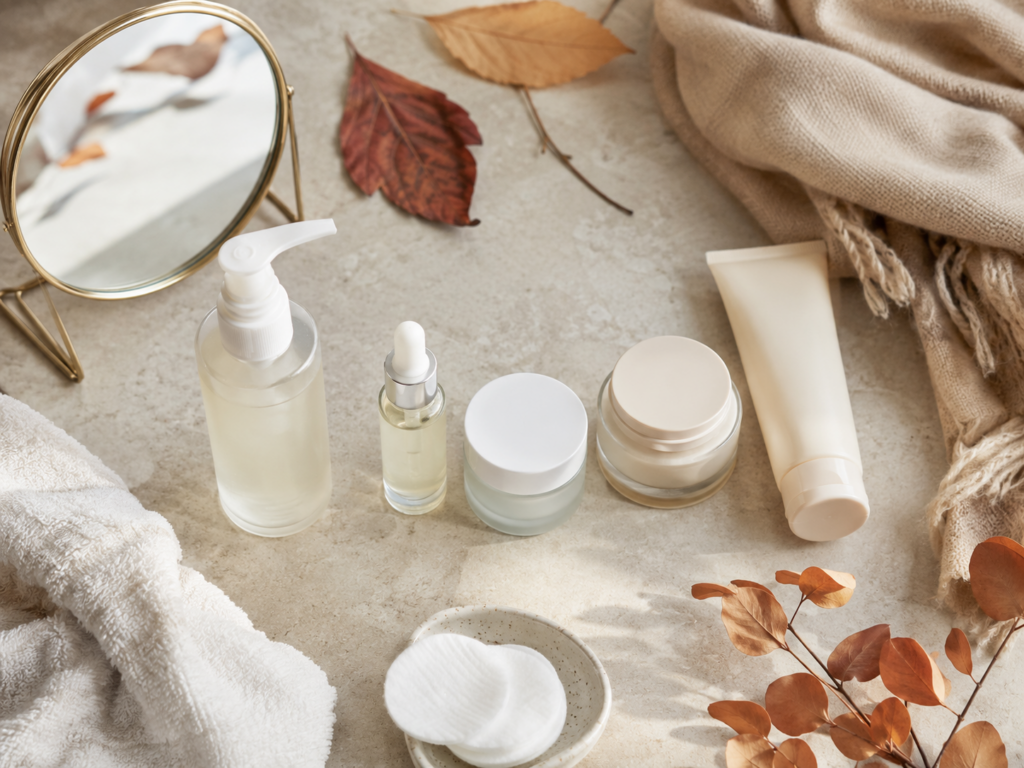

Fall has a funny way of exposing every weak spot in a skincare routine.
One week, your forehead is shiny by lunchtime. The next, your cheeks feel tight before you’ve even finished your morning coffee. Your nose still seems perfectly capable of producing enough oil for the entire face, yet the skin around your mouth has suddenly decided to flake.
Welcome to fall skincare for combination skin.
Combination skin already asks you to balance two very different needs. Then autumn arrives with cooler air, lower humidity in many climates, windy mornings, warmer indoor heating, longer showers, and perhaps a little too much enthusiasm for pumpkin-spice everything.
Your skin notices the change.
The good news? You probably don’t need a completely new skincare routine.
You need a smarter adjustment.
The American Academy of Dermatology notes that skincare may need to change with the seasons and that colder, drier conditions can make it harder for skin to hold onto moisture. Dermatologists also caution that you don’t necessarily need to replace every product when temperatures drop.
For combination skin, that advice is especially useful.
Instead of treating your whole face as oily or your whole face as dry, start paying attention to what each area is actually asking for.
Sounds simple. In practice? It can make a huge difference.
First, What Does Combination Skin Actually Look Like?
Combination skin generally means some areas of your face produce more oil while others feel normal or dry.
The classic pattern is an oily T-zone, your forehead, nose, and chin, with drier cheeks or skin around the eyes.
But skin doesn’t always follow the textbook.
Cleveland Clinic notes that combination skin can vary from person to person. Some people may even experience a drier T-zone with oilier cheeks. That’s why copying someone else’s “perfect combination skin routine” doesn’t always work.
Your skin may show signs such as:
- Shine across the forehead or nose a few hours after cleansing
- Visible or congested pores around the nose
- Blackheads on the chin or nose
- Occasional acne in oilier areas
- Tightness across the cheeks
- Dry patches around the mouth
- Makeup separating on oily areas but clinging to dry ones
- Skin that feels greasy and dehydrated at the same time
That last one is surprisingly common.
And it brings us to something important.
Your Skin Can Be Oily and Dehydrated at the Same Time
Oil and water aren’t the same thing.
Sebum is oil produced by your sebaceous glands. Hydration refers largely to the water content within the upper layers of your skin.
So yes, your forehead can look shiny while your skin still feels tight.
This is where people with combination skin sometimes get caught in a frustrating loop.
Your nose looks greasy, so you wash more aggressively.
Then your cheeks become dry.
You add stronger exfoliating acids because the texture looks rough.
Now your skin stings.
Then you apply a thick cream everywhere.
Suddenly your forehead feels coated, and you notice three new bumps.
The routine becomes a skincare tug-of-war.
Here’s the thing: fall isn’t necessarily the time to fight your oil harder. Often, it’s the time to become more careful about protecting moisture while continuing to manage congestion.
The skin barrier, the outer protective layer of the skin, helps limit water loss and shields the body from irritants. When that barrier becomes disrupted, water loss and sensitivity can increase.
That doesn’t mean every dry patch equals a “damaged barrier.” Social media has stretched that term pretty far.
Still, repeated over-cleansing, aggressive exfoliation, irritating products, and dry weather can absolutely leave skin feeling rough, tight, or uncomfortable.
And fall may make those habits harder for your skin to tolerate.
Think of Combination Skin as Two Faces Sharing One Address
This may be the most useful fall skincare rule you’ll learn:
You don’t have to apply every product evenly across your entire face.
The American Academy of Dermatology has even described combination skin care as treating the face almost like “two faces.” Some people may need moisturiser mainly on their dry areas rather than across an already-oily centre of the face.
That’s wonderfully freeing.
Your nose doesn’t need to receive a thick layer of cream simply because your cheeks are thirsty.
Likewise, your dry jawline doesn’t need salicylic acid every night simply because your nose has blackheads.
Think zone by zone.
Your T-zone may benefit from lighter hydration and targeted pore care.
Your cheeks may need a little more cushioning.
Your eye area may need something gentler still.
Once you stop forcing the same treatment onto every square inch of your face, combination skin becomes much easier to understand.
The Fall Morning Routine: Keep It Calm and Light
Mornings don’t need twelve steps.
Especially if you’re packing lunches, answering emails, searching for a missing shoe, preparing for class, commuting to work, or doing all of the above before 8 a.m.
A fall morning routine for combination skin should do three things:
refresh, moisturise, protect.
That’s enough.
Step 1: Cleanse Gently, or Don’t
If you wake up noticeably oily, use a gentle facial cleanser.
Look for something that leaves your skin feeling clean but comfortable rather than squeaky.
That squeaky feeling isn’t a trophy.
If your skin feels stretched five minutes after cleansing, your cleanser may be too harsh for your current needs.
People who wake up relatively dry may find that rinsing with lukewarm water is enough some mornings, especially if they cleansed thoroughly the night before.
The goal isn’t to remove every trace of natural oil.
You need some of it.
Harsh soaps and prolonged hot water can worsen dryness by stripping oils from the skin, according to the AAD.
And yes, that steaming-hot shower feels lovely when mornings get chilly.
Your cheeks may disagree.
Step 2: Add Hydration Without Creating a Sticky Layer Cake
A hydrating serum or essence is optional, not mandatory.
If you enjoy one, ingredients such as glycerin or hyaluronic acid can fit nicely into a combination skin routine. The AAD includes both among ingredients commonly found in moisturisers designed to support dry skin.
Apply hydrating products to slightly damp skin when the product instructions allow.
And resist the temptation to stack three hydrating toners, two essences, a serum, an ampoule, and something TikTok convinced you was essential at 1 a.m.
More hydration layers don’t automatically mean more hydrated skin.
A good routine doesn’t have to look impressive lined up beside your bathroom sink.
It has to work.
Step 3: Use Moisturiser Strategically
Fall is often when combination skin starts asking for a little more moisturiser.
But don’t automatically jump from a lightweight summer gel to the thickest cream you can find.
Instead, consider texture.
Gels tend to feel lighter. Lotions sit somewhere in the middle. Creams contain more oil and usually provide more cushioning for dry skin.
For combination skin, you might use:
A lightweight lotion or gel-cream across most of the face, then add a small amount of richer cream to the cheeks.
Or:
A richer moisturiser only on dry areas, while keeping the T-zone lighter.
This is one of those rare skincare situations where being inconsistent is actually quite sensible.
Your face isn’t uniform.
Your moisturiser doesn’t have to be either.
Step 4: Sunscreen Is Still a Fall Product
There seems to be an unofficial skincare ritual every September where people pack away sunscreen beside the sandals.
Please don’t.
Cool weather doesn’t switch off ultraviolet radiation.
The AAD recommends broad-spectrum, water-resistant sunscreen with SPF 30 or higher as part of daily sun protection, including during colder weather.
For combination skin, sunscreen texture matters.
A very heavy formula can feel uncomfortable on an oily forehead, while an extremely matte formula may exaggerate flaky cheeks.
Look for a sunscreen that dries down comfortably without making the dry areas feel like paper.
And remember: the sunscreen you’ll actually apply consistently beats the theoretically perfect one gathering dust in a drawer.
Then Night Comes, and Your Skin Needs a Little More Help
Night routines can handle more treatment because you aren’t immediately layering makeup or sunscreen over everything.
Still, fall is not the season to turn your bathroom into a chemistry lab.
Step 1: Remove Makeup and Sunscreen Properly
If you’ve worn makeup, water-resistant sunscreen, or heavier products during the day, cleanse them off thoroughly.
Some people like using an oil cleanser or cleansing balm followed by a gentle water-based cleanser.
Others do perfectly well with one effective cleanser.
Double cleansing is a method, not a moral obligation.
If double cleansing leaves your cheeks tight and irritated, simplify it.
Your skin doesn’t care how aesthetically pleasing your routine looks on camera.
Step 2: Decide Whether Tonight Is a Treatment Night
This is where combination skin usually benefits from restraint.
You may use salicylic acid, retinol, adapalene, azelaic acid, or another treatment depending on your concerns.
But you don’t need everything every night.
Let’s break it down.
Salicylic Acid: Great for the T-Zone, Not Necessarily the Whole Face
If blackheads, clogged pores, or oiliness are your main concerns, salicylic acid may be useful.
The AAD notes that salicylic acid helps unclog pores and can be especially useful for whiteheads and blackheads.
For combination skin, consider treating the areas that need it.
That may mean your nose, forehead, and chin rather than sweeping the product across dry cheeks out of habit.
If your skin becomes dry or irritated, reduce frequency or switch between your active cleanser and a gentler one. The AAD specifically suggests alternating with a mild cleanser if salicylic acid causes dryness or irritation.
Fall may also be the time to reduce how often you exfoliate if your skin suddenly feels more sensitive.
Don’t cling to a summer schedule because “I always exfoliate Tuesday and Friday.”
Your skin doesn’t own a calendar.
Exfoliation: Flakes Aren’t an Invitation to Scrub Harder
Dry flakes can make you want to exfoliate immediately.
It feels logical.
Remove flakes = smooth skin.
Except sometimes exfoliating already-dry skin makes the problem worse.
The AAD warns that exfoliation isn’t right for everyone and that improper exfoliation can contribute to irritation, redness, and breakouts. It also notes that exfoliating while using products such as retinol or benzoyl peroxide may worsen dryness.
So if your cheeks suddenly look flaky in October, try moisture first.
Give your skin a few days.
See what happens.
You might discover you didn’t need another peel. You needed less stripping.
What About Retinol in Fall?
Retinoids can be useful for acne, uneven tone, texture, and signs of skin ageing.
But they’re also famous for testing the patience of dry skin.
If you’ve already been using a retinoid comfortably, fall doesn’t mean you must stop.
You might, however, need to adjust your routine if dryness appears.
Dermatologists may recommend using retinoids less often or pairing them with moisturiser when irritation becomes an issue.
Try not to introduce a stronger retinol, a new exfoliating toner, and a new acne treatment during the same week.
When irritation appears, you’ll have no idea which product started the rebellion.
And if you have deeper skin tones, irritation deserves particular attention. The AAD notes that retinoid-related irritation can contribute to post-inflammatory hyperpigmentation in darker skin. Starting slowly and using moisturiser can help reduce irritation.
One more important note: retinoids shouldn’t be used during pregnancy. If you’re pregnant or planning pregnancy, talk with your healthcare professional about pregnancy-compatible alternatives.
Step 3: Finish With Moisture
Nighttime is when you can usually get away with something slightly richer.
Look for moisturisers containing ingredients such as:
- Ceramides
- Glycerin
- Hyaluronic acid
- Dimethicone
- Squalane
- Niacinamide or nicotinamide
Ceramides are part of the lipid structure associated with the skin’s protective barrier, while nicotinamide has evidence supporting barrier function and reduced water loss.
Again, combination skin doesn’t require identical application.
Maybe your forehead gets one thin layer.
Your cheeks get two.
That is completely fine.
A Simple Fall Routine Might Look Like This
Morning: gentle cleanse or rinse → hydrating serum if needed → lightweight moisturiser, with extra cream on dry areas → broad-spectrum SPF 30+
Evening: remove makeup and sunscreen → gentle cleanse → treatment on selected nights or selected zones → moisturiser
That’s the foundation.
Everything else is extra.
A face mist? Fine.
Milky toner? Lovely if your skin enjoys it.
Eye cream? Use one if you want one.
Facial oil? Maybe on dry areas.
But none of those products can compensate for aggressive cleansing, constant exfoliation, and forgotten sunscreen.
Sometimes skincare gets marketed like a 14-person project meeting when the job could have been handled by four people.
Same idea.
The Ingredients Combination Skin Often Appreciates in Fall
Shopping for skincare becomes easier when you stop chasing product names and start reading the ingredient list.
Glycerin
Glycerin is a humectant that helps attract water.
It’s hardly glamorous. It doesn’t get dramatic launch campaigns every month.
Yet it remains one of the dependable hydration ingredients you’ll find in cleansers, serums, and moisturisers.
That’s skincare for you. Sometimes the quiet employee is carrying the whole department.
Hyaluronic Acid
Hyaluronic acid can support hydration and works well in many lightweight formulas.
If you already use it without irritation, there’s little reason to abandon it when fall begins.
Just remember that a hydrating serum isn’t always a substitute for moisturiser. A moisturiser can also help reduce water loss.
Ceramides
If your cheeks are feeling rough, tight, or more sensitive than usual, ceramide-containing moisturisers may be worth considering.
Ceramides are naturally connected to the skin’s barrier structure, and dermatologist resources commonly mention them in barrier-supportive skincare.
Niacinamide
Niacinamide has become one of skincare’s favourite multitaskers, and combination skin is a logical audience for it.
It can fit into routines focused on hydration, barrier support, uneven tone, and oil-related concerns.
But stronger isn’t always better.
If a high-strength serum makes your face flush, itch, or sting, don’t assume you’re “purging.”
Your skin may simply dislike the formula.
Salicylic Acid
Think pores and congestion.
Use it thoughtfully, especially around the T-zone.
More isn’t automatically more effective.
Azelaic Acid
Azelaic acid can be useful for some people dealing with acne and the dark marks that remain after blemishes. The AAD includes it among ingredients used for adult acne and post-acne discolouration.
It can still irritate some skin, so introduce it gradually rather than treating it like bottled water.
The Fall Skincare Mistakes Combination Skin Really Doesn’t Need
Fall skincare marketing can make you feel as though September 1 requires a complete bathroom renovation.
It doesn’t.
A few mistakes cause far more trouble than not owning the newest seasonal serum.
Mistake 1: Switching to a Heavy Cream Everywhere
Rich creams can feel gorgeous when temperatures drop.
Your dry cheeks may love them.
Your congestion-prone nose may not.
Apply richer products where they’re useful rather than coating every area equally.
Mistake 2: Washing More Because You’re Still Oily
Oil isn’t dirt.
And producing oil doesn’t mean your skin can tolerate endless cleansing.
In fact, acne treatments themselves often cause dryness and irritation, which is one reason dermatologists may recommend moisturiser even for acne-prone skin.
Clean skin should feel comfortable.
Not stripped.
Mistake 3: Treating Every Flake With Acid
Sometimes flaky skin needs exfoliation.
Sometimes it needs moisture.
Those are very different solutions.
If your skin is burning, stinging, unusually red, or suddenly reacting to products that never bothered you before, adding another acid isn’t the obvious next move.
Mistake 4: Taking Very Hot Showers
Cold morning.
Warm bathroom.
Steaming shower.
Understandable.
But long, hot showers can worsen dryness. The AAD recommends shorter showers or baths with warm rather than hot water when dryness is an issue.
Your face doesn’t need to be steamed like a dumpling every morning.
Mistake 5: Changing Five Products at Once
This is the classic seasonal reset mistake.
New cleanser.
New toner.
New moisturiser.
New retinol.
New sunscreen.
Three days later, your chin is covered in bumps,s and you’re staring at the shelf like a detective at a crime scene.
Change one major variable at a time whenever possible.
The AAD recommends testing new skincare products before adding them fully to a routine, particularly if you’re prone to reactions.
Boring?
A little.
Useful?
Very.
Mistake 6: Skipping Moisturiser Because You Have Acne
Breakouts and dehydration aren’t mutually exclusive.
Treatments such as salicylic acid, benzoyl peroxide, adapalene, and prescription retinoids may all cause dryness. Moisturiser can help skin tolerate acne treatment.
Choose non-comedogenic formulas if you’re prone to clogged pores.
Then adjust the amount by zone.
Mistake 7: Forgetting Sunscreen After Summer
The beach bag may be gone.
UV exposure isn’t.
Keep the sunscreen.
What If Your Combination Skin Is Also Sensitive?
Then simplicity becomes even more important.
Use a mild cleanser.
Keep fragrance to a minimum if fragrance tends to bother you.
Reduce irritating actives when your skin starts feeling raw.
Choose moisturiser based on comfort rather than marketing language.
And introduce new products slowly.
“Natural” doesn’t automatically mean gentle either. Botanical extracts and essential oils can still cause irritation or allergic reactions in some people. The AAD specifically warns that natural branding doesn’t guarantee a product will be hypoallergenic.
Your skin doesn’t read labels.
It responds to chemistry.
What If Your Combination Skin Is Acne-Prone?
Keep your pore-clearing products, but resist the urge to dry the acne into submission.
That strategy often creates a miserable combination of pimples, flakes, concealer clinging to dry patches, and a forehead that somehow still becomes shiny by noon.
Target acne.
Protect the rest of the face.
Use non-comedogenic moisturiser where needed.
If acne is persistent, painful, cystic, leaving scars, or causing dark marks that keep accumulating, professional treatment may save you months of trial and error.
And What If You’re a Very Busy Human?
This deserves its own section because skincare advice sometimes assumes everyone spends forty peaceful minutes each evening standing beside an immaculate marble sink.
Meanwhile, real life is happening.
You’re exhausted.
There’s coursework to finish.
Your inbox has multiplied.
A toddler suddenly needs water despite refusing water for the previous six hours.
You don’t need an elaborate routine to care for combination skin.
On chaotic mornings:
moisturiser + sunscreen.
On exhausted nights:
cleanse + moisturise.
That’s your minimum.
Treatments can wait until tomorrow.
Consistency with a simple routine usually serves your skin better than alternating between a ten-step masterpiece and falling asleep in makeup because the masterpiece felt impossible.
Try the “Fall Skin Check” Once a Week
Rather than changing your routine according to a rigid seasonal calendar, look at your actual skin.
Once a week, ask:
Is my forehead oilier than usual?
Are my cheeks tighter?
Is my moisturiser disappearing instantly?
Does sunscreen suddenly pill over dry areas?
Are products stinging?
Am I getting more blackheads?
Did I increase retinol recently?
Have I started using indoor heating more often?
Did the weather suddenly become colder or drier?
This tiny check-in can prevent weeks of unnecessary product swapping.
Your fall skincare routine isn’t fixed.
It should respond to what your face is doing.
Remember That “Fall” Doesn’t Feel the Same Everywhere
Here’s an important little tangent.
Beauty content often talks about fall as though everyone wakes up on September 22 surrounded by orange leaves, crisp air, wool sweaters, and dramatically falling humidity.
Real climates don’t work that neatly.
Some places stay warm and humid well into autumn.
Other regions become dry very quickly.
In tropical climates, seasonal changes may feel completely different from a Northeast American or European autumn.
Even your indoor environment matters.
Air conditioning, heating, long office hours, frequent travel, windy commutes, and hot showers can influence how your skin feels.
So don’t change your routine because Pinterest says it’s “cream season.”
Change it because your skin has changed.
That’s a much better reason.
How Do You Know Your Fall Routine Is Working?
Good skincare doesn’t always announce itself with instant glass-skin brilliance.
Often, improvement is quieter.
Your cheeks stop feeling tight after cleansing.
Your forehead still produces oil, but it isn’t unbearably greasy.
Makeup sits more evenly.
You notice fewer flakes around your mouth.
Products no longer sting.
Breakouts aren’t appearing every time you moisturise.
Your skin simply becomes less dramatic.
That’s success.
Combination skin probably won’t become perfectly uniform. Nor does it need to.
Sebum production varies across different areas of the face. Your goal isn’t to force every pore into identical behaviour.
You’re trying to keep the whole system comfortable, supported, and manageable.
When It’s More Than Seasonal Combination Skin
Sometimes what looks like stubborn combination skin isn’t just a skin type issue.
Persistent flaking around the nose or eyebrows, severe redness, burning, itching, painful acne, cracked skin, rashes, or ongoing irritation may point toward a condition that deserves professional evaluation.
Cleveland Clinic notes, for example, that seborrheic dermatitis can affect oily facial areas, including around the nose and eyebrows.
The AAD also recommends seeing a dermatologist when dryness becomes persistent, painful, cracked, bleeding, stinging, or doesn’t improve with routine care.
Don’t spend six months buying new moisturisers for something that may need actual treatment.
The Bigger Fall Skincare Lesson? Stop Fighting Your Face
Combination skin has a reputation for being difficult.
I don’t think difficult is quite the right word.
It’s responsive.
One area wants less oil.
Another wants more protection.
Summer humidity disappears, and your cheeks complain.
You turn up the heat and suddenly your mouth area flakes.
Your period arrives,s and your chin produces a breakout right when the rest of your face is dry.
Annoying? Absolutely.
But once you stop insisting that one product must solve every problem everywhere, combination skin becomes far less mysterious.
Keep cleansing gently.
Hydrate without drowning your T-zone.
Use richer moisturiser where dryness actually occurs.
Treat congestion where congestion actually occurs.
Ease up on exfoliation when your skin starts protesting.
And wear sunscreen even when the sky looks grey enough to cancel all your plans.
Fall skincare for combination skin doesn’t require a glamorous shelf reset.
It requires observation.
A little flexibility.
And perhaps the surprisingly radical idea that your forehead and your cheeks don’t have to follow the same skincare routine.
Sometimes that’s the whole trick.