

There’s a particular moment every fall when your skin seems to notice the season has changed before you do.
One week, your lightweight summer moisturiser feels perfectly fine. Then suddenly? Your cheeks feel tight after cleansing. Foundation starts catching around your nose. Your lips need balm every twenty minutes, and that expensive serum you loved all summer somehow doesn’t feel like enough anymore.
Welcome to the seasonal skincare shuffle.
For people with naturally dry skin, fall can be especially tricky. Cooler temperatures, wind, lower humidity, and indoor heating can all make it harder for skin to hold onto moisture. Dermatologists also point out that the products that worked beautifully during humid summer weather may not perform as well once humidity drops.
But here’s the good news: you don’t need a completely new skincare shelf.
A smart fall skincare routine for dry skin is less about adding ten new products and more about changing the texture, timing, and intensity of what you’re already using. For the broader seasonal framework, see the complete fall skincare routine.
Think less “total skincare makeover” and more “put a cardigan on your summer routine.”
Let’s build one that actually fits real life.
Why Does Dry Skin Get Worse in Fall?
First, a tiny bit of skin science, because understanding what’s happening makes the routine much easier to figure out.
Your skin has a protective outer layer called the skin barrier. Imagine it as a brick wall. Skin cells are the bricks, while lipids such as ceramides, cholesterol, and fatty acids help fill the spaces between them.
When that barrier is working well, it helps keep moisture in and irritants out.
When it isn’t?
Hello, tightness, rough patches, flaking, itching, sensitivity, and that strangely uncomfortable feeling where you want to apply moisturiser again even though you did it fifteen minutes ago.
Cooler seasons create a few challenges at once. Outdoor air can become colder and drier. Indoor heating may reduce humidity. Then we make matters worse by taking steaming showers because, well, they’re lovely when it’s cold.
Unfortunately, hot water can strip some of the oils that help protect the skin. Cleveland Clinic recommends shorter showers with lukewarm rather than very hot water for people dealing with seasonal dryness.
So if your August routine suddenly feels inadequate in October, it doesn’t necessarily mean your products “stopped working.”
The environment changed.
Your routine needs to catch up.
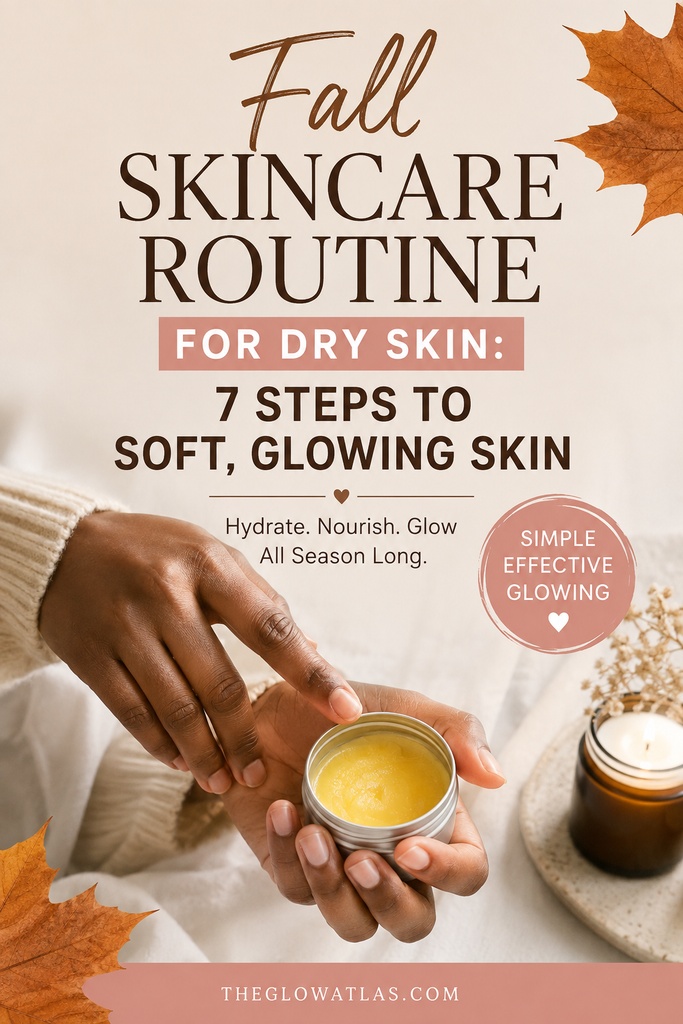
The Ideal Fall Skincare Routine for Dry Skin
Let’s keep this practical.
You don’t need twelve steps before your 8 a.m. meeting, lecture, school run, or commute. Most dry skin does better with a handful of thoughtfully chosen products used consistently.
A solid fall routine can be surprisingly simple:
- Gentle cleanser
- Hydrating serum or essence, if desired
- Richer moisturizer
- Broad-spectrum SPF 30+
- Gentle evening cleanse
- Treatment products used thoughtfully
- Barrier-supporting night cream
- Optional facial oil or occlusive for very dry areas
That’s it.
The magic isn’t in having more bottles. It’s in preventing unnecessary moisture loss while giving your skin enough hydration and emollience to stay comfortable.
Now let’s go step by step.
Step 1: Stop Cleansing Your Face Like It’s Still July
This is one of the easiest seasonal changes to make.
During hot summer months, sweat, sunscreen, excess oil, and humidity can make a foaming cleanser feel wonderful. You wash your face and get that squeaky-clean feeling.
Then autumn arrives.
Suddenly that same “fresh” feeling becomes tightness.
That’s your clue.
If your face feels stretched, squeaky, itchy, or uncomfortable immediately after cleansing, your cleanser may be too aggressive for your current skin needs.
Consider switching to a gentle cream, lotion, or hydrating cleanser.
Look for formulas containing ingredients such as:
Glycerin – a humectant that helps attract water.
Ceramides – lipids that support the skin barrier.
Hyaluronic acid – another humectant commonly used to support hydration.
Squalane – a lightweight emollient that can help soften dry skin.
Colloidal oatmeal – often used in products designed for dry or sensitive skin.
And don’t assume “natural” automatically means gentler. Botanical extracts and essential oils can still irritate sensitive or compromised skin. The American Academy of Dermatology specifically recommends paying attention to fragrance when choosing products for dry skin.
Your cleanser has one job: clean your face without making it angry.
It doesn’t need to leave your skin feeling polished enough to squeak.
Do You Even Need a Morning Cleanse?
Here’s where skincare gets refreshingly flexible.
Some people with very dry skin find that cleansing twice a day is unnecessary.
If you wake up without significant oil, sweat, or product residue, you might simply rinse your face with lukewarm water before moving into your morning routine.
Others prefer using a small amount of gentle cleanser.
Both approaches can work.
Pay attention to what your skin does afterwards. If skipping cleanser leaves your skin comfortable, great. If it leaves you feeling greasy or congested, use one.
Skincare should respond to your skin, not an arbitrary rule you saw in a 30-second video.
Step 2: Add Hydration While Your Skin Is Still Slightly Damp
This little habit can make your routine feel much more effective.
After cleansing, don’t necessarily wait until your face feels completely bone-dry before continuing.
Apply your hydrating products while your skin retains a little moisture.
This is especially useful when you’re using humectants.
Think:
- glycerin
- hyaluronic acid
- panthenol
- beta-glucan
- sodium PCA
- urea in appropriate concentrations
Humectants help attract and retain water, which is exactly what thirsty autumn skin is asking for.
A hydrating toner, essence, or serum can work here.
Do you absolutely need one?
No.
That’s worth repeating because skincare marketing loves turning optional steps into emotional emergencies.
You do not need a hydrating serum to have healthy skin.
If your cleanser, moisturiser, and sunscreen provide enough hydration, fantastic. Save your money.
But if your skin feels tight despite using a good moisturiser, adding a simple humectant-rich layer underneath it may help.
Step 3: Your Summer Moisturiser May Need a Promotion
Here’s where the biggest seasonal change usually happens.
That featherlight gel moisturiser that felt dreamy in July?
It might not be strong enough for October.
The American Academy of Dermatology notes that creams generally retain more moisture than lotions, while ointments provide even greater occlusion, an important distinction for people dealing with significant dryness.
So as autumn settles in, consider moving up the texture ladder:
Gel → lotion → cream → balm/ointment
You don’t automatically need to jump straight to petroleum jelly.
For many people, switching from a lightweight lotion to a medium or rich cream is enough.
Look for moisturisers containing a combination of humectants, emollients, and occlusives.
Let me explain those without turning this into chemistry class.
Humectants bring water into the picture
Examples include glycerin, hyaluronic acid, urea, and panthenol.
Emollients soften the skin
Think squalane, shea butter, fatty alcohols, and certain plant oils.
Occlusives reduce water loss
Petrolatum is the classic example. Dimethicone and various waxes can also provide occlusive effects.
The nicest fall moisturisers often combine these categories.
It’s a little like dressing for unpredictable October weather. A T-shirt alone isn’t enough, but neither do you necessarily need a ski coat. Layers work.
Ceramides Deserve Some Attention
If there’s one ingredient category dry skin tends to appreciate during cooler weather, it’s ceramides.
Ceramides are lipids naturally found in the skin barrier. Dermatologists frequently recommend looking for ceramide-containing moisturisers when dryness becomes an issue, and formulations combining ceramides with other barrier-supporting lipids are common in products designed for dry or eczema-prone skin.
You’ll find them in products across very different price ranges.
The label may list things such as:
Ceramide NP
Ceramide AP
Ceramide EOP
Don’t worry about memorising the alphabet soup.
A well-formulated moisturiser matters more than chasing the longest ceramide list.
Step 4: Yes, You Still Need Sunscreen in Fall
Cloudy morning?
Still sunscreen.
Cold outside?
Still sunscreen.
Wearing a chunky sweater and drinking something cinnamon-flavoured?
Yep. Still sunscreen.
UV exposure doesn’t disappear because summer ended.
The American Academy of Dermatology recommends broad-spectrum, water-resistant sunscreen with SPF 30 or higher as part of year-round sun protection.
For dry skin, fall is a good time to reconsider your sunscreen texture.
If your matte summer SPF suddenly makes your cheeks feel like paper, look for a more moisturising formula.
Creamier sunscreens can sit beautifully over a richer moisturiser, particularly when your skin starts becoming flaky.
You may also appreciate sunscreen formulas containing glycerin, hyaluronic acid, ceramides, or squalane.
One important point: moisturising sunscreen is still sunscreen.
Apply enough to achieve the labelled protection. Don’t treat SPF like a tiny dab of eye cream.
Your Simple Morning Fall Routine
For a busy morning, your entire routine might look like this:
1. Gentle cleanse or water rinse
Remove overnight residue without stripping your skin.
2. Hydrating serum
Optional, but useful if your skin feels dehydrated or tight.
3. Moisturiser
Choose a creamier texture than you used during summer if needed.
4. Broad-spectrum SPF 30+
Finish with sunscreen every morning.
Four steps.
No 5:30 a.m. alarm required.
If you’re racing between breakfast, emails, getting dressed, finding someone’s missing shoe, and remembering where you put your coffee, you can even simplify this further.
Cleanse. Moisturize. Sunscreen.
Done.
Consistency beats an elaborate routine you only have enough energy to follow twice a month.
Your Evening Fall Skincare Routine for Dry Skin
Nighttime is where you can give dry skin a little more support.
Your skin isn’t dealing with makeup, UV exposure, commuting, wind, or environmental grime while you’re asleep, so evening is a useful window for richer textures.
A practical night routine looks like this:
Step 1: Remove makeup and sunscreen.
Step 2: Cleanse gently.
Step 3: Apply your treatment or hydrating serum.
Step 4: Follow with moisturiser.
Step 5: Seal especially dry areas if necessary.
Let’s unpack the parts that tend to cause trouble.
Double Cleansing: Helpful, but Not Mandatory
If you wear makeup or water-resistant sunscreen, double cleansing can make sense.
Your first cleanser dissolves makeup, sunscreen, and oily residue. Your second cleanser removes what remains.
But dry skin doesn’t automatically require two cleansers every night.
If one gentle cleanser removes everything effectively, that’s fine.
The goal is clean skin.
Not exhausted skin.
If you’re double cleansing and your face feels uncomfortable afterwards, try using a gentler first cleanser, changing your second cleanser, or simply cleansing once when you don’t have much to remove.
Be Careful With Fall Exfoliation
This is where things get interesting.
Dry skin gets flaky.
Flaky skin makes you want to exfoliate.
Exfoliation temporarily removes flakes, so your face feels smoother.
Naturally, you think: Excellent. More exfoliation.
And that’s how the cycle begins.
Over-exfoliation can make an already compromised barrier feel even worse. The American Academy of Dermatology specifically cautions against aggressively exfoliating dry, peeling skin and recommends focusing on moisturization instead.
That doesn’t mean everyone with dry skin needs to abandon exfoliation forever.
It means less may be more during fall.
If you use AHAs, BHAs, exfoliating toners, scrubs, peel pads, or enzyme treatments, watch how your skin responds when the weather changes.
You may need to reduce frequency.
For example, something you comfortably used three evenings per week during summer may feel better once weekly in cooler weather.
If your skin burns when moisturiser touches it, that’s not the moment to reach for another acid.
Give your barrier some peace.
What About Retinol?
You don’t necessarily need to stop retinoids because autumn arrived.
But you may need to adjust how you use them.
Retinoids can cause dryness and irritation, particularly when you’re new to them or using stronger formulas. Combine that with cooler, drier weather and suddenly a routine that worked beautifully in August feels uncomfortable.
Consider reducing frequency temporarily if irritation develops.
You can also try the moisturiser sandwich method:
Moisturizer → retinoid → moisturizer
This can make retinoid nights more comfortable for some people.
And please don’t turn skincare into a competitive sport.
Using retinol seven nights a week isn’t automatically “better” than using it three nights a week. Your ideal frequency is the one your skin can tolerate consistently.
If you’re using prescription retinoids, follow your clinician’s instructions rather than changing treatment solely based on internet advice.
Step 5: Try an Occlusive on Extra-Dry Areas
This is where slugging enters the conversation.
Despite the slightly unfortunate name, slugging simply means applying an occlusive layer—often petrolatum—over skincare to reduce moisture loss.
You don’t necessarily need to coat your entire face.
For dry skin in fall, targeted slugging can be surprisingly practical.
Apply a small amount to places that get particularly dry:
- around the nostrils
- lips
- corners of the mouth
- dry cheek patches
- under-eye area, if tolerated
Petroleum jelly can be particularly useful for very dry areas, and dermatologists commonly recommend ointment-type products for severe dryness because they reduce water loss effectively.
One caution: don’t casually seal strong irritating actives beneath an occlusive layer. Occlusion can change how some products behave against the skin and may worsen irritation.
Keep slugging nights simple.
Hydration. Moisturizer. Occlusive.
Your skin doesn’t need fireworks every evening.
The Fall Ingredients Dry Skin Usually Loves
Walk into the skincare aisle, and every bottle promises hydration.
So what should you actually look for?
Ceramides
Great for supporting the skin barrier and commonly included in richer moisturisers.
Glycerin
Old-school, inexpensive, effective.
Glycerin is one of those ingredients that doesn’t get enough glamour because it has been around forever. Your skin doesn’t care about glamour.
Hyaluronic Acid
A useful humectant that helps support hydration.
Just remember: hyaluronic acid isn’t a complete moisturiser by itself. Layer it underneath a cream that helps retain moisture.
Squalane
A lightweight emollient that can help soften dry skin without necessarily feeling extremely greasy.
Panthenol
Also known as provitamin B5, it appears frequently in soothing and moisturising formulas.
Colloidal Oatmeal
Often found in formulas created for dry, irritated, or eczema-prone skin.
Petrolatum
Not glamorous.
Not trendy.
Very useful.
Petrolatum creates an occlusive layer that helps reduce moisture loss and can be especially helpful for cracked lips and stubborn dry patches.
Sometimes the skincare product sitting quietly on the bottom shelf is doing more work than the bottle with the futuristic packaging.
What Should You Use Less of During Fall?
Dry skin isn’t necessarily sensitive skin, but dryness can make skin more reactive.
This means autumn isn’t always the ideal time to throw every active ingredient you own onto your face.
Watch your use of:
Strong exfoliating acids
Physical scrubs
High-strength retinoids
Harsh foaming cleansers
Alcohol-heavy formulas
Fragranced skincare if you’re sensitive
You don’t necessarily need to eliminate all of these.
Just pay attention.
If your skin suddenly becomes tight, flaky, red, itchy, or stingy, simplify your routine before buying six products designed to “repair” the damage caused by the other six.
Sometimes skincare needs subtraction.
The Shower Habit That’s Quietly Drying Out Your Skin
We need to talk about hot showers.
I know.
They’re one of life’s small pleasures when the air turns cold.
But if your face and body become dramatically drier every autumn, your shower temperature deserves investigation.
Dermatologists recommend using warm or lukewarm rather than hot water and keeping showers relatively short because prolonged hot water exposure can strip protective oils from the skin.
Afterwards, gently pat, not aggressively rub, your skin with a towel.
Then moisturise while your skin is still slightly damp.
This timing matters. Moisturisers help trap existing water in the skin, which is why dermatologists frequently recommend applying them shortly after bathing.
And don’t forget your body.
Your face isn’t the only thing wearing skin.
Build a Fall Body-Care Routine Too
Dry elbows, flaky shins, itchy arms- autumn body dryness can sneak up quickly.
Keep a fragrance-free body cream somewhere you’ll actually use it.
Not tucked behind seventeen products in a cabinet.
Put it next to your towel, beside your bed, or wherever you normally get dressed.
Apply it after showering while your skin remains slightly damp.
For particularly dry spots such as heels, elbows, knees, or hands, a thicker balm or ointment can help.
And hand cream?
Keep one everywhere.
Desk.
Handbag.
Bathroom.
Bedside table.
Constant handwashing can strip moisture, so reapplying moisturiser after washing can make a noticeable difference. The AAD recommends moisturising whenever skin feels dry and after handwashing.
Don’t Forget Your Lips
Lip balm season has officially entered the building.
Lips have a delicate barrier and can become dry quickly when temperatures and humidity fall.
Use a simple, non-irritating balm or petroleum jelly throughout the day.
If your lips are already cracked, temporarily avoid products that sting or tingle.
That minty cooling sensation might feel satisfying, but irritated lips don’t need entertainment.
They need protection.
Apply a generous layer before bed.
You’ll probably notice the difference in the morning.
A Humidifier Might Be Your Most Underrated “Skincare Product”
Here’s a slight detour that matters.
Sometimes your skincare products aren’t the whole problem.
Your bedroom may be.
Indoor heating can reduce humidity, which means you’re spending hours every night in dry air while wondering why your moisturiser isn’t performing miracles.
A humidifier can help add moisture back into indoor air. Dermatologists from both the AAD and Cleveland Clinic recommend humidifiers as one strategy for managing seasonal dry skin.
Run one in the room where you spend the most time, especially your bedroom.
Just remember to clean it according to the manufacturer’s instructions.
A dirty humidifier isn’t a skincare hack anyone needs.
A Minimal Fall Routine for Extremely Busy Days
Some mornings are beautifully organised.
Others begin with a missed alarm, three notifications, cold coffee, and someone asking you where something is while it’s literally in their hand.
For those days:
Morning
Gentle cleanse → moisturizer → SPF
Night
Cleanse → moisturizer
That’s a legitimate skincare routine.
Seriously.
You don’t lose skincare points for skipping essence.
A consistent two- or three-step routine is far more useful than an elaborate nine-step routine you resent doing.
A More Complete Fall Routine When Your Skin Needs Extra Support
If you enjoy skincare or your dryness needs additional support, try:
Morning
Gentle cleanser
Hydrating toner or essence
Hydrating serum
Barrier-supporting moisturiser
Broad-spectrum SPF 30+
Evening
Makeup/SPF remover if needed
Gentle cleanser
Hydrating serum
Treatment product on appropriate nights
Rich moisturizer
Occlusive on stubborn dry patches
Notice something?
There’s no mandatory exfoliating toner, facial mist, eye serum, oil, sleeping mask, essence, ampoule and overnight peel.
You can use those products if you enjoy them.
They’re extras, not admission tickets to healthy skin.
Common Fall Skincare Mistakes That Make Dryness Worse
Sometimes what you stop doing matters as much as what you add.
Mistake 1: Waiting Until Your Skin Is Already Flaking
Start adjusting your routine when temperatures and humidity begin dropping.
You don’t have to wait until your cheeks resemble pastry.
Mistake 2: Keeping Your Summer Moisturiser Out of Loyalty
Your moisturiser won’t be offended.
Switch to something richer.
Mistake 3: Exfoliating Every Flake Away
Flaking can indicate that your barrier needs support, not necessarily another peel.
Mistake 4: Taking Very Hot Showers
Comforting? Yes.
Ideal for dry skin? Not particularly.
Mistake 5: Skipping Sunscreen
Autumn isn’t an SPF vacation.
Mistake 6: Introducing Too Many New Products at Once
This is especially tempting during seasonal sales.
You buy the cleanser. And the serum. And the moisturiser. And the exfoliant. And that cute little overnight mask.
Then your skin becomes irritated, and you have absolutely no idea which product did it.
Introduce new products gradually.
Future you will appreciate the detective work you avoided.
What If Your Dry Skin Is Also Acne-Prone?
This combination confuses a lot of people.
Your skin can absolutely be dry and acne-prone.
You don’t need to choose between treating breakouts and having a functioning moisture barrier.
Look for moisturisers labelled non-comedogenic if clogged pores are a concern. Choose comfortable cream textures rather than assuming every dry-skin product needs to feel like butter.
You may also need to rethink your acne treatment frequency during colder months.
Benzoyl peroxide, salicylic acid, and retinoids can all contribute to dryness.
That doesn’t mean they’re bad.
It means dose and frequency matter.
For example, you might use your acne treatment on certain evenings while dedicating the other nights to hydration and barrier support.
Your routine doesn’t have to do everything every night.
And What If You Have Sensitive, Dry Skin?
Go simpler.
Seriously.
Sensitive dry skin generally doesn’t need an experimental laboratory sitting on the bathroom counter.
Focus first on:
A gentle fragrance-free cleanser.
A simple moisturiser.
Sunscreen.
Then introduce other products one at a time.
Fragrance-free options can be particularly useful when skin is reactive; both the AAD and Cleveland Clinic advise people with dry or easily irritated skin to pay attention to fragrance in skincare.
Patch testing new products is also sensible if your skin reacts easily.
Boring skincare sometimes produces remarkably un-boring results.
How Long Does It Take to Adjust Your Skin for Fall?
There’s no universal timeline.
If you’re simply experiencing mild seasonal dehydration, changing your cleanser and moisturiser may improve comfort relatively quickly.
A compromised barrier can take longer.
The key is watching symptoms rather than expecting your skin to obey a calendar.
Ask yourself:
Does my skin feel comfortable after cleansing?
Does my moisturiser last through the day?
Has the flaking decreased?
Does sunscreen apply smoothly?
Does my face sting when I apply basic products?
Those questions tell you more than whether you’ve followed your new routine for exactly seven days.
When Dry Skin Isn’t Just “Fall Skin”
Seasonal dryness is common.
But persistent or severe symptoms deserve attention.
If your skin becomes intensely itchy, red, painful, cracked, bleeding, or develops a persistent rash, don’t keep throwing cosmetic products at it.
Excessive dryness can sometimes be associated with conditions such as eczema, psoriasis, or other dermatologic issues. The AAD recommends seeing a dermatologist when dryness becomes severe, painful, cracked, bleeding, or persistently irritating.
Likewise, if every moisturizer suddenly burns your face, your skin may need more than another trending barrier serum.
Get professional guidance.
Your Fall Skincare Shopping Checklist
Before buying anything new, check what you already own.
Then, if gaps remain, prioritise:
A gentle cleanser
Preferably creamy or hydrating rather than aggressively foaming.
A richer moisturiser
Look for ingredients such as glycerin, ceramides, fatty acids, squalane, or hyaluronic acid.
Broad-spectrum SPF 30+
Choose a comfortable moisturising formula you’ll actually wear.
Lip balm or petroleum jelly
Tiny product. Huge autumn value.
Optional hydrating serum
Useful if moisturiser alone isn’t enough.
Optional occlusive
For particularly dry or flaky areas.
Notice what’s missing?
A giant seasonal haul.
You probably don’t need one.
The Bigger Fall Skincare Lesson: Protect Before You Correct
Summer skincare often feels focused on control.
Control sweat. Control shine. Control breakouts. Control sun exposure.
Fall asks for something slightly different.
Protection.
Your skin is dealing with environmental change, and the smartest response isn’t necessarily another powerful active. Sometimes it’s a gentler cleanser. A thicker cream. A shorter shower. A humidifier humming quietly beside your bed.
Simple things.
Not exciting enough for a dramatic skincare video, perhaps, but surprisingly effective.
And that’s the mildly contradictory truth about fall skincare: you may need richer products while doing less to your skin.
More moisture.
Less stripping.
More consistency.
Less experimentation.
Final Thoughts: Your Fall Routine Doesn’t Need to Be Complicated
The best fall skincare routine for dry skin isn’t necessarily the routine with the most steps.
It’s the one that keeps your skin comfortable.
As humidity falls and temperatures cool, start paying attention to small signals—tight cheeks after cleansing, flaky makeup, rough texture, persistent lip dryness. Those are often your skin’s way of asking for a little more support.
Switch your harsh cleanser for something gentler.
Bring out the richer moisturizer.
Ease up on aggressive exfoliation.
Apply moisturizer while your skin is still slightly damp.
Keep using sunscreen.
And perhaps turn the shower temperature down a notch. Yes, even when it’s freezing outside. Sorry.
Most importantly, don’t feel pressured to rebuild your entire skincare routine every September.
Skin likes consistency.
Give it hydration, lipids, protection, and a little patience, and you’ll be far better prepared for the cooler months ahead.
Because the goal isn’t perfect skin.
It’s skin that feels comfortable enough that you don’t spend your entire afternoon thinking about it.

Pingback: Fall Skincare Routine for Dry Weather: Simple Steps