
You can buy the gentle cleanser. You can layer the moisturiser, protect your hair at night, use heat sparingly, and finally remember your sunscreen before leaving the house.
But there’s another part of the skin-and-hair conversation that happens far away from the bathroom mirror: what you eat.
Nutrition isn’t a magic beauty treatment, and eating a bowl of berries tonight won’t give you glowing skin by tomorrow morning. Hair won’t suddenly grow three inches because you added an avocado to lunch either.
Still, your skin and hair are living tissues. They depend on protein, fats, vitamins, minerals, energy, and other nutrients to build cells, maintain protective structures, respond to damage, and keep normal biological processes moving.
That makes nutrition less like a miracle serum and more like the supply department behind the scenes. When supplies are steady, the system has what it needs. When important nutrients are repeatedly missing, problems may start appearing.
And sometimes, your hair and skin notice before you do.
Research continues to explore the relationship between food and dermatological health. Current evidence supports the importance of a varied, balanced diet containing adequate protein, vitamins, minerals, healthy fats, and plant compounds rather than relying on one supposed “beauty food.”
So, what should actually be on your plate?
First, Your Skin and Hair Need Enough Food, Period
This point sounds almost too obvious.
It isn’t.
Many conversations about beauty nutrition jump immediately to vitamin C, collagen powders, biotin gummies, salmon, berries, or green smoothies while skipping something more basic: your body needs enough energy and nutrients overall.
When you consistently eat too little, your body has to prioritise.
Your heart matters more than your hair.
Your lungs matter more than glowing skin.
Keeping essential organs working takes priority over maintaining maximum hair growth. That is one reason severe calorie restriction, crash dieting, or significant nutritional deficiencies can sometimes contribute to hair shedding.
The American Academy of Dermatology specifically notes that eating too few calories or getting insufficient protein and certain nutrients can contribute to hair loss.
That’s worth remembering during every new diet trend.
If a plan asks you to survive on juices, eliminate several major food groups for no medical reason, or treat hunger like a character flaw, your hair probably isn’t cheering from the sidelines.
Healthy skin and hair generally do better with consistency than chaos.
Protein Is Basically Construction Material
Hair is largely made from a protein called keratin.
Skin also contains major structural proteins, including collagen and elastin.
So yes, protein matters.
Your body breaks dietary protein into amino acids. Those amino acids then become available for countless jobs throughout the body, including building and repairing tissues.
You don’t necessarily need gigantic portions of meat or a protein shake glued to your hand all day. But repeatedly eating meals that contain almost no meaningful protein can make meeting your overall needs harder.
Think about breakfast.
Toast and coffee might get you through the door.
Toast, eggs, fruit, and coffee give the meal a little more staying power.
Lunch could include chicken, fish, beef, beans, peas, lentils, tofu, yoghurt, eggs, or another protein-rich food. Dinner can follow the same idea.
Even inexpensive staples count.
Beans and lentils aren’t glamorous Instagram “beauty foods,” but nutritionally they can do serious work.
Eggs are useful too. So are sardines, yoghurt, groundnuts or peanuts, soy foods, milk, and other accessible sources depending on what you eat and what is affordable where you live.
There’s no need to make every meal look like a wellness retreat.
Build something you’ll actually eat.
Vitamin C Does More Than Make Orange Juice Sound Healthy
Vitamin C deserves some of its good reputation.
Your body needs it for collagen synthesis, and collagen is an important part of connective tissue. Vitamin C also acts as an antioxidant and can improve the absorption of non-heme iron, the form of iron found in plant foods.
That gives vitamin C a rather nice résumé.
Fortunately, getting it from food isn’t difficult for most people who eat fruit and vegetables regularly.
Citrus fruits are the obvious example, but they aren’t the only one. Bell peppers, tomatoes, broccoli, strawberries, guava, kiwi, papaya, and several other fruits and vegetables can contribute vitamin C.
And here’s a useful nutrition pairing: eat a vitamin-C-rich food alongside plant sources of iron.
Beans with tomatoes.
Lentils with peppers.
Leafy greens followed by fruit.
It doesn’t need to become a chemistry experiment at lunch. You’re simply giving your body a better chance to absorb the iron available in the meal. NIH guidance confirms that vitamin C enhances the absorption of non-heme iron.
Simple habit. Useful payoff.
Iron Deserves More Attention Than Another Fancy Hair Gummy
If you menstruate, iron is one nutrient worth knowing about.
Adult women between 19 and 50 have higher recommended iron intakes than adult men because of menstrual blood loss, and iron needs increase further during pregnancy.
Iron plays a much bigger role in the body than hair, of course. It is essential for haemoglobin and oxygen transport.
But low iron status can also matter when someone is experiencing hair shedding.
The American Academy of Dermatology includes inadequate iron among nutritional factors that may contribute to noticeable hair loss, and a 2025 systematic review examining diet and hair health also found important associations involving iron status.
Food sources include meat, poultry, seafood, beans, lentils, peas, fortified cereals, nuts, and some leafy vegetables.
Animal foods contain heme iron, which the body generally absorbs more efficiently. Plant foods contain non-heme iron, and that’s where pairing the meal with vitamin C can be particularly useful.
But please don’t read “iron supports hair” and immediately order the strongest iron tablets you can find.
Iron is not a casual beauty supplement.
Too much can be harmful, and iron deficiency should ideally be confirmed and managed appropriately rather than guessed from a few hairs in the shower.
If you’re noticing unusual hair shedding alongside tiredness, weakness, heavy menstrual periods, shortness of breath, or other concerning symptoms, speak with a qualified healthcare professional.
Sometimes the smartest beauty decision is a blood test, not another bottle in the supplement drawer.
Then There’s Zinc
Zinc participates in many processes involving growth, immune function, protein synthesis, DNA synthesis, and wound healing.
It also comes up frequently in conversations about hair health because zinc deficiency can be associated with hair loss.
Good dietary sources include meat, seafood, fish, eggs, and dairy products. Beans, nuts, seeds, and whole grains provide zinc as well, although zinc from some plant foods is not absorbed as efficiently because compounds called phytates can reduce its absorption.
Does that mean plant-based eaters are doomed to terrible hair?
Of course not.
It simply means variety and adequate intake matter.
Someone eating beans, lentils, seeds, nuts, whole grains, vegetables, and other nutrient-rich foods can build a very different nutritional picture from someone technically eating ” plant-based” while living mainly on chips, sweet drinks, and white bread.
Labels don’t feed you. Food does.
Healthy Fats Aren’t the Enemy of Healthy Skin
For years, dietary fat had an image problem.
Everything became low-fat.
Yogurt. Biscuits. Dressings. Snacks. Almost anything that could lose its fat did.
We now know the story is more nuanced.
Certain fats are essential nutrients. Fat also helps your body absorb fat-soluble vitamins, and lipids are important components of the skin barrier.
Essential fatty acids, including omega-3 and omega-6 fatty acids, play biological roles involving cell membranes and inflammatory pathways. Current dermatology literature continues to examine their relationship with skin function and various skin conditions.
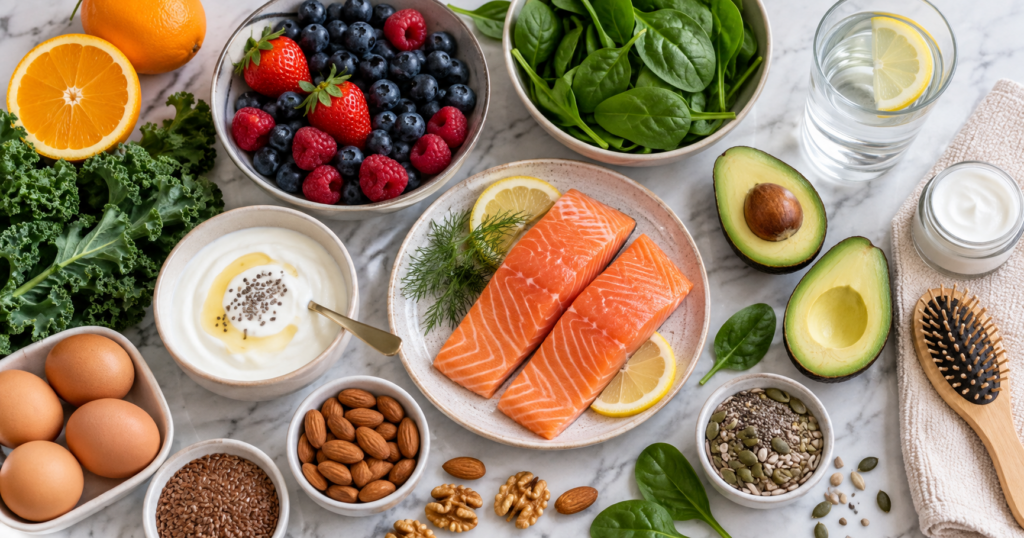
Omega-3 sources include fatty fish such as sardines, salmon, herring, mackerel, and tuna. Plant foods including chia seeds, flaxseed, walnuts, and certain plant oils provide alpha-linolenic acid, or ALA.
Other foods such as avocado, nuts, seeds, olive oil, and nut or seed butters can also contribute useful unsaturated fats to the diet.
You don’t need to start drinking olive oil or putting avocado on everything.
The point is simply that a healthy diet doesn’t need to be afraid of fat.
Vitamin A: Important, but More Isn’t Better
Vitamin A supports normal cell growth and differentiation and is important for maintaining several tissues throughout the body. Dietary vitamin A comes from preformed vitamin A in foods such as eggs, dairy products, fish, and liver, as well as provitamin A carotenoids found in foods such as carrots, spinach, pumpkin, sweet potatoes, and other green, orange, and yellow produce.
So yes, those orange vegetables deserve space on your plate.
But vitamin A also illustrates one of the central rules of nutrition:
Enough is good. More is not automatically better.
High intakes of preformed vitamin A, particularly from supplements, can be harmful. High-dose vitamin A also requires special caution during pregnancy because excessive intake can cause birth defects.
This is why “hair and skin vitamins” deserve a proper label check rather than a shrug and two gummies.
Nutrients still have doses.
Cute packaging doesn’t change physiology.
What About Vitamin D?
Vitamin D has become one of the most talked-about nutrients in health and beauty spaces.
Your body needs vitamin D for functions that extend far beyond skin and hair, including bone health and immune regulation.
Foods that can provide vitamin D include fatty fish, egg yolks, cheese, and fortified products such as some milks, cereals, juices, and plant-based drinks. The exact foods available will vary by country.
Hair research has also explored associations between vitamin D status and several forms of hair loss. A recent systematic review found vitamin D was among the most frequently investigated nutrients in hair-health research, though the authors also emphasised that more research is needed.
That distinction matters.
An association between low levels and a condition does not mean everybody should start swallowing high-dose vitamin D for thicker hair.
Testing, medical history, sun exposure, diet, skin pigmentation, geography, pregnancy status, and other factors can all affect the bigger picture.
Antioxidants: Less Hype, More Plants
“Antioxidant” is one of those words marketing departments absolutely love.
The science is less flashy.
Normal metabolism and environmental exposures can generate reactive molecules that contribute to oxidative stress. Your body has its own antioxidant defence systems, while several nutrients and plant compounds can also participate in antioxidant activity.
Vitamin C and vitamin E are familiar examples. Polyphenols and flavonoids found in many plant foods are also being studied in relation to skin health. A recent review of nutritional dermatology highlighted vitamins A, C, D, and E, zinc, essential fatty acids, selenium, copper, and plant compounds among nutrients of interest for skin health.
What does that mean at the supermarket?
Mostly something wonderfully unexciting:
Eat different plants.
Tomatoes.
Berries.
Citrus.
Leafy greens.
Carrots.
Sweet potatoes.
Peppers.
Beans.
Herbs.
Fruit that happens to be in season.
You don’t need an imported berry powder harvested during a full moon.
Your ordinary grocery basket can handle the assignment.
Your Plate Doesn’t Need to Be Perfectly “Clean”
There’s a strange moment that happens when people become interested in nutrition.
Suddenly food becomes morally loaded.
Salad is “good.”
Cake is “bad.”
Bread needs a lawyer.
And one unplanned takeaway apparently means the entire week is ruined.
That mindset isn’t necessary for healthy skin or hair.
A useful eating pattern is built across days and weeks, not decided by one lunch.
You can eat vegetables and birthday cake.
You can cook most evenings and occasionally order dinner because work was chaotic.
You can care about nutrition without making every meal a performance review.
Think pattern, not perfection.
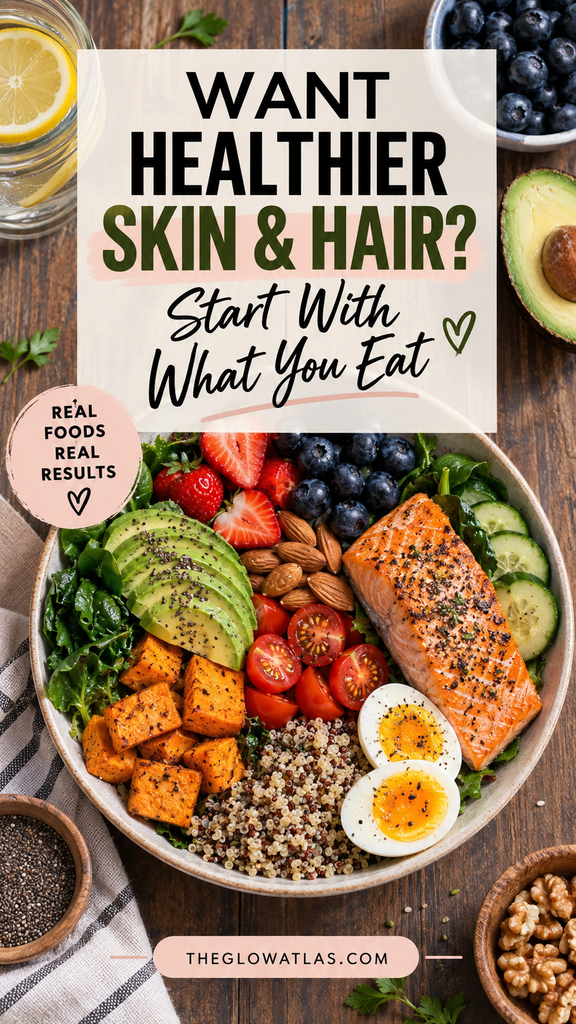
A practical meal might simply contain a protein source, a carbohydrate that keeps you satisfied, vegetables or fruit, and some fat.
For example, rice, beans, vegetables, and avocado.
Eggs, whole-grain toast, and fruit.
Yoghurt, oats, fruit, and nuts.
Fish, potatoes, and vegetables.
Lentils, a grain, greens, and a tomato-based sauce.
Chicken, rice, vegetables, and groundnut sauce.
None of those meals needs to be photographed.
That’s rather the point.
Does Sugar Ruin Your Skin?
No single food automatically “ruins” your skin.
Still, diet may influence certain skin conditions in some people, particularly acne.
Research reviewed by the American Academy of Dermatology suggests that lower-glycemic eating patterns may help reduce acne in some people. High-glycemic foods raise blood glucose quickly and include many highly refined carbohydrates and sugary foods. However, dermatologists also stress that acne usually requires more than dietary changes alone.
That means you don’t need to fear every dessert.
A more useful question is what your usual pattern looks like.
If breakfast is a sugary drink, lunch is a pastry, the afternoon brings another sweet drink, and dinner is followed by several packaged snacks, there simply isn’t much room left for protein, fibre, essential fats, iron-rich foods, fruit, vegetables, and the rest of the nutritional cast.
Sometimes improving nutrition isn’t about banning something.
It’s about making room for something better.
Hydration Matters, but Water Isn’t a Facial
Yes, drink enough fluids.
No, water is not going to erase wrinkles by Friday.
Your body needs adequate fluid for normal function, and dehydration can certainly make you feel awful. But the internet often stretches “hydration is important” into “drink enormous amounts of water and cure every skin concern.”
Those aren’t the same claim.
Fluid needs vary with body size, activity, climate, pregnancy, breastfeeding, illness, food intake, and other factors.
Water is an excellent default beverage. Milk, tea, soups, fruits, vegetables, and other foods and drinks can also contribute fluid.
A practical clue is simply not spending your entire day ignoring thirst because you’re buried in emails, lectures, childcare, meetings, or commuting.
Keep water accessible.
Drink regularly.
Then continue with your life.
About Those Biotin Gummies
Biotin might be the celebrity of the “hair, skin and nails” aisle.
Its reputation needs context.
True biotin deficiency can cause hair loss and skin changes. But deficiency is uncommon in people eating a reasonably varied diet, and NIH guidance says evidence supporting biotin supplementation for improving hair, skin, or nails in people without deficiency is limited.
There’s another wrinkle: high-dose biotin supplements can interfere with certain laboratory tests and produce misleading results, including some tests involving thyroid hormones and vitamin D.
That’s not a tiny footnote if your supplement contains thousands of micrograms.
The American Academy of Dermatology similarly advises healthy adults to meet nutrient requirements primarily through food unless a deficiency or medical condition makes supplementation appropriate.
So before automatically renewing that monthly hair gummy subscription, ask a boring but useful question:
Do I actually need it?
And Collagen Powder?
Collagen deserves a more nuanced answer.
Your digestive system breaks collagen-containing foods and collagen supplements down into peptides and amino acids, which the body can then use.
Several previous meta-analyses reported improvements in measures such as skin hydration and elasticity with hydrolysed collagen supplements.
But newer research has raised questions about study quality and funding. A 2025 meta-analysis found that apparent improvements became much less convincing when researchers separately examined higher-quality trials and studies without pharmaceutical-company funding.
Translation?
Collagen supplements might have some benefit, but they’re not a prerequisite for healthy skin.
If you enjoy one, can afford it, and it fits your dietary needs, fine. Just don’t let an expensive powder distract from the less glamorous basics: adequate protein, fruit, vegetables, whole grains or other quality carbohydrates, healthy fats, and sufficient micronutrients.
A supplement should be supplementary.
The clue is literally in the name.
Busy Schedule? Make Nutrition Easier, Not More Impressive
Healthy eating can sound beautiful until Tuesday arrives.
You slept badly. Your child can’t find a shoe. Your inbox is multiplying. You have an 8 a.m. lecture. The fridge contains half an onion and a mysterious container nobody wants to open.
This is where realistic nutrition wins.
Keep a few low-effort foods around.
Eggs cook quickly.
Tinned sardines, tuna, salmon, beans, or lentils can rescue lunch.
Frozen vegetables are still vegetables.
Plain yoghurt can become breakfast with oats, fruit, seeds, or nuts.
Fruit requires almost no preparation.
Peanut or groundnut butter can add energy, protein, and fat to a simple snack.
Leftover beans can become tomorrow’s lunch.
Cooked grains can be reused.
A boiled egg, banana, yoghurt, or handful of nuts is often more useful than waiting until you’re ravenous enough to buy whatever happens to be closest.
Nutrition doesn’t need to feel like another full-time job.
Reduce friction.
That matters more than collecting complicated recipes you’ll never cook.
If You Eat Mostly Plant-Based, Pay Attention to the Details
A well-planned plant-based diet can provide plenty of nutrients.
The important phrase is well planned.
Protein can come from beans, lentils, peas, soy foods, nuts, seeds, whole grains, and other foods. Iron is available from legumes, fortified foods, nuts, seeds, and leafy greens, while vitamin C-rich produce can help increase absorption of plant-based iron. Zinc is also present in beans, nuts, seeds, and whole grains, although its absorption can be lower from some plant foods.
Vitamin B12 needs particular attention in fully vegan diets because reliable natural sources are primarily animal-derived; fortified foods or supplementation are commonly needed.
The goal isn’t to panic over individual nutrients.
It’s to make sure restriction hasn’t quietly become deficiency.
Pregnancy, Postpartum Life, and Hair Changes Need Their Own Conversation
Pregnancy and the months after childbirth can change nutritional needs, hormones, routines, appetite, sleep, and hair behaviour all at once.
Postpartum hair shedding, for example, commonly has a hormonal component and cannot simply be “fixed” by adding more vitamins.
At the same time, pregnancy and breastfeeding can alter nutritional requirements, and iron deserves particular attention during pregnancy. NIH guidance lists a higher iron requirement during pregnancy than for nonpregnant adult women.
If you’re pregnant, breastfeeding, recently postpartum, experiencing substantial hair loss, or dealing with restrictive eating because of nausea or food aversions, personalised medical or dietetic advice is far more valuable than copying a supplement routine from social media.
Especially because some nutrients that are essential in normal amounts can become harmful in excessive doses.
Vitamin A is a good example.
More is not automatically safer for you or your baby.
When Hair Loss Probably Needs More Than a Grocery List
Nutrition matters, but hair loss has many possible causes.
Genetics, thyroid disease, hormonal changes, autoimmune conditions, medications, scalp disorders, physical stress, illness, rapid weight loss, tight hairstyles, and nutritional deficiencies can all play a role.
That is why persistent or unusual hair loss deserves proper assessment.
The American Academy of Dermatology recommends identifying the cause rather than assuming supplements will solve it. Blood testing may sometimes be appropriate when deficiency is suspected.
Pay particular attention if shedding is sudden, severe, patchy, painful, accompanied by scalp inflammation, or happening alongside other physical symptoms.
You can improve your breakfast and book the appointment.
Those actions don’t compete.
Skin Problems Work the Same Way
Diet can support healthy skin.
It doesn’t replace treatment.
Acne may require topical or oral medication.
Eczema may require barrier care and medical treatment.
Persistent rashes need diagnosis.
Sudden pigmentation changes, sores that don’t heal, suspicious moles, painful inflammation, or severe itching aren’t problems to treat solely with green juice.
Food supports the body.
Medicine treats disease.
Sometimes those worlds overlap, but they aren’t interchangeable.
So, What Does a “Skin and Hair Friendly” Day Actually Look Like?
Nothing exotic.
Breakfast could be eggs with whole-grain toast and fruit, or oatmeal with yoghurt, berries, and nuts.
Lunch might be beans or lentils with rice, vegetables, and avocado.
An afternoon snack could be fruit with peanuts, yoghurt, or another protein-containing food.
Dinner might be sardines or another fish with potatoes, greens, and tomatoes.
Another day can look completely different.
That variety is useful because different foods bring different nutrients.
The bigger idea is to regularly include protein, colourful produce, iron and zinc sources, healthy fats, satisfying carbohydrates, and enough total food.
Your meals don’t need to contain every nutrient every time.
Your diet gets more than one chance.
A Better Beauty Strategy Is Surprisingly Boring
Here’s the thing about nutrition for healthy skin and hair: the advice that holds up best is rarely dramatic.
Eat enough.
Eat protein regularly.
Include fruit and vegetables.
Don’t fear healthy fats.
Get iron and zinc from reliable sources.
Choose a variety of foods.
Drink enough fluids.
Be cautious with supplements.
And don’t assume every breakout or shed hair is a nutritional emergency.
There will always be a new powder, gummy, seed, drink, detox, or “glow diet” promising faster results. Some products may have interesting evidence behind them. Many are simply better at marketing than biology.
Food works differently.
It supports the body quietly, meal after meal.
You probably won’t wake up tomorrow and notice that yesterday’s lentils strengthened your hair or that your orange contributed vitamin C to collagen synthesis.
The payoff is cumulative.
And perhaps that’s the useful shift: eat for healthy function first, and let appearance be one of the benefits rather than the entire mission.
Healthy skin and hair don’t come from nutritional perfection.
They come from giving your body the materials it needs, consistently enough, while remembering that genetics, hormones, age, health conditions, stress, sleep, sun exposure, skincare, hair practices, and plain old life are part of the picture too.
No miracle menu required.
Just a better-supported body.