
If your skincare shelf is starting to look like a small pharmacy, you’re not alone.
One bottle says vitamin C. Another says retinol. There’s salicylic acid somewhere in the back, a moisturiser you bought because TikTok loved it, and now you’ve spotted niacinamide everywhere.
So, what exactly is niacinamide? And does your skin really need another ingredient?
Here’s the good news: niacinamide is one of the more practical skincare ingredients around. It’s a form of vitamin B3, also called nicotinamide, and it’s been studied for several skin concerns, including acne, excess oil, uneven pigmentation, redness, and signs of skin aging. Research also supports its role in maintaining the skin barrier.
It’s not a miracle ingredient. It won’t erase every dark spot overnight or make acne disappear by Monday morning.
But that’s part of its appeal.
Niacinamide is more like the reliable colleague who quietly keeps the project moving while everyone else is making noise. It can support several parts of your skincare routine without demanding much from you.
For students rushing to class, professionals juggling meetings, or moms trying to squeeze skincare in between breakfast and bedtime, that simplicity matters.
Let’s break it down.
What Is Niacinamide?
Niacinamide is a water-soluble form of vitamin B3.
Your body needs vitamin B3 for normal cellular processes, including energy metabolism. In skincare, topical niacinamide has been studied for its effects on the skin barrier, inflammation, pigmentation, sebum production, and visible signs of aging.
You may also see it listed on an ingredient label as nicotinamide. They’re essentially referring to the same skincare ingredient.
One important distinction: niacinamide isn’t the same as niacin, another form of vitamin B3. Niacin can cause flushing when taken in certain amounts, while topical niacinamide is generally well tolerated.
And that’s one reason it has become such a popular ingredient.
It doesn’t need a dramatic marketing story. Its strength is versatility.
So, What Does Niacinamide Actually Do?
Think of your skin barrier as the security system around your home.
It helps keep useful things in, such as water, while keeping irritating external factors out. When the barrier is weakened, skin can become dry, tight, rough, irritated, or more reactive.
Niacinamide can help support this barrier.
Research reviews describe several mechanisms through which topical niacinamide may improve barrier function, reduce inflammation and oxidative stress, and influence pigmentation.
That sounds technical, but the everyday version is much simpler:
Healthy barrier → better water retention → calmer, more comfortable skin.
And niacinamide doesn’t stop there.
1. It can support the skin barrier
A healthy skin barrier is one of the foundations of good skincare.
Niacinamide has been associated with improved barrier function and skin hydration. This makes it especially interesting if your skin feels dry or easily irritated after cleansing.
This doesn’t mean you should throw away your moisturiser and replace it with a niacinamide serum.
Please don’t.
A moisturiser still has a job to do. Niacinamide is a supporting player.
2. It may help control excess oil
If your forehead looks shiny by lunchtime even though you washed your face that morning, you’re probably familiar with this problem.
Some research suggests topical niacinamide can reduce facial sebum levels. Clinical research has also found reductions in sebum when niacinamide was used alongside acne treatments.
This can be useful for oily and combination skin.
But there’s an important catch: oil isn’t the enemy.
Your skin needs lipids to function properly. Trying to strip every last trace of oil can leave the skin irritated, which may make your routine harder to manage.
The goal is balance, not a completely matte face.
3. It can help with the appearance of hyperpigmentation
Dark marks can be stubborn.
Especially after acne.
Especially if your skin tends to develop post-inflammatory hyperpigmentation.
Niacinamide has been studied for pigmentation because it can interfere with the transfer of melanosomes from melanocytes to keratinocytes. In one clinical study, 5% niacinamide reduced hyperpigmentation compared with a vehicle after four weeks.
Other clinical studies have found improvements in hyperpigmented spots with topical 5% niacinamide.
That doesn’t mean niacinamide “bleaches” your skin.
It doesn’t.
A better way to think about it is that it may help reduce uneven pigmentation and improve the appearance of a more even complexion.
And if you’re dealing with persistent dark marks, sunscreen matters enormously. A systematic review of topical treatments for post-inflammatory hyperpigmentation found support for several treatments, including niacinamide, while broad-spectrum SPF 30 or greater appeared across almost all included studies.
So yes, use your brightening serum.
But don’t skip sunscreen and expect the serum to do all the heavy lifting.
4. It may help acne-prone skin
This is where niacinamide gets particularly interesting.
Topical nicotinamide has anti-inflammatory properties, and clinical trials have investigated it for inflammatory acne. One randomised trial found that 4% nicotinamide gel produced improvements in moderate inflammatory acne comparable to 1% clindamycin gel over eight weeks.
Another randomised study comparing 4% nicotinamide with 1% clindamycin also found significant improvement in acne severity over eight weeks.
However, don’t read that as “niacinamide replaces every acne treatment.”
Acne is complicated.
Depending on the type and severity, treatments such as benzoyl peroxide, topical retinoids, salicylic acid, or prescription medications may have a more established role.
A review of the available nicotinamide-acne literature also noted that the evidence base remains limited and that more studies are needed.
So niacinamide can be a useful part of an acne routine, but it shouldn’t be treated as a universal acne cure.
5. It may improve the appearance of fine lines and wrinkles
Here’s another reason niacinamide appears in so many anti-aging products.
In controlled studies, topical 5% niacinamide improved several visible signs of facial aging, including fine lines, wrinkles, hyperpigmented spots, texture, redness, and elasticity.
Notice the wording: improved the appearance.
Skincare isn’t a time machine.
Niacinamide won’t freeze your face at 25, and honestly, it shouldn’t have to. The goal of a sensible anti-aging routine is healthier-looking, better-supported skin over time.
And yes, sunscreen still sits near the top of that priority list.
Niacinamide Concentrations: Does 10% Really Mean Better?
This is where skincare marketing can get a little noisy.
You’ll often see products containing:
- 2% niacinamide
- 4% niacinamide
- 5% niacinamide
- 10% niacinamide
- Occasionally, even higher concentrations
The obvious assumption is that 10% must be twice as good as 5%.
Skin doesn’t work like that.
Higher concentration doesn’t automatically mean better results.
In fact, many of the clinical studies supporting niacinamide’s cosmetic benefits have used concentrations around 2% to 5%. Research has investigated 4% formulations for acne and 5% formulations for pigmentation and visible aging.
For beginners, a lower concentration can be a perfectly sensible place to start.
If your skin tolerates it well, you can continue.
There’s no prize for using the strongest serum in the bathroom.
How to Use Niacinamide in Your Skincare Routine
Here’s the part busy people usually want.
Where does it actually go?
A basic routine might look like this:
Morning
1. Gentle cleanser
Cleanse without leaving your face tight and squeaky.
That “squeaky clean” feeling isn’t necessarily a sign that your cleanser worked brilliantly. Sometimes it means your skin barrier isn’t thrilled.
2. Niacinamide serum
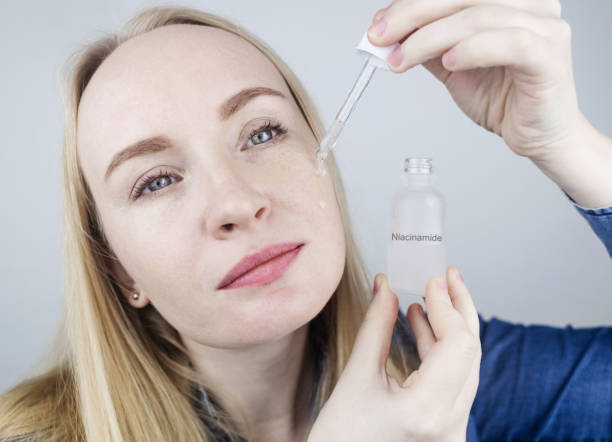
Apply a few drops to clean skin.
You don’t need to soak your face.
3. Moisturiser
Use one suited to your skin type.
4. Broad-spectrum sunscreen
This is the non-negotiable step if pigmentation, premature skin aging, or sun protection matters to you.
Evening
1. Cleanser
Remove sunscreen, makeup, sweat, and the day’s general chaos.
2. Niacinamide
Apply your serum if you’re using one.
3. Treatment, if appropriate
This could include a retinoid or another active depending on your skin needs.
4. Moisturiser
Keep things comfortable and supported.
That’s it.
You don’t need seven serums.
You don’t need a 14-step routine.
You need a routine you can actually maintain.
Can You Use Niacinamide Every Day?
For most people, yes.
Topical niacinamide is generally well tolerated, and clinical studies have reported good tolerability.
You can use it once or twice daily depending on the product and how your skin responds.
But if you’re new to active skincare, starting once daily is reasonable.
Watch how your skin behaves.
If it feels comfortable, keep going.
If you develop persistent burning, itching, redness, or a rash, stop using the product and reassess.
Sometimes the problem isn’t niacinamide itself. It can be the fragrance, preservatives, another active ingredient, or simply too many products being introduced at once.
What Ingredients Can You Use With Niacinamide?
One of niacinamide’s biggest advantages is that it generally fits comfortably into many routines.
Niacinamide + Hyaluronic Acid
A simple combination.
Hyaluronic acid helps attract and hold water, while niacinamide supports the skin barrier.
If your skin feels dehydrated, this pairing can make sense.
Niacinamide + Ceramides
Another logical combination.
Ceramides are important components of the skin barrier, while niacinamide can support barrier function.
This can be especially useful when your routine is focused on keeping skin comfortable rather than throwing every possible active at it.
Niacinamide + Vitamin C
Yes, you can use them together.
The old idea that niacinamide and vitamin C must never touch comes from concerns that don’t apply neatly to modern skincare formulations.
Many products are formulated to combine compatible ingredients safely.
If your skin is sensitive, though, you don’t have to use everything at once.
For example:
Morning: Vitamin C → moisturiser → sunscreen
Evening: Niacinamide → moisturiser
Simple.
Niacinamide + Retinoids
This can be a useful combination.
Retinoids can be effective but irritating, particularly when someone starts too quickly. Niacinamide’s barrier-supporting properties can make it a useful companion in a routine that includes a retinoid.
But remember: more actives don’t necessarily mean faster results.
If your face is peeling like it’s auditioning for a snake documentary, your routine needs a rethink.
Niacinamide + Salicylic Acid
These ingredients can complement each other in routines for oily or acne-prone skin.
Salicylic acid helps exfoliate inside pores, while niacinamide may support barrier function and help with inflammation and oiliness.
The trick is moderation.
You don’t need to apply five acids because you had three breakouts.
What About Niacinamide and AHAs?
You can generally use them in the same overall routine, but your skin’s tolerance matters.
Alpha hydroxy acids such as glycolic or lactic acid can increase irritation when overused.
If you’re already using an exfoliating acid, retinoid, benzoyl peroxide, and several other actives, adding another product isn’t necessarily a smart move.
Think of skincare like a work calendar.
One important meeting is manageable.
Twelve meetings back-to-back with no lunch break?
Chaos.
Your skin can feel the same way.
Who Should Use Niacinamide?
Niacinamide can make sense for many skin types.
For oily skin
It may help reduce excess sebum and can be useful in routines aimed at managing shine and breakouts.
Look for lightweight serums or gel-based moisturisers if heavier products make you uncomfortable.
For dry skin
Don’t assume niacinamide is only for oily skin.
Its barrier-supporting role can make it useful for dry skin too.
Pair it with a moisturiser containing ingredients such as ceramides, glycerin, or other humectants and emollients.
For combination skin
This is often where niacinamide feels particularly useful.
You can support the barrier while addressing oilier areas without necessarily drying out the rest of your face.
For acne-prone skin
Niacinamide may help with inflammation, oil control, and post-acne marks. Clinical studies support potential benefits, although it shouldn’t replace established acne treatment when stronger treatment is needed.
For mature skin
Studies have found improvements in the appearance of wrinkles, pigmentation, texture, redness, and elasticity with topical niacinamide.
It’s a particularly appealing ingredient for people who want a relatively simple anti-aging routine.
Is Niacinamide Good for Dark Skin?
It can be.
Niacinamide has been studied for hyperpigmentation, including its effect on melanosome transfer, and research supports its potential to improve uneven pigmentation.
This can be relevant for deeper skin tones because inflammation from acne, irritation, and other skin problems can sometimes leave noticeable dark marks.
That said, pigmentation is not one-size-fits-all.
Melasma, post-inflammatory hyperpigmentation, acne marks, and sun-induced pigmentation can require different approaches.
If pigmentation is persistent, spreading, or changing despite a consistent routine, a dermatologist can help identify what’s actually causing it.
Can Niacinamide Cause Breakouts?
Niacinamide itself isn’t generally considered a pore-clogging ingredient.
But any new skincare product can potentially cause problems.
Maybe the formulation is too heavy for your skin.
Maybe you’re reacting to another ingredient.
Maybe you’ve introduced three new products simultaneously and now have no idea which one is responsible.
This is why changing one major product at a time is useful.
It gives you a clearer picture of what your skin likes.
Can Niacinamide Cause Irritation?
It can, although many people tolerate it well.
Some users experience:
- Redness
- Burning or stinging
- Itching
- Dryness
- Small bumps or irritation
A very high-strength formula may be more irritating for some people than a lower-strength product.
If your skin reacts, stop using the product for a while and return to a simple cleanser, moisturiser, and sunscreen routine.
Once your skin settles, you can decide whether to try a lower concentration or a different formulation.
And if the reaction is severe or doesn’t improve, seek medical advice.
Common Niacinamide Mistakes
Let’s talk about the things that can quietly sabotage an otherwise good routine.
Mistake #1: Starting with too many actives
Niacinamide + retinol + glycolic acid + salicylic acid + benzoyl peroxide + vitamin C sounds impressive.
It also sounds exhausting.
Start with the basics.
Mistake #2: Assuming 10% is automatically superior
It isn’t.
A well-formulated 4% or 5% product can be perfectly useful, and clinical research supports benefits at these concentrations.
Mistake #3: Using too much
More serum doesn’t equal more results.
Follow the product directions.
A few drops are usually enough for the face.
Mistake #4: Skipping sunscreen
This is particularly important if your goal is reducing pigmentation.
Niacinamide may help improve the appearance of dark spots, but UV exposure can continue driving pigmentation.
You can’t out-serum the sun.
Mistake #5: Expecting overnight results
Skincare is slow.
Clinical studies often assess changes over several weeks or months, not three mornings. Studies of niacinamide for acne and visible skin aging have commonly measured outcomes at four, eight, or twelve weeks.
Give a reasonable routine time to work.
A Simple Niacinamide Routine for Busy People
If you’re a student running from lectures to assignments, a young professional moving between work and social plans, or a parent who considers uninterrupted shower time a luxury, here’s a routine that doesn’t require a spreadsheet.
Morning
Cleanser → Niacinamide → Moisturizer → SPF 30+
That’s your core routine.
If you also use vitamin C, you can place it before moisturiser and sunscreen.
Evening
Cleanser → Niacinamide → Moisturizer
If you’re using a retinoid or acne medication, add it according to your treatment plan.
That’s enough.
Seriously.
You don’t need to spend your entire evening layering products.
A Beginner’s Weekly Approach
If you’re completely new to active skincare, start slowly.
Week 1: Use niacinamide once every other day.
Week 2: If your skin is comfortable, increase to once daily.
Week 3 onward: Continue once daily or follow the product’s directions.
You may eventually use it twice daily if your skin tolerates it and the formulation recommends that schedule.
There’s no need to rush.
Your skincare routine isn’t a deadline.
When Should You Expect Results?
This depends on what you’re trying to improve.
Oiliness may change sooner than pigmentation.
Acne takes time.
Dark marks often take even longer.
And visible signs of aging generally require consistent use over months rather than days.
Clinical research provides a useful reality check: studies have found measurable changes with niacinamide after several weeks, with some pigmentation benefits appearing around four weeks and broader appearance improvements assessed over 8–12 weeks.
So if you’ve been using niacinamide for six days and your dark spot is still there, that’s not a failure.
That’s skin being skin.
Niacinamide vs. Vitamin C: Which One Is Better?
Neither wins.
They do different jobs.
Niacinamide is particularly useful for:
- Barrier support
- Oil control
- Inflammation
- Uneven pigmentation
- Acne-prone skin
- General skin maintenance
Vitamin C is commonly used for:
- Antioxidant protection
- Brightening
- Uneven skin tone
- Supporting collagen-related skin processes
You can use both.
You can also choose one if your routine needs to stay simple.
For a busy person, I’d rather see a consistent routine with three or four products than an elaborate routine that gets abandoned after two weeks.
Niacinamide vs. Retinol
Again, they’re not direct competitors.
Retinoids have a strong role in treating acne and photoaging, but they can also cause dryness and irritation, particularly during the adjustment period.
Niacinamide tends to be gentler and more supportive.
You can use both in a broader routine, but introduce them carefully.
If you’re pregnant or trying to conceive, speak with your healthcare professional about retinoid use rather than making assumptions based on skincare trends.
Niacinamide is a different ingredient and shouldn’t be treated as interchangeable with retinoids.
When Should You See a Dermatologist?
Skincare products are useful, but they aren’t always enough.
Consider seeing a dermatologist if:
- Your acne is painful or severe.
- Acne is leaving significant scars or dark marks.
- Your pigmentation keeps worsening.
- Your skin burns or reacts persistently.
- You have a rash that won’t settle.
- Over-the-counter treatment isn’t helping after a reasonable trial.
The American Academy of Dermatology notes that persistent acne and post-inflammatory hyperpigmentation may need professional assessment and a more targeted treatment plan.
And that’s not a failure.
Sometimes your skin simply needs a better diagnosis, not another viral serum.
Frequently Asked Questions About Niacinamide
Can I use niacinamide every day?
Yes. Most people can use topical niacinamide daily, provided their skin tolerates it.
Should I use niacinamide in the morning or at night?
Either is fine. Many people use it once or twice daily depending on the product and their routine.
Can niacinamide help acne?
It may. Research has found improvements with topical nicotinamide in inflammatory acne, but the evidence base is smaller than for some established acne treatments.
Does niacinamide remove dark spots?
It can help reduce the appearance of hyperpigmentation over time. It works best as part of a broader routine that includes sun protection.
Is 10% niacinamide too strong?
Not necessarily, but stronger isn’t automatically better. Many clinical studies have used concentrations around 4–5%, so beginners don’t need to chase the highest percentage on the shelf.
Can I use niacinamide with vitamin C?
Yes. Modern skincare formulations can contain or combine these ingredients. If your skin is sensitive, using them at different times can keep your routine simpler.
Can niacinamide help oily skin?
It may help reduce sebum production and can fit well into routines for oily or blemish-prone skin.
Does niacinamide lighten skin?
Niacinamide can help reduce uneven pigmentation and improve the appearance of dark spots. It isn’t intended to change your natural skin colour.
Can niacinamide damage the skin barrier?
Niacinamide is generally considered barrier-supportive and well tolerated. However, irritation can occur with individual products or high-strength formulas.
How long does niacinamide take to work?
Give it several weeks. Some studies have observed changes after around four weeks, while improvements in acne and visible aging have often been assessed over 8–12 weeks.
The Bottom Line
Niacinamide isn’t flashy.
That’s exactly why it’s worth considering.
It’s a versatile vitamin B3 ingredient that can support the skin barrier, help manage excess oil, improve the appearance of uneven pigmentation, calm inflammation, and contribute to healthier-looking skin over time. Clinical evidence supports several of these benefits, although the strength of evidence varies by concern.
For a busy student, professional, or mom, its biggest advantage may be how easily it fits into a routine.
You don’t need to build your entire skincare strategy around it.
Start with the basics:
Gentle cleanser.
Niacinamide.
Moisturizer.
Daily sunscreen.
Then add other treatments only when there’s a clear reason for them.
Because good skincare isn’t about having the most products.
It’s about having the right ones, and actually using them consistently.
And honestly, that’s a much easier plan to stick with when life gets busy.