You open your bathroom cabinet, and there they are.
The half-used serum you bought after watching a TikTok review. The exfoliating toner you’re slightly scared to use. A moisturiser that feels too heavy. Two cleansers. Three tiny bottles whose labels promise brighter, smoother, clearer, younger-looking skin.
And somehow, despite owning all of this stuff, you still aren’t completely sure what your skincare routine should be.
Sound familiar?
Skincare has become strangely complicated.
There’s always another ingredient to learn about, another “must-have” step, another viral routine that makes your perfectly ordinary bathroom shelf look inadequate. Retinol. Peptides. PDRN. Ceramides. Snail mucin. Exosomes. Growth factors. Toners. Essences. Ampoules.
Some of these products can absolutely have a place in skincare.
But here’s the thing: your skin doesn’t automatically need more products.
In fact, the American Academy of Dermatology notes that using too many skincare products can irritate the skin, especially when several treatment products are used together. Dermatologists continue to recommend a much simpler foundation: gentle cleansing, moisturising, and sun protection.
That gives us a surprisingly manageable routine:
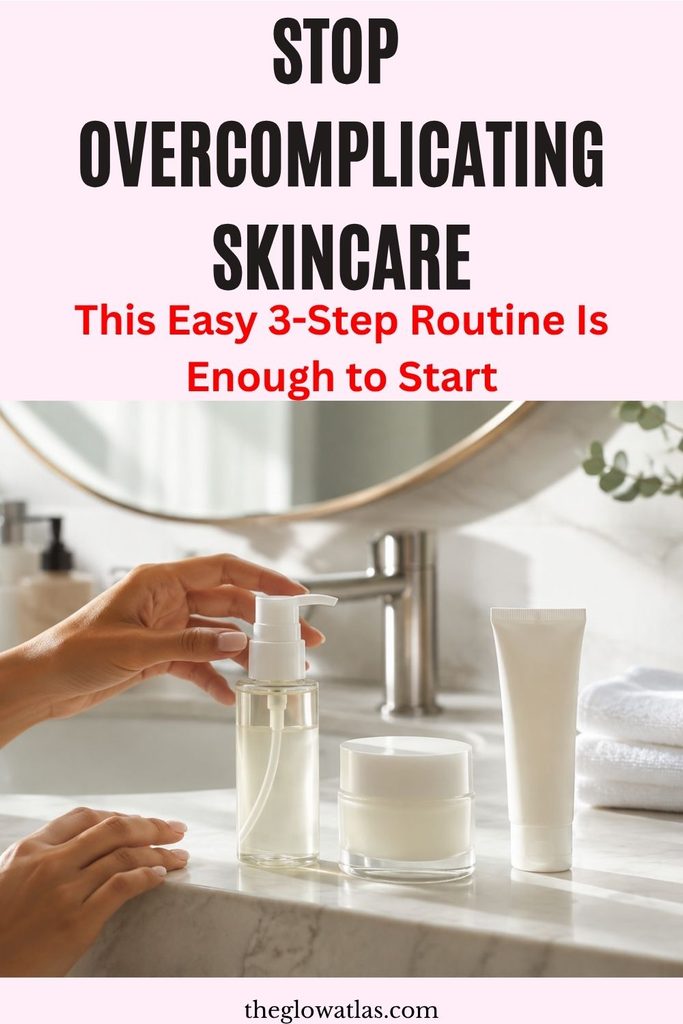
Cleanse. Moisturize. Protect.
Three steps.
That’s it.
Well, mostly.
There are a few details worth knowing because oily skin needs slightly different textures from dry skin, sunscreen deserves more respect than the rushed swipe most of us give it, and your evening routine obviously doesn’t need SPF.
But if you’re a student rushing to an 8 a.m. lecture, a young professional trying to get out of the house before traffic turns ugly, a mother getting everyone ready except herself, or simply someone tired of skincare feeling like another job, this routine is a very good place to start.
And perhaps more importantly, it’s a routine you might actually keep doing.
First, Can Three Skincare Products Really Be Enough?
Yes.
And also, sometimes no.
There’s our small contradiction.
Three products can provide the foundation of a solid skincare routine. They won’t necessarily treat every case of acne, melasma, eczema, rosacea, persistent pigmentation, or other skin concerns. Those may need targeted treatment or professional care.
But healthy skincare and corrective skincare aren’t quite the same thing.
Think about brushing your teeth. Toothpaste and brushing form the daily foundation. If you develop a cavity, you don’t respond by buying seven more toothpastes. You see a dentist and deal with the specific problem.
Skin can work similarly.
A basic routine supports cleanliness, moisture, the skin barrier, and protection from ultraviolet radiation. Then, if you have a specific concern, you can carefully add a targeted product rather than turning your face into a chemistry experiment.
Recent beauty coverage has even moved back toward this kind of streamlined routine. In 2026, dermatologists interviewed by Allure recommended simplifying routines around cleanser, moisturiser, and sunscreen, with multitasking formulas helping people reduce unnecessary steps.
It’s skincare without the administrative burden.
And that sounds rather nice.
Step 1: Cleanse Without Declaring War on Your Face
Cleansing seems almost too obvious to discuss.
Face gets dirty. Wash face.
Done.
Except plenty of skincare problems begin with cleansing that’s too aggressive.
That tight, squeaky feeling after washing?
It can feel satisfying. Clean. Almost polished.
But your face isn’t a frying pan.
You don’t need to degrease it until it squeaks.
A cleanser’s basic job is to remove accumulated oil, sweat, dirt, sunscreen, makeup, pollution particles, and other debris without leaving your skin unnecessarily irritated.
The American Academy of Dermatology recommends gentle cleansing and generally advises limiting facial washing to twice daily and after heavy sweating.
For many people, that means cleansing at night is particularly important.
During the day, your face collects quite a little résumé of life: sunscreen, makeup, sweat from walking to class, oil from a long commute, dust, hands touching your face during meetings, and whatever your environment throws at you.
Wash it off before bed.
Do You Need to Cleanse in the Morning Too?
Not everyone does.
If you wake up oily or sweaty, a gentle morning cleanse may feel good.
If your skin is dry or sensitive, washing only with water in the morning, or skipping a full cleanse until evening, may sometimes feel better. The AAD notes that some people with dry or sensitive skin may find once-daily evening cleansing sufficient.
Your skin gets a vote here.
That’s something social media skincare routines often forget.
A creator saying, “You absolutely need to cleanse twice every day” is advising thousands of different faces as though they all have the same barrier, climate, oil production, medication use, and lifestyle.
They don’t.
Choosing a Cleanser Without Losing Your Mind
Walk into a beauty aisle, and cleansers suddenly have job titles.
Clarifying cleanser. Barrier cleanser. Brightening cleanser. Jelly cleanser. Milk cleanser. Oil cleanser. Cream cleanser. Foaming cleanser.
Don’t panic.
For a simple routine, start with something gentle that leaves your skin comfortable after washing.
Dry or sensitive skin often does well with creamy, milky, or low-foaming formulas.
Oily skin may prefer a gel or light foaming cleanser.
Combination skin usually needs something in the middle, effective enough around an oily forehead or nose without making the cheeks feel like parchment.
Acne-prone skin may benefit from a cleanser labelled non-comedogenic or “won’t clog pores.” Those terms can also be useful when choosing moisturisers and sunscreens.
And fragrance?
If you love a scented cleanser and your skin tolerates it, fine.
But if your skin frequently stings, becomes red, feels itchy, or seems annoyed by everything you buy, a fragrance-free option is a sensible place to start. Dermatologists often recommend fragrance-free products for sensitive skin because fragrance can trigger irritation or allergic reactions in some people.
What About Double Cleansing?
Double cleansing can be useful.
It is not a citizenship requirement.
If you wear heavy or waterproof makeup, a water-resistant sunscreen, or a lot of long-wear complexion products, removing those first with an oil cleanser, cleansing balm, or appropriate makeup remover before using your regular cleanser can make sense.
If you wore nothing except a light sunscreen and your regular cleanser removes it comfortably?
You may not need another bottle.
Simple skincare gets much easier once you stop adding steps because somebody online said everyone “must” do them.
Step 2: Moisturise, Yes, Even If Your Skin Is Oily
Here’s where oily-skinned readers sometimes disappear.
Come back.
Moisturiser is not reserved for dry skin.
Your skin naturally contains water, oils, and barrier components that help keep it comfortable and functional. Cleansing, weather, air conditioning, sun exposure, certain medications, exfoliating products, and plain old biology can all affect how hydrated that outer layer feels.
A moisturiser helps reduce water loss and support that comfortable skin-barrier environment.
The AAD recommends applying moisturiser while skin is still slightly damp because this helps trap water in the skin.
This is one of those tiny habits that requires almost no extra effort.
Wash.
Pat gently.
Leave the skin slightly damp.
Apply moisturiser.
Done.
“But Moisturiser Makes Me Break Out”
Sometimes the problem isn’t moisturiser itself.
It’s the moisturiser you’re using.
If your skin becomes shiny enough to signal aircraft fifteen minutes after applying a thick cream, you probably need a lighter texture.
Look for lightweight lotions, fluids, gels, or gel creams. If you’re prone to clogged pores, words such as non-comedogenic, oil-free, or won’t clog pores are useful label clues.
Dry skin sits at the other end of the table.
If your face drinks a lightweight gel moisturiser and asks, “Was that it?” you may need a richer cream.
Ingredients such as glycerin, hyaluronic acid, ceramides, squalane, petrolatum, or other humectant and barrier-supporting ingredients often appear in moisturisers formulated for dryness.
You don’t need to memorise an ingredient dictionary, though.
Texture matters.
Comfort matters.
How your skin behaves after two weeks matters far more than whether the packaging looks impressive beside your toothbrush.
Your Moisturiser Doesn’t Need to Be Exciting
This may be one of the least glamorous skincare opinions available.
A moisturiser can be boring.
In fact, boring is occasionally fantastic.
It doesn’t need seven trending ingredients, microcapsules, fermented something-or-other and a rare botanical gathered under a full moon.
If it leaves your skin comfortable, doesn’t consistently trigger irritation, works under your sunscreen or makeup, and fits your budget, it’s doing its job.
Save the drama for your group chat.
Your moisturiser can clock in quietly.
Step 3: Sunscreen – The Step People Still Treat Like an Extra
Cleanser gets attention.
Serums get excitement.
Sunscreen gets excuses.
“It’s cloudy.”
“I’m only going to work.”
“I’ll mostly be indoors.”
“My makeup has SPF.”
“I don’t burn easily.”
Meanwhile, sun protection is one of the most evidence-backed pieces of a skincare routine.
The AAD recommends a broad-spectrum, water-resistant sunscreen with SPF 30 or higher for exposed skin. Broad-spectrum protection covers both UVA and UVB radiation; UVA contributes to premature skin ageing, while UVB is strongly associated with sunburn.
Regular sun protection also matters if pigmentation and uneven skin tone bother you.
You can spend serious money trying to fade dark marks while continuing to expose unprotected skin to the environmental factor that can make pigmentation harder to manage.
It’s a bit like mopping while the tap is still running.
So What Sunscreen Should You Buy?
The best sunscreen for a simple routine has one magical property:
You’ll actually wear it.
Texture becomes surprisingly important here.
If your sunscreen is greasy, pills under makeup, stings your eyes, leaves your face looking violet-grey, or makes you feel as though you spread cooking oil across your forehead, you’ll find excuses not to use it.
Try another formula.
There are now creams, gels, milks, fluids, sticks, tinted sunscreens, mineral formulas, chemical formulas, hybrid formulas, matte finishes, moisturising finishes and sunscreens designed specifically to sit under makeup.
People with deeper skin tones may especially appreciate sunscreens designed to disappear without a noticeable white cast. The AAD also notes that tinted sunscreens can be useful options for darker skin tones.
Choose based on the face you actually have, not the face in an advertisement.
SPF 30 or SPF 50?
SPF 30 is a solid minimum.
The AAD recommends SPF 30 or higher. SPF 30 filters about 97% of UVB radiation when used correctly, though no sunscreen blocks 100%.
SPF 50 is also perfectly reasonable and may provide a little more margin in real life, where most of us don’t apply sunscreen with laboratory-level precision.
What matters most is using enough, covering exposed areas and reapplying when needed, particularly during prolonged outdoor exposure, swimming, or heavy sweating.
The AAD advises reapplying roughly every two hours when outdoors and after swimming or sweating.
And yes, sunscreen goes after your moisturiser and before makeup.
Your Three-Step Morning Routine
Now we can put everything together.
A basic morning skincare routine looks almost suspiciously easy:
- Cleanse – Use a gentle cleanser, or adjust morning cleansing if your dry or sensitive skin does better with less washing.
- Moisturise – Apply a suitable moisturiser, preferably while skin still has a little dampness.
- Protect – Finish with broad-spectrum SPF 30+ sunscreen on exposed skin.
That’s the whole meeting.
No PowerPoint required.
If your sunscreen is moisturising enough for your skin, you may even find that one product can handle the moisturiser-and-sunscreen portion of your morning routine. The AAD specifically mentions dual-function moisturiser-and-sunscreen products as one way to simplify skincare, provided the sunscreen gives appropriate broad-spectrum SPF protection.
For someone trying to get a child dressed, make breakfast, pack a bag, answer a work message and locate the keys that were definitely on the table thirty seconds ago, one fewer step matters.
And Your Three-Step Night Routine?
Night changes things slightly because you don’t need sunscreen before getting into bed.
So think of your evening routine as:
Cleanse → treat if needed → moisturise.
If you don’t use a treatment product, it may effectively become a two-step evening routine.
That is completely fine.
Your cleanser removes the day.
Your moisturiser helps keep your skin comfortable overnight.
Go to sleep.
Your face won’t file a complaint because you forgot to use an essence.
Wait, where do serums, retinol, and acids go?
This is where skincare becomes interesting, but it can also become chaotic.
A three-step routine is your foundation.
Treatment products are add-ons.
You might eventually use vitamin C for antioxidant support, retinoids for acne or signs of photoaging, salicylic acid for clogged pores, azelaic acid for certain pigmentation or acne concerns, benzoyl peroxide for acne, or another targeted ingredient recommended for your skin.
But add them because you have a reason.
Not because the bottle is trending.
A useful rule is one concern, one thoughtful addition.
If your basic routine has been stable and comfortable, then you can assess what still bothers you.
Maybe it’s breakouts.
Maybe it’s post-acne marks.
Maybe it’s texture.
Maybe nothing bothers you, and you simply want to keep your routine uncomplicated.
That last option is allowed.
The AAD similarly recommends addressing your main concern rather than starting several anti-ageing products together, since multiple active products introduced too quickly can irritate skin.
Your skin isn’t impressed by the number of bottles you own.
It responds to formulation, consistency, tolerability, and time.
Adjust the Routine to Your Skin Type, Not Someone Else’s Shelf
This is where the routine gets personal.
The steps remain mostly the same. The textures and formulas change.
If your skin is oily, you may prefer a gel cleanser, lightweight moisturiser, and fluid or gel sunscreen.
If your skin is dry, try a gentle creamy cleanser, richer moisturiser, and comfortable moisturising sunscreen.
For combination skin, resist the urge to attack the oily areas. A balanced cleanser and medium-weight moisturiser may work better than stripping the whole face because your nose gets shiny at 2 p.m.
Sensitive skin usually appreciates restraint: gentle cleansing, fragrance-free moisturiser, comfortable sunscreen, and slow product changes.
Acne-prone skin doesn’t automatically need the harshest products either. Acne treatments themselves can dry or irritate skin, which is one reason dermatologists may still recommend an acne-friendly moisturiser.
Then there’s “normal” skin, which skincare marketing sometimes seems determined to convince has twelve hidden problems.
If your skin feels comfortable, doesn’t become excessively oily or dry, and you aren’t dealing with a particular condition?
You don’t need to invent a crisis.
Cleanse it.
Moisturise it.
Protect it.
Carry on with your day.
The Skincare Shopping Rule That Can Save You a Lot of Money
Never build your whole routine in one shopping trip.
That gorgeous shelf of matching bottles may look convincing, but skin doesn’t care whether your cleanser and moisturiser have matching typography.
Buy the essentials first.
Use them.
See what happens.
This is especially important for students, young professionals, growing families, and anyone trying to keep personal-care spending under control.
Skincare can become sneaky.
A $12 serum doesn’t sound expensive.
Neither does a $15 toner.
Or the $18 cleanser.
The $20 moisturiser.
The $17 exfoliant.
The $25 sunscreen.
Suddenly, you’re running a small dermatology warehouse from your bedroom.
A simple routine lets you spend more deliberately.
A modestly priced cleanser that works for you beats an expensive cleanser that irritates your skin. The same goes for moisturiser and sunscreen.
Price and effectiveness aren’t married.
Three Products Can Still Go Wrong
Simple doesn’t mean foolproof.
You can have only three skincare products and still irritate your skin if they aren’t suited to you.
One common problem is cleansing too aggressively.
Another is skipping moisturiser because your skin is oily.
Then there’s the big one: applying sunscreen only when the weather looks sunny.
You can also derail a perfectly good routine by changing products constantly.
Skin needs time.
If you use one moisturiser on Monday, another on Wednesday, a new serum on Friday, then wake up with bumps on Sunday, figuring out the culprit becomes detective work.
Introduce products gradually when possible.
Pay attention to patterns.
And if something burns, swells, produces a rash, or causes persistent irritation, don’t keep using it because an influencer told you the “tingling means it’s working.”
Pain is not a skincare KPI.
What About Face Masks, Scrubs and Those Little Skincare Treats?
You’re allowed to enjoy skincare.
Not every product must earn a permanent position in the routine.
A hydrating mask on a quiet Sunday evening can feel lovely.
So can a facial.
So can putting on a sheet mask while watching something ridiculous on Netflix.
But extras are extras.
The AAD’s 2026 guidance on facial masks makes a similar point: masks can be enjoyable, but they don’t replace cleansing, moisturising, and sun protection. It also warns against stacking masks with active ingredients already present elsewhere in your routine because this can increase irritation.
That’s worth remembering.
Skincare can be both functional and fun.
The problem starts when fun products crowd out the boring things that actually form your routine.
What If You’re Too Tired for Skincare?
This deserves more attention than it gets.
Sometimes “I don’t have a skincare routine” really means:
“I get home exhausted.”
You’ve studied all day.
Worked a long shift.
Sat through traffic.
Made dinner.
Cleaned something.
Helped with homework.
Answered the email you forgot to answer earlier.
Then 10:47 p.m. arrives, and the thought of performing a nine-step beauty ceremony feels completely absurd.
This is exactly why a simple routine works.
Make your evening threshold embarrassingly low.
Wash your face.
Put on moisturiser.
Finished.
If you routinely wear heavy makeup, keep your makeup remover where it’s easy to reach.
If remembering sunscreen is your problem, store it beside something you never forget in the morning.
Behaviour matters as much as bottles.
A mediocre routine you follow for months usually makes more sense than an elaborate routine you perform enthusiastically for six days and abandon.
Consistency sounds boring because it is boring.
It’s also powerful.
Seasonal Changes? Keep the Steps, Change the Texture
Your three steps don’t necessarily need to change when the weather does.
Your products might.
Cold weather, indoor heating, strong air conditioning, low humidity, wind, heat, heavy sweating and increased outdoor time can all change how your skin feels.
Dry season arrives, and your light gel moisturiser suddenly feels like nothing?
Move to a richer cream.
Hot, humid weather makes that same cream unbearable?
Switch back to something lighter.
The AAD also points out that even warm, humid summer conditions can coincide with dry or irritated skin because sun exposure, swimming pools, and air conditioning can contribute to dryness.
This is why rigid skincare rules get silly.
Your skin in January may not behave exactly like your skin in August.
Your skin during exam week may not even behave like your skin during the holidays.
Hormones, sleep, stress, environment, medications, travel and habits all join the conversation.
Keep the framework.
Adjust the details.
When a Simple Routine Isn’t Enough
There’s one important line we shouldn’t blur.
Skincare products are not substitutes for diagnosis or treatment.
If you’re dealing with persistent or painful acne, repeated rashes, intense itching, wounds that don’t heal, sudden pigment changes, significant irritation, suspected eczema, rosacea, severe dryness, or another ongoing skin problem, getting help from a qualified healthcare professional or dermatologist makes sense.
The same applies if your skin keeps getting worse despite simplifying your routine.
Sometimes the answer isn’t another serum.
Sometimes you need to know what you’re actually treating.
And once you do, the solution may still sit beautifully beside this three-step foundation.
Your Routine Does Not Need to Look Impressive
There’s something almost rebellious about owning three skincare products in an era of beauty hauls and bathroom “shelfies.”
But your skin isn’t content.
It doesn’t need to generate engagement.
It needs reasonable care.
So if you’ve been overwhelmed by skincare, start here:
Use a gentle cleanser that doesn’t leave your face angry.
Apply a moisturiser that suits your skin.
Wear broad-spectrum SPF 30 or higher during the day.
Do those things consistently.
Then wait.
Pay attention.
See what your skin actually needs before buying the next thing.
Because the goal isn’t to build the longest routine.
It isn’t to collect the trendiest ingredients.
And it certainly isn’t to wake up every morning wondering which six bottles go first.
A good skincare routine should fit into your life—not quietly take it over.
Three thoughtful steps can do that.
Cleanse. Moisturize. Protect.
Simple?
Absolutely.
But simple and ineffective are not the same thing.