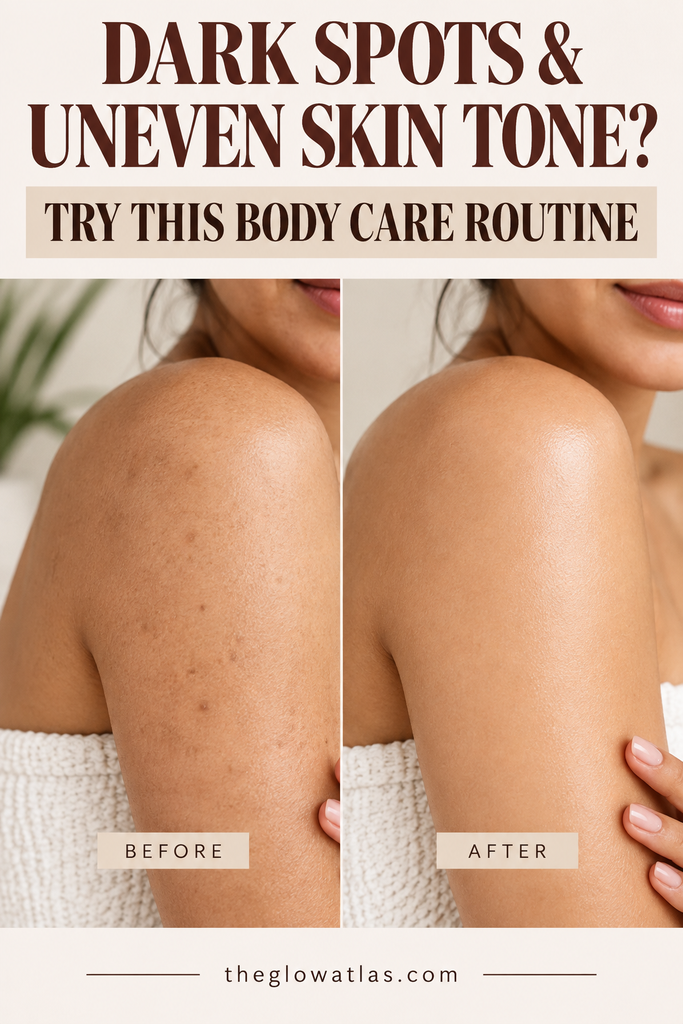

Uneven skin tone on the body can be surprisingly frustrating.
Maybe your knees look much darker than your thighs. Your shoulders have old acne marks. Your underarms seem to get darker every time you shave. Or perhaps those mosquito bites from months ago left little brown dots across your legs that simply refuse to leave.
Then comes the temptation to attack everything at once: scrub harder, buy three acids, add a brightening serum, switch soaps, exfoliate every shower, and hope your skin gets the memo.
Unfortunately, skin doesn’t work quite like that.
If anything, doing too much can make uneven tone worse. Irritation itself can trigger more discolouration, especially in medium to deep skin tones. The American Academy of Dermatology notes that dark spots can develop after pimples, burns, cuts, inflammatory skin conditions, irritating products, and other forms of skin injury.
So caring for uneven body tone isn’t really about “bleaching” your skin or trying to make every inch of it the same shade. Natural variation is normal. Knees, elbows, knuckles, inner thighs, and other high-friction areas often look somewhat different from surrounding skin.
The more useful goal is healthier, calmer skin with fewer new marks and gradual fading of unwanted discolouration.
And yes, gradual is an important word here.
First, What Does “Uneven Skin Tone” Actually Mean?
Uneven skin tone is a broad description rather than one specific diagnosis.
Sometimes it means hyperpigmentation, areas where the skin contains more pigment and appears brown, grey, black, reddish-brown, or darker than nearby skin. Increased melanin production can happen after inflammation, injury, hormonal changes, sun exposure, medications, or certain health conditions.
Other times, uneven tone involves hypopigmentation, where patches become lighter than your usual skin colour. Conditions including tinea versicolor, psoriasis, previous inflammation, certain medications, and other skin disorders can cause lighter areas.
That distinction matters.
A glycolic acid body lotion may make sense for rough skin with lingering dark marks. It is not the answer for every white or pale patch that suddenly appears on your chest.
Before reaching for another bottle, look at what your skin is actually doing.
Why Is My Body Skin Getting Darker in Certain Areas?
Quite a few things can be involved, and several can happen at the same time.
Post-inflammatory hyperpigmentation, usually shortened to PIH, is one of the big ones. It happens after inflammation or injury. The original problem settles down, but extra pigment remains behind.
Think of the sequence like this: bump, inflammation, healing, dark mark.
Body acne can do it. So can eczema, ingrown hairs, insect bites, cuts, burns, folliculitis, scratching, waxing, shaving irritation and even a product that repeatedly stings your skin. Dermatologists emphasise that getting the underlying inflammation under control is an important part of preventing fresh pigmentation.
Then there’s friction.
Your bra band rubs one spot every day. Tight leggings repeatedly catch your inner thighs. A backpack sits against the same part of your shoulders. Underwear seams rub the bikini area. Your knees regularly press against the floor during workouts or housework.
None of these automatically causes severe pigmentation, but repeated irritation can contribute to inflammation and make an already pigment-prone area harder to settle.
Shaving deserves its own mention, too.
Shaving, waxing and plucking can injure hair follicles and contribute to razor bumps or folliculitis. Tight clothing and skin-to-skin rubbing can create similar problems.
So sometimes that “dark bikini line” isn’t simply a pigmentation problem. You’re looking at the visible aftermath of repeated irritation.
Treat only the pigment and ignore the irritation? You’ll probably keep chasing your tail.
Sun Exposure Matters Below Your Neck Too
We spend so much time talking about facial sunscreen that body skin sometimes gets treated like it lives indoors.
It doesn’t.
Your shoulders, arms, chest, hands, feet and lower legs can receive significant sun exposure, especially if you live somewhere warm, commute on foot, drive regularly, spend weekends outdoors or wear short sleeves most of the year.
Ultraviolet exposure can darken existing pigmentation. Dermatologists recommend broad-spectrum sunscreen as a core part of managing hyperpigmentation, including in people with brown and Black skin.
For exposed body areas, SPF 30 or higher is a practical starting point. Reapply when you’re outside for extended periods, especially after heavy sweating or swimming.
And no, darker skin isn’t naturally exempt.
Melanin provides some natural protection, but it doesn’t make sun protection irrelevant. Visible light may also worsen pigmentation in darker skin tones, which is why tinted sunscreens containing iron oxides are sometimes recommended for stubborn hyperpigmentation on exposed areas.
You don’t necessarily need to cover yourself head to toe in tinted sunscreen every morning before answering emails. Keep this realistic. Focus most closely on the areas that are exposed and the areas you’re actively trying to fade.
Before Brightening Anything, Calm the Skin Down
This may be the least glamorous part of the routine, but it’s often the part that changes everything.
If an area is itchy, burning, peeling, freshly shaved, covered in active bumps or irritated by eczema, treat that issue before piling on brightening acids.
Why?
Because inflammation can stimulate more pigmentation.
This is particularly relevant for deeper skin tones, where even mild irritation may leave noticeable dark marks. The AAD specifically advises switching to gentler products when skin-care irritation is contributing to discolouration and stopping products that cause significant burning or stinging.
Start with boring things: a gentle cleanser, comfortable shower temperature and a good moisturiser.
Boring can be excellent skin care.
Choose a body wash that cleans without leaving your skin tight enough to squeak. Fragrance isn’t automatically terrible for everybody, but fragrance-free formulas can be a sensible choice if your skin reacts easily.
Then moisturise after bathing, ideally while the skin still has a little moisture on it.
A healthy skin barrier gives you a better foundation for anything you add later.
Now We Can Talk About Exfoliation
Exfoliation can help uneven body tone, especially when discolouration comes with roughness, clogged follicles or a dull surface.
But there is a catch.
Exfoliation should not feel like sanding a kitchen counter.
Scrubs made with coarse particles, aggressive exfoliating gloves, stiff brushes and enthusiastic daily rubbing can create tiny injuries and inflammation. That’s exactly what you’re trying to reduce.
Chemical exfoliants are often easier to control.
Alpha-hydroxy acids such as glycolic acid and lactic acid loosen connections between dead surface cells and encourage smoother-looking skin. Glycolic acid is among the topical ingredients used for hyperpigmentation, according to dermatology guidance.
Lactic acid can be particularly appealing when dryness and rough texture accompany uneven tone because it tends to work well in moisturising body-lotion formulas.
Start slowly.
A body lotion containing an AHA two or three nights a week may be plenty at first. Give your skin time to tell you what it thinks before marching into nightly use.
More acid doesn’t automatically mean faster fading. Sometimes more acid simply means more irritation—and more marks.
Funny how skin keeps ruining our shortcuts.
What About Salicylic Acid?
Salicylic acid is a beta-hydroxy acid, or BHA, and it becomes especially useful when bumps, clogged pores and ingrown hairs are part of the picture.
That makes it relevant for areas such as the back, chest, upper arms, buttocks and shaving-prone zones.
If you keep getting breakouts on your back that heal into dark marks, for example, focusing only on the marks misses half the project. Reduce the breakouts, and you reduce the number of new marks arriving every month.
The same logic applies to recurring follicular bumps.
Salicylic acid is one of the topical ingredients sometimes used in hyperpigmentation care, though the correct routine still depends on what caused the discolouration.
You don’t need to combine salicylic acid with every other active you own. A salicylic body wash several times a week may be enough if congestion is your main concern.
Azelaic Acid: Quietly Useful
Azelaic acid doesn’t always get the same social-media attention as stronger peels, yet dermatologists use it for several pigment-related concerns.
It can help with hyperpigmentation while also being useful for acne-prone skin, which makes it an interesting choice when discolouration and breakouts overlap. Both the AAD and Cleveland Clinic include azelaic acid among ingredients used to address dark spots and hyperpigmentation.
For the body, the practical challenge is coverage. A tiny facial tube can disappear rather quickly when you’re treating shoulders, upper arms and your entire back.
So reserve concentrated treatments for smaller stubborn areas unless you find a body formula designed for larger surfaces.
That’s skin care economics. Your elbows shouldn’t bankrupt you.
Retinoids Can Help. But Respect Them
Retinoids increase skin-cell turnover and can help with acne and pigmentation irregularities. Retinol products are available without a prescription in many markets, while stronger retinoids such as tretinoin may require a prescription.
For body colouration, they can be useful when acne, rough texture and lingering marks occur together.
Still, this isn’t an ingredient to introduce aggressively.
Irritation from retinoids can itself contribute to hyperpigmentation in darker skin. Dermatologists therefore recommend starting gently and using a moisturiser to reduce irritation.
Begin with a low-strength product a few nights per week rather than coating yourself in the strongest formula you can find.
And an important safety note: topical retinoids should be avoided during pregnancy unless your healthcare professional has specifically advised otherwise. The AAD advises against retinoid use during pregnancy.
If you’re pregnant, breastfeeding or trying to conceive, ask your healthcare professional which pigment treatments are appropriate for you.
Niacinamide and Vitamin C Have a Place Too
Niacinamide, a form of vitamin B3, appears in plenty of body lotions now, and that’s not surprising. It fits nicely into routines focused on the skin barrier and more even-looking tone.
Vitamin C is another common brightening ingredient and is included by the AAD among ingredients that may help fade dark spots.
Neither ingredient needs to become another layer in an already crowded routine, though.
If your body moisturiser already contains niacinamide, great. If your AHA lotion is giving you visible improvement, you don’t need to add three serums simply because somebody’s “everything shower” video featured them.
Consistency usually beats ingredient collecting.
So What Does a Realistic Routine Look Like?
Keep the morning simple.
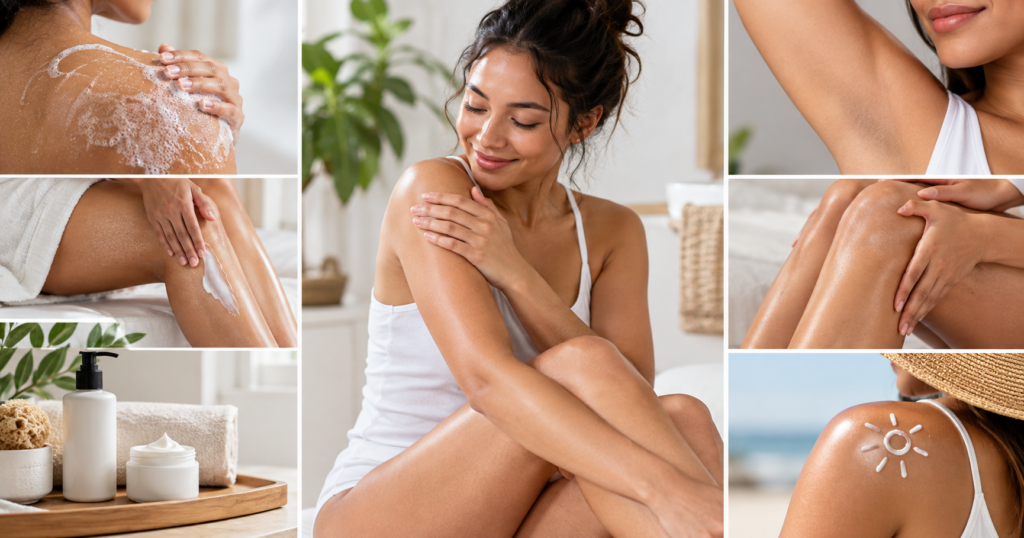
If you’re showering, cleanse gently rather than repeatedly scrubbing pigmented areas. Apply moisturiser where needed. On skin that will be exposed outside, finish with broad-spectrum SPF 30 or higher.
At night, cleanse if necessary and use one targeted active on the areas you’re treating. That might be an AHA body lotion several nights per week, a salicylic acid product for acne-prone areas, azelaic acid on smaller marks, or a carefully introduced retinoid.
Follow with moisturiser whenever your treatment leaves the skin dry.
That’s it.
You aren’t failing skin care because the routine fits on one bathroom shelf.
Dark Underarms Need a Little Detective Work
Underarm discolouration is extremely common, but treating every dark underarm with acid isn’t a great strategy.
Frequent shaving, deodorant irritation and friction can all contribute. If shaving leaves you covered in bumps, reconsider your technique before adding stronger pigment products.
Use a sharp razor, shave with adequate lubrication and avoid repeatedly running the blade over the same spot.
If a deodorant consistently makes your underarms burn or itch, that reaction matters. Repeated irritation can encourage darkening.
Also pay attention to the character of the skin itself.
If your underarm skin becomes noticeably thick, dark and velvety rather than simply a little darker after shaving, consider getting it assessed.
A condition called acanthosis nigricans can produce darker, thicker, velvety skin around the underarms, neck, groin and other folds. It can sometimes be associated with insulin resistance, prediabetes, diabetes, thyroid problems and other medical conditions.
Scrubbing won’t remove acanthosis nigricans. The underlying cause may need attention.
That distinction could save you months of buying the wrong products.
Inner-Thigh Pigmentation Often Has a Friction Component
Inner thighs rub. Bodies move. Sweat happens.
This isn’t a moral failing or evidence that you aren’t “clean enough.”
If friction contributes to irritation, reducing that repeated rubbing can help prevent new discolouration. Breathable clothing, anti-chafing products and changing out of sweaty clothes can be surprisingly useful additions to a pigment routine.
The same principle applies during workouts.
Tight, damp clothing can damage hair follicles through friction and contribute to folliculitis. Dermatology guidance recommends changing out of sweaty workout clothing and reducing rubbing when folliculitis is an issue.
For existing discolouration, a gentle lactic or glycolic acid body lotion may help if your skin tolerates it.
Do not apply strong acids to broken, freshly shaved or severely chafed skin.
Your skin will complain. Loudly.
What About Dark Knees and Elbows?
Knees and elbows naturally experience more friction, pressure and dryness, so they can look darker and feel rougher than neighbouring skin.
The first step is often moisture rather than aggressive brightening.
Look for body creams containing ingredients such as urea or lactic acid, which can soften thick, rough skin while supporting smoother texture. Once the surface feels less dry and hardened, tone may also look more even.
Avoid lemon juice, baking soda and vigorous scrubbing.
Yes, these home remedies keep circulating. No, your elbow doesn’t need a chemistry experiment from the kitchen.
Acidic citrus juice can irritate the skin, while abrasive DIY mixtures may create additional inflammation. When pigmentation is partly driven by repeated irritation, adding more irritation makes little sense.
Bikini-Line Marks: Treat the Bumps, Not Just Their Footprints
The bikini line is another area where people often chase pigmentation without addressing why the marks keep appearing.
If shaving or waxing produces ingrown hairs, pustules or razor bumps, each new episode can leave another pigmented spot behind.
The first target should be reducing follicular irritation.
The AAD notes that shaving, waxing and plucking can damage follicles and contribute to folliculitis. When hair removal is the trigger, temporarily stopping the activity can allow the area to recover.
If shaving is necessary, soften the hair first, use lubrication, avoid excessive pressure and don’t repeatedly shave over irritated bumps.
A gentle salicylic acid product may help some people prone to ingrown hairs, but don’t introduce it immediately after shaving if that leaves you stinging.
And please resist squeezing trapped hairs with your fingernails.
Picking adds another injury to an area that’s already inflamed.
Back and Chest Marks Need Acne Control
Those scattered brown spots across the upper back can hang around long after the pimple that caused them disappeared.
If new acne continues to form, however, fading products alone won’t get you very far.
Control the breakouts and the pigment routine suddenly has a chance to catch up.
Dermatologists warn that picking or squeezing acne increases the chance of dark spots and scarring. They also note that acne-related dark spots are often post-inflammatory hyperpigmentation rather than true scars.
Depending on your skin, a body cleanser containing salicylic acid or benzoyl peroxide may help active breakouts. Be careful with dryness and irritation, and introduce treatments gradually.
If your body acne is widespread, painful, scarring or stubborn, seeing a dermatologist sooner rather than later can save both your skin and your patience.
Mosquito Bites, Scratches and Random Little Marks
Sometimes uneven body tone has nothing to do with a complicated pigment disorder.
It’s the evidence trail of ordinary life.
A mosquito bite itched, you scratched it for three nights, and now there’s a brown mark on your ankle.
Your sandal rubbed the top of your foot.
You picked at a tiny bump on your arm.
A hot baking tray touched your wrist for half a second.
Post-inflammatory pigmentation can follow injuries such as bites, cuts and burns, especially in pigment-rich skin.
The prevention strategy is almost comically simple: reduce inflammation, protect healing skin and leave it alone.
Of course, “don’t scratch the mosquito bite” sounds wonderful until 2 a.m.
Still, the less trauma the area experiences, the smaller the chance that you’re creating a mark that hangs around for months.
Please Don’t Turn Your Shower Into an Exfoliation Olympics
There is a peculiar idea online that smooth, evenly toned body skin requires an exfoliating glove, scrub, acid cleanser, exfoliating toner and acid lotion—preferably all on Tuesday.
Your skin barrier would like to decline the invitation.
Choose one main exfoliating method and see how your skin responds.
If you’re using an AHA lotion, you may not need a gritty scrub. If you’re using a retinoid, adding glycolic acid on the same evening may be too irritating when you’re new to both.
The AAD notes that retinol and glycolic acid can irritate some people and recommends testing unfamiliar skin-care products before broad use. A practical patch-test approach is to apply the product to a small area consistently for several days and watch for redness, itching or swelling.
Slow isn’t exciting.
Slow also keeps you from spending Friday evening trying to calm down skin you exfoliated into rebellion on Thursday.
Moisturiser Matters More Than People Think
Moisturiser doesn’t usually get marketed as the dramatic hero of uneven-tone routines.
It should get more credit.
Dry, compromised skin is easier to irritate. Irritated skin is harder to treat. And when you’re using acids or retinoids, a moisturiser can make the difference between a routine you maintain for six months and one you abandon after six days.
Ingredients such as glycerin, ceramides, petrolatum, hyaluronic acid and urea can help support hydration in different types of formulas.
Texture matters too.
A lightweight lotion may be easier during humid weather, while a richer cream can feel better during colder months or on chronically dry legs.
Choose something you will actually use.
The theoretically perfect moisturiser sitting untouched because it feels like cooking oil isn’t helping anyone.
How Long Does Uneven Body Tone Take to Fade?
This is where expectations need a reality check.
Pigmentation is usually measured in months, not days.
The AAD notes that once the cause of a dark spot is controlled, a mark only a few shades darker than your natural tone may take roughly six to 12 months to fade naturally. Pigment located deeper in the skin may take considerably longer.
Treatment can help speed that process, but even a good treatment isn’t an eraser.
Take progress photos once a month rather than inspecting the area every morning under a bright bathroom light.
Daily checking can make slow improvement almost impossible to notice.
Monthly comparison tells a much clearer story.
When Stronger Isn’t Smarter
You’ll come across products promising dramatic whitening, bleaching or instant correction.
Be careful.
The AAD warns that some unregulated fading products have been found to contain undeclared corticosteroids or mercury. Long-term exposure to inappropriate topical steroids can cause thinning, acne-like eruptions and lasting discolouration. Liquid household bleach should never be applied to skin.
Be particularly cautious with products that lack a trustworthy ingredient list or make extreme promises such as changing your natural skin colour within days.
The goal is to treat unwanted discolouration while preserving healthy skin, not damage the skin until it looks lighter.
What If the Uneven Areas Are Lighter, Not Darker?
Pause the brightening routine.
Light patches can have many causes, including previous inflammation and conditions such as tinea versicolor, psoriasis and other pigment disorders.
If you’re unsure what you’re looking at, getting the cause identified is smarter than treating blindly.
This becomes even more important when pale patches are spreading, sharply defined, scaly, itchy or appearing without an obvious previous injury.
More exfoliation isn’t automatically the answer.
Sometimes you don’t need a stronger product. You need the right diagnosis.
When It’s Time to See a Dermatologist
Most mild post-inflammatory marks aren’t emergencies, but certain changes deserve professional attention.
See a healthcare professional when discolouration appears suddenly, spreads quickly, bleeds, becomes painful, repeatedly forms sores, accompanies significant itching or scaling, or looks noticeably different from your usual marks.
Dark, thick, velvety skin around the neck, underarms or other folds is also worth discussing with a clinician because acanthosis nigricans may be associated with underlying health issues. Sudden widespread acanthosis nigricans should be assessed promptly.
Likewise, don’t assume every new dark mark is hyperpigmentation from irritation. Changes in moles or unusual new pigmented lesions deserve assessment.
Skin care has limits, and knowing those limits is part of taking good care of your skin.
A Simpler Way to Think About Uneven Body Tone
If all the ingredient names start sounding like alphabet soup, remember four things.
Stop whatever is repeatedly irritating the area.
Keep the skin moisturised and comfortable.
Use one targeted treatment consistently rather than five treatments randomly.
Protect exposed areas from the sun.
That’s the framework.
Your exact routine can change depending on whether the problem is body acne, shaving marks, rough knees, inner-thigh friction or old insect bites. But the foundation stays surprisingly similar.
Treat the cause. Protect the barrier. Fade the leftover pigment patiently. Prevent the next round.
Not flashy, perhaps.
But skin rarely rewards chaos.
Final Thoughts
Uneven body tone is common, particularly in areas that deal with friction, inflammation, shaving, acne and sun exposure. And some variation in colour across the body is completely normal.
You don’t need perfectly uniform skin to have healthy skin.
If there are specific marks you want to fade, start by asking why they’re appearing. A brightening lotion can help an old spot, but it can’t outrun new irritation happening every day.
Build your routine around gentle cleansing, regular moisturising, sun protection on exposed skin and one carefully chosen active ingredient. Give it several weeks before judging it, and several months before expecting major pigment changes.
Then watch the triggers.
The razor that’s always leaving bumps. The leggings that rub one spot raw. The breakout you keep picking. The acid that burns every time you use it.
Sometimes caring for uneven skin tone means adding something.
Sometimes, rather satisfyingly, it means doing less.