
You wash your hands. You answer a few emails. Maybe you do the dishes, wipe down the kitchen counter, sanitise your hands on the way into class or work, wash them again after changing a diaper, and suddenly the skin around your knuckles feels tight enough to complain.
Then comes the roughness.
A tiny split beside your thumbnail. Flaky patches between your fingers. That irritating crack on a knuckle that seems perfectly positioned to reopen every time you bend your hand.
Dry, cracked hands can feel like a minor beauty problem until they start hurting.
The good news? Preventing them usually doesn’t require a complicated 10-step hand-care routine or an expensive collection of products. What matters most is protecting the skin barrier and giving it moisture often enough to recover from everything your hands go through during the day.
And your hands go through a lot.
Frequent washing, cleaning products, sanitiser, cold weather, dry-season air, indoor heating, air conditioning, childcare, laboratory work, food preparation, gardening, and even long hours handling paper can leave them feeling rough and depleted.
Here’s how to prevent dry, cracked hands without reorganising your whole life around hand cream.
First, Why Do Hands Get So Dry?
Your skin has a protective outer layer called the skin barrier. Think of it as a brick wall.
The skin cells are the bricks. Natural fats, including ceramides, help form the mortar between them.
When that wall is healthy, it helps keep water inside your skin while blocking irritants outside.
Repeated exposure to water, harsh soap, detergents, solvents, dry air, and other irritants can weaken that protective layer. Water then escapes more easily, and the skin becomes tight, rough, flaky, itchy, or cracked.
Ironically, water itself can become part of the problem.
Dermatologists use the term “wet work” for jobs or activities that keep the hands wet or require frequent handwashing. Nurses, cleaners, hairstylists, caterers, parents of young children, healthcare workers, and people who wash dishes repeatedly are especially familiar with this problem. Repeated water and chemical exposure is also associated with hand dermatitis.
So yes, you need to wash your hands.
The trick is making those necessary washes less punishing.
1. Turn Down the Water Temperature
A steaming-hot shower may feel wonderful after a long day.
Your hands aren’t nearly as impressed.
Hot water can strip natural oils from the skin and worsen dryness. Dermatology guidance generally recommends warm or lukewarm water rather than hot water when you’re dealing with dry skin.
You don’t need icy water either.
Aim for comfortably lukewarm.
This applies when washing your hands, showering, bathing children, rinsing dishes, or doing other jobs that leave your hands under running water for several minutes.
If you’re someone who automatically turns the tap toward “almost boiling,” this one small change can make a noticeable difference.
2. Take a Closer Look at Your Hand Soap
That beautifully scented hand wash sitting beside your sink may smell like vanilla cookies, tropical fruit, or an expensive hotel lobby.
It may also be making your hands miserable.
Strong cleansers can remove more of the oils that help protect your skin.
If your hands frequently feel tight immediately after washing, consider switching to a mild, fragrance-free cleanser or moisturising hand wash.
The fragrance-free part matters.
“Unscented” and “fragrance-free” aren’t always the same thing. An unscented product may still contain ingredients designed to disguise another smell, while fragrance-free products are generally the better choice for sensitive, irritated skin. The American Academy of Dermatology specifically recommends gentle fragrance-free products for dry skin.
That doesn’t mean everyone must throw away ordinary soap.
If your skin handles your current cleanser beautifully, there’s no need to create a problem that doesn’t exist.
But if every handwash ends with tight, squeaky-feeling skin, your soap deserves a little suspicion.
3. Don’t Stop Washing Your Hands Just Because They’re Dry
This deserves its own point because dry hands sometimes make people reluctant to wash them.
Don’t solve one problem by creating another.
Proper hand hygiene still matters.
Instead, change what happens after you wash.
The American Academy of Dermatology recommends washing as needed and then applying hand cream or ointment to slightly damp skin.
Think of handwashing and moisturising as a pair.
Wash.
Dry.
Moisturise.
Repeat.
It’s less glamorous than whatever viral skin hack is making the rounds this week, but it works with the biology of your skin rather than against it.
4. Moisturise While Your Hands Are Still Slightly Damp
Timing makes a surprisingly big difference.
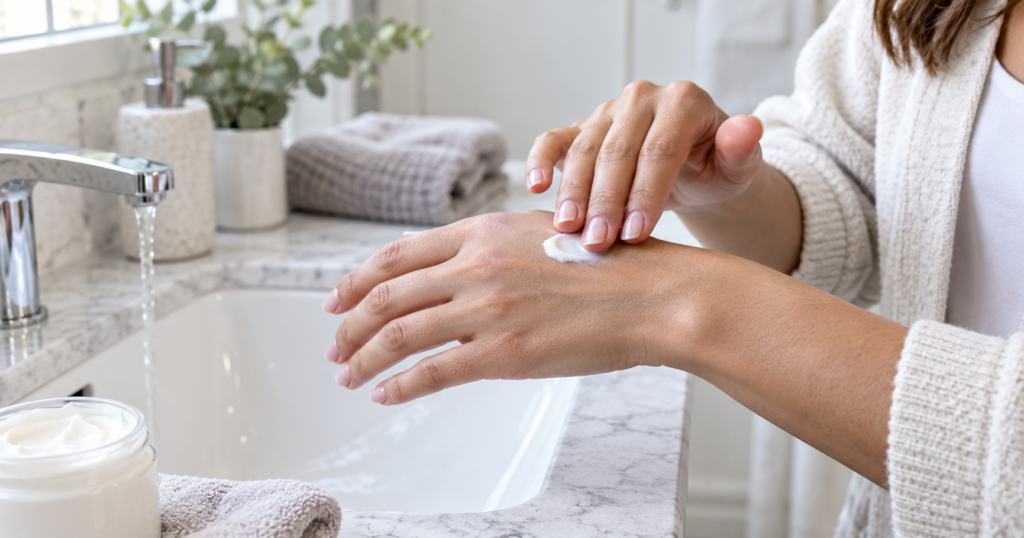
After washing, gently dry your hands but apply moisturiser before every trace of water disappears from the skin.
Why?
Moisturisers help trap some of that water and reduce moisture loss.
Both the American Academy of Dermatology and Mayo Clinic recommend moisturising after washing while skin is still damp.
You don’t need to race against the clock like you’re defusing a bomb.
Just don’t wait 20 minutes until your hands are already dry and uncomfortable.
Keep your hand cream beside the sink if possible. That removes the “I’ll do it later” problem.
Because later, as we both know, has a habit of becoming never.
5. If Your Hands Are Very Dry, Lotion May Not Be Enough
All moisturisers aren’t built the same way.
Lotions contain more water and tend to feel lighter. That’s lovely when your skin is mildly dry, and you need something that disappears quickly.
Creams are thicker.
Ointments contain more oil and create a stronger barrier against water loss.
For very dry hands, creams and ointments usually make more sense than thin lotions. NHS guidance notes that ointments contain the most oil and are especially effective at keeping moisture in the skin, while creams offer a useful middle ground.
Here’s an easy way to use that information without turning your bathroom into a pharmacy shelf:
Daytime: use a cream that absorbs reasonably well.
Nighttime: switch to a richer cream or ointment.
Simple.
If greasy hands make typing, writing notes, handling documents, or using your phone annoying, save the heavier product for bedtime.
6. Look for Ingredients That Actually Help the Skin Barrier
You don’t need to memorise an ingredient dictionary before buying hand cream.
A few names are worth recognising, though.
Useful moisturising ingredients may include:
- Glycerin, which attracts water into the outer layers of the skin
- Ceramides, which help support the skin barrier
- Petrolatum, which forms a protective layer and reduces water loss
- Mineral oil, another effective occlusive ingredient
- Hyaluronic acid, which helps attract moisture
- Shea butter, commonly used as a rich emollient
- Urea, which can help hydrate and soften very dry, rough skin
Mayo Clinic lists ingredients such as ceramides, glycerin, fatty acids, shea butter, urea, and petrolatum-based products among useful options for dry skin.
There’s no single magical ingredient.
A product only works if you’ll actually use it.
The world’s fanciest hand cream won’t help much if you hate how it feels and leave it untouched in a drawer.
7. Put Hand Cream Where Dryness Actually Happens
This is less dermatology and more human behaviour.
If your moisturiser lives upstairs in a bathroom cabinet, but you wash your hands 12 times downstairs, you’re probably not going to moisturise after every wash.
Make the habit stupidly easy.
Keep a small tube:
- beside the bathroom sink
- beside the kitchen sink
- in your work bag
- in your handbag
- near your laptop
- on your bedside table
- in your school or university bag
For mothers, keeping a tube near the changing station or wherever you wash bottles can be surprisingly useful.
For students, put one beside your notebooks or laptop.
For office workers, your desk drawer is prime real estate.
The goal isn’t to moisturise your hands according to some perfect timetable.
It’s to make moisturising available at the moments your hands need it.
8. Hand Sanitiser Isn’t the Enemy. But Follow It With Moisturiser
Hand sanitiser can leave already-dry hands feeling tight or stingy, especially when the skin barrier is damaged.
Still, there are situations where sanitiser is the practical choice.
Use it when appropriate. Then wait until it has dried and apply a moisturising cream or ointment.
The American Academy of Dermatology specifically recommends moisturising after hand sanitiser dries when dryness is an issue.
If your workplace, university, clinic, or child’s school has sanitiser stations everywhere, carrying a small tube of hand cream can make a big difference over the course of a week.
No elaborate ritual required.
Sanitise. Let it dry. Moisturise.
9. Wear Gloves for Dishes, Cleaning and Other Wet Jobs
If there’s one hand-care habit worth borrowing from your grandmother, it’s this one.
Wear the gloves.
Washing dishes, scrubbing bathrooms, handwashing clothes, bleaching surfaces, cleaning kitchen counters, gardening, and handling detergents can expose your skin to both water and irritating chemicals.
Protective gloves create a physical barrier between your skin and that mess.
DermNet and NHS guidance both recommend task-appropriate gloves for people dealing with hand dermatitis or repeated irritant exposure.
But there’s one catch.
Sweaty hands trapped inside waterproof gloves for a long time can also aggravate irritated skin.
If you’re doing a longer job, cotton-lined gloves or thin cotton gloves beneath waterproof gloves can be more comfortable. Remove waterproof gloves when the wet task is over rather than wearing them for hours unnecessarily.
This is especially useful for young parents.
Bottle washing doesn’t look like hard labour, but when you’re doing it several times a day, every day, your hands may disagree.
10. Don’t Forget About Rings
Here’s a strangely specific problem that makes perfect sense once you notice it.
Soap and water can sit beneath rings.
So can detergent.
And if the area stays damp, irritated skin may become worse.
If your skin around a ring is dry, red, itchy, or cracked, remove the ring before washing whenever practical. Rinse the area well and dry carefully, including between your fingers. Dermatology hand-care guidance recommends removing rings where possible before washing because soap and moisture can become trapped underneath them.
And yes, drying between the fingers matters.
A quick wipe across your palms followed by grabbing your phone may leave moisture behind in all those little spaces.
Take the extra few seconds.
11. Give Your Hands a Night Shift
Daytime hand care has one obvious problem.
Life keeps getting in the way.
You wash something.
Touch something.
Type.
Cook.
Clean.
Drive.
Wash again.
Bedtime gives your moisturiser several uninterrupted hours to sit on your skin.
Take advantage of it.
Before bed, apply a generous layer of thick fragrance-free hand cream or an ointment such as plain petrolatum to particularly dry areas.
If your hands are extremely rough, you can apply the ointment and wear soft cotton gloves overnight.
Mayo Clinic recommends heavier oil-based creams or petroleum jelly at night for cracked fingertips and notes that cotton gloves can be used over the product.
It isn’t glamorous.
Neither are painful knuckles.
Pick your battle.
One practical note: oily emollients can make fabrics more flammable when residue builds up, so keep treated clothing, gloves, and bedding away from cigarettes, candles, gas flames, and other open flames.
12. Prepare for Cold Weather, and Dry Weather Too
“Winter hands” are famous for a reason.
Cold outdoor air holds less moisture, while indoor heating can make rooms dry. That combination can leave hands rough, itchy, and chapped.
But winter isn’t the only culprit.
Hot, dry climates, dusty dry seasons, strong winds, and hours spent beneath air conditioning can also pull moisture from the skin.
If your hands always deteriorate during a certain season, don’t wait for the cracks to appear before changing your routine.
Start using richer moisturiser early.
When it’s cold, wear gloves outdoors.
If indoor air feels exceptionally dry, a humidifier may help add moisture to the environment. Mayo Clinic and the American Academy of Dermatology both include humidifiers among strategies for dry skin.
Prevention is easier than trying to heal ten tiny cuts on your fingers later.
13. Your Cuticles Need Moisture Too
Hand care shouldn’t stop at the knuckles.
Dry cuticles can split, peel, and form painful little hangnails that tempt you to pull them.
Don’t.
We’ve all done it.
It rarely ends well.
When applying hand cream, massage a little around your nails and cuticles too. Petrolatum or another rich ointment can be especially useful at bedtime.
The American Academy of Dermatology recommends applying moisturiser to the hands, nails, and cuticles after washing when dryness is a problem.
And resist aggressive cuticle cutting.
Your cuticle helps protect the area where the nail grows.
Sometimes boring maintenance wins.
14. Watch for the Sneaky Irritants You Touch Every Day
Some hand dryness is obvious.
Bleach? Fair enough.
Dishwashing liquid? Makes sense.
But irritation can also build from smaller exposures.
Think about your day.
Maybe you’re:
handling cleaning sprays without gloves,
washing paintbrushes,
working with hair products,
using solvents in a lab,
mixing cement,
gardening in soil,
doing pottery with clay,
or cleaning kitchen surfaces ten times because you have a toddler who considers lunch an installation-art project.
Certain jobs and hobbies expose the hands to irritants more often. Mayo Clinic specifically lists occupations and activities involving frequent washing or contact with substances such as cement, clay, and soil among situations associated with dry skin.
You don’t have to stop living.
Identify the exposure, then protect your skin around it.
That’s much more realistic.
15. If Your Hands Are Already Cracked, Switch From Prevention to Repair
Once a crack appears, especially around a fingertip or knuckle, everyday movement can keep reopening it.
That’s why these tiny cracks sometimes take forever to disappear.
For mild cracking, apply a thick moisturising ointment regularly and protect the area from detergents and unnecessary water exposure.
Mayo Clinic also suggests liquid bandage for cracked thumb tips and heavier moisturiser or petroleum jelly at night.
Avoid picking at peeling skin.
Yes, it’s sitting there begging to be pulled.
Leave it alone.
If the skin is bleeding, gently clean and protect it as you would another small wound.
And once the crack improves, don’t immediately abandon your hand-care routine. Keep moisturising. The goal is to help the barrier stay healthy rather than repeating the dry-crack-heal-dry cycle every two weeks.
Wait, Could It Be More Than Dry Skin?
Sometimes what looks like extremely dry hands isn’t ordinary dryness.
It may be hand eczema, also called hand dermatitis.
Possible signs include persistent dryness, red or darker irritated patches, scaling, burning, itching, blisters, deep painful cracks, bleeding, weeping, crusting, or pus.
Hand eczema can be triggered by irritants, frequent wet work, allergies, or a history of atopic eczema. Some people react to substances they handle at work; others may even react to certain glove materials.
This matters because moisturiser alone may not solve it.
Contact dermatitis, psoriasis, fungal infections, and other conditions can sometimes resemble dry skin too.
Consider seeing a healthcare professional or dermatologist if:
your hands remain severely dry despite consistent moisturising,
the skin becomes very painful,
cracks repeatedly bleed,
you develop blisters,
the rash keeps returning,
you have spreading redness,
there is pus, crusting, swelling, or increasing tenderness,
or your skin is interfering with work, sleep, childcare, or normal daily activities.
Very dry cracked skin can sometimes allow bacteria to enter, which raises the risk of infection.
Persistent symptoms deserve a proper diagnosis rather than another random cream from social media.
A Realistic Hand-Care Routine for Busy People
You don’t need a dedicated “hand-care Sunday.”
Try this instead.
In the morning
Wash with lukewarm water and a gentle cleanser.
Pat your hands mostly dry.
Apply a fragrance-free hand cream.
If the backs of your hands will be exposed outdoors for long periods, use broad-spectrum SPF 30 or higher there as well. Dermatologists recommend protecting exposed skin from ultraviolet radiation, including with sunscreen.
Then go live your life.
Throughout the day
Reapply hand cream after washing when possible.
Apply moisturiser after sanitiser dries.
Wear gloves for prolonged cleaning, dishwashing, laundry, gardening, or chemical exposure.
If your hands begin feeling tight, don’t wait until they’re visibly flaky. Moisturise.
In the evening
Notice how your hands actually feel.
Fine? Use your normal cream.
Rough?
Use something richer.
Cracking around the fingertips?
Apply a heavier ointment over those areas before bed.
That whole routine can take less time than scrolling through three Instagram Reels.
What About Drinking More Water?
Staying hydrated is good for your general health.
But drinking several extra glasses of water isn’t a substitute for protecting a damaged skin barrier.
If your hands become dry every time you wash dishes without gloves, a giant water bottle isn’t going to cancel out the detergent.
Work on the exposure.
Work on the barrier.
Moisturise consistently.
Sometimes the less exciting answer is the useful one.
Common Mistakes That Keep Hands Dry
You may already own a perfectly good moisturiser and still struggle with cracked hands because the routine around it is working against you.
A few common mistakes include washing with very hot water, using strongly fragranced soap, waiting until hands are painfully dry before moisturising, relying only on thin lotion for severely dry skin, cleaning without gloves, peeling flaky skin, and forgetting to protect your hands during cold or dry weather.
Another big one?
Expecting one application of cream every morning to survive ten handwashes.
It probably won’t.
Moisturiser needs to be reapplied because handwashing, friction, work, and daily activities remove it.
That’s normal.
So, What’s the Best Way to Prevent Dry, Cracked Hands?
Don’t overcomplicate it.
Use lukewarm water.
Choose gentler cleansers.
Moisturise after washing.
Use creams or ointments when your hands are very dry.
Wear gloves when you’re doing wet or irritating jobs.
Give badly dry areas a heavier layer of moisture overnight.
And pay attention when dryness becomes persistent, painful, inflamed, or unusually severe.
Those habits aren’t flashy.
That’s precisely why they tend to be overlooked.
Your hands don’t really care whether your moisturiser comes in minimalist luxury packaging or a giant pharmacy tub. They care about a healthy barrier, less irritation, and enough moisture to do their job.
Give them that consistently, and those painful little cracks become much easier to prevent.
Frequently Asked Questions
Why are my hands so dry even though I use hand cream?
Your moisturiser may be too light, you may not be applying it often enough, or something in your routine may keep stripping moisture away.
Frequent washing, hot water, detergents, sanitiser, cleaning chemicals, cold weather, and dry indoor air can all contribute.
Try applying a thicker cream after every handwashing period you can reasonably manage and using an ointment at night.
Is Vaseline good for dry, cracked hands?
Plain petroleum jelly can be useful for very dry skin because it forms an occlusive layer that reduces moisture loss. Mayo Clinic specifically recommends petroleum jelly as one option for cracked fingertips and very dry skin.
It can feel greasy, so many people prefer using it before bed.
Should I use lotion or cream for dry hands?
For mild dryness, lotion may be enough.
For persistent dryness, a cream usually provides more staying power.
For very dry or cracked hands, an ointment can provide stronger protection against moisture loss. NHS guidance notes that ointments contain more oil and are generally more effective at retaining moisture than lotions.
How often should I moisturise my hands?
Apply moisturiser after handwashing and whenever your hands begin to feel dry.
People exposed to frequent wet work may need much more frequent application. DermNet notes that people with hand dermatitis may sometimes need to reapply thick emollients many times throughout the day.
You don’t need to count applications obsessively. Let your routine and your skin guide you.
Why do my fingers crack around my nails?
The fingertips and skin around the nails face plenty of friction, washing, detergent exposure, and movement. When that skin becomes very dry, small fissures can form and repeatedly reopen.
Apply hand cream around the fingertips, nails, and cuticles, not just the backs of your hands.
Can hand sanitiser cause dry hands?
Frequent use can contribute to dryness, particularly when your skin barrier is already irritated.
That doesn’t mean you should skip necessary hand hygiene. Let the sanitiser dry, then apply hand cream or ointment.
Can dry, cracked hands become infected?
Severe cracking can break the protective skin barrier and give bacteria an entry point. Deep cracks that become increasingly painful, red, swollen, warm, crusted, or filled with pus should be assessed by a healthcare professional.
Why do my hands get worse in cold weather?
Cold outdoor temperatures and dry indoor heating can reduce moisture in the skin and worsen chapping. Wearing gloves outdoors, using richer moisturiser, and adding humidity indoors may help.
What’s the simplest routine if I’m too busy for hand care?
Keep a fragrance-free cream beside the sink.
Use it after washing.
Wear gloves for dishes and cleaning.
Apply a thicker moisturiser or petrolatum before bed.
That’s it.
Four habits. No beauty cabinet overhaul required.