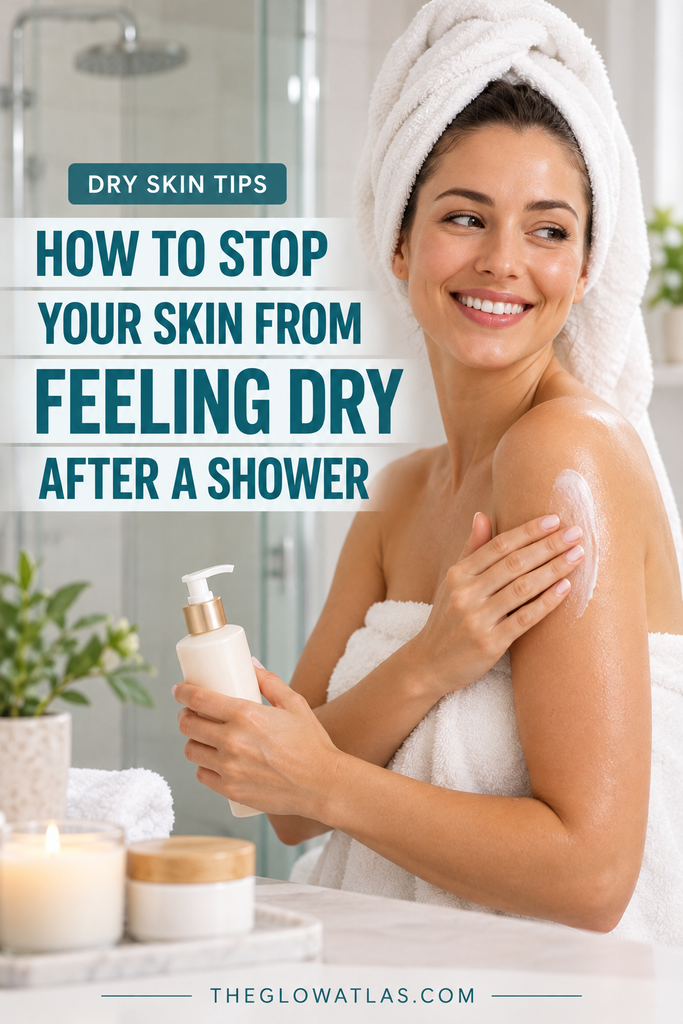

There’s something deeply unfair about stepping out of a shower feeling clean and refreshed, only to notice that your skin feels tight five minutes later.
Maybe your shins look a little chalky. Your arms feel rough. Your shoulders start itching under your shirt. Or you put on lotion, get dressed, and somehow your legs still look dry by lunchtime.
If this keeps happening, your shower itself may be part of the problem.
That doesn’t mean water is “bad” for your skin. Far from it. The problem is usually what happens during the shower — hot water, long soaking, strong cleansers, too much scrubbing, and what doesn’t happen quickly enough afterwards.
The good news? Preventing dry skin after a shower usually doesn’t require a complicated 12-step body-care routine or a bathroom cabinet filled with expensive products.
A few small changes can make a surprisingly big difference.
Let’s start with the part that seems almost backwards.
Why Does Your Skin Feel Dry After Being Covered in Water?
You’d think getting wet would automatically make skin more hydrated.
For a short time, it does.
But your outer skin layer, the stratum corneum, works a little like a brick wall. Skin cells are the bricks, while lipids such as ceramides, cholesterol, and fatty acids help form the material between them. Together, they create a barrier that helps keep moisture inside your skin while keeping irritants out.
Then along comes a long, steaming shower.
Hot water, repeated washing, strong soap, and aggressive scrubbing can remove some of the oils that support that barrier. Once you step out of the shower, water sitting on your skin begins evaporating. If the barrier is already struggling, your skin may lose moisture faster than you expect.
Dermatologists therefore recommend warm rather than hot water and generally suggest keeping showers around five to ten minutes when dry skin is an issue.
There’s a technical name for water escaping through the skin barrier: transepidermal water loss, often shortened to TEWL.
Fancy term. Very ordinary experience.
It’s that tight, slightly papery feeling you notice after washing your face with the wrong cleanser. It’s the itchy shin situation after a long winter shower. It’s also why simply standing under water for another ten minutes won’t necessarily solve your dryness.
The goal isn’t to avoid water.
The goal is to help your skin hold on to it.
First Things First: Turn the Temperature Down
A piping-hot shower can feel glorious after a long commute, a gym session, a cold morning, or a day spent chasing children around the house.
Your skin may have a different opinion.
Very hot water can strip away more of the natural oils that help protect your skin. Mayo Clinic and the American Academy of Dermatology both recommend warm water instead of hot water for people dealing with dryness.
You don’t need to shower in icy water.
Think comfortably warm rather than steaming hot.
A useful test? If you leave the shower looking noticeably red or the bathroom mirror resembles a sauna window, try turning the temperature down.
This matters even more if you already have sensitive skin, eczema-prone skin, or skin that becomes itchy after bathing.
And yes, cold mornings make this advice slightly annoying.
Still worth it.
Your 30-Minute Shower May Be Working Against You
Sometimes a shower is less about washing and more about temporarily disappearing from everyone who needs something from you.
Understandable.
But if dry skin is becoming a regular problem, marathon showers aren’t helping.
Dermatologists commonly recommend limiting baths and showers to roughly five to ten minutes when excessive dryness is an issue.
Why?
Because prolonged exposure to hot or warm water, especially when combined with cleanser, can disturb the skin’s protective oils.
You don’t have to set a military-style timer every morning. Just become aware of how long you’re standing there.
Wash your hair. Clean your body. Shave if needed. Rinse.
Done.
Save the 40-minute existential thinking session for somewhere your skin isn’t being continuously washed.
Your Body Wash Matters More Than the Pretty Bottle
Body wash shopping has become an event.
Tropical fruit. Vanilla frosting. Sugared coconut. Amber woods. Something called “midnight cashmere.”
Fun? Absolutely.
Ideal for every dry or sensitive skin type? Not necessarily.
Fragrance and certain cleansing ingredients can irritate already-dry skin. Dermatologists commonly recommend mild, fragrance-free cleansers when dryness is a problem.
Notice that phrase: fragrance-free.
It isn’t necessarily the same thing as “unscented.” An unscented product may still contain ingredients designed to cover other smells, while fragrance-free products are generally the safer direction for easily irritated skin.
Look for body washes described as gentle, moisturising, creamy, non-soap, fragrance-free, or suitable for sensitive skin.
Brands such as CeraVe, Cetaphil, Vanicream, Eucerin, Aveeno, Bioderma, and La Roche-Posay make products in this general category, though the best formula depends on your skin and what is available where you live.
You also don’t need a mountain of foam.
More lather doesn’t automatically mean cleaner skin.
Do You Really Need Cleanser Everywhere?
Here’s one habit worth reconsidering: coating your entire body in cleanser every time you shower.
For most everyday showers, that level of degreasing isn’t always necessary.
The American Academy of Dermatology suggests using cleanser where it is needed, such as areas prone to sweat and odour. Mayo Clinic gives similar guidance, suggesting soap primarily on areas such as the armpits and groin when dry skin is a concern.
Your feet may also need more focused cleansing, particularly after exercise or wearing closed shoes all day.
But your forearms?
Your shins?
Your stomach?
Unless they’re visibly dirty, sweaty, covered in sunscreen, or need cleansing for another reason, they may not require aggressive soaping every single time.
Think targeted cleaning rather than pressure-washing the entire building.
Your skin barrier will appreciate the restraint.
Be Careful With Scrubs, Loofahs and “Squeaky Clean” Skin
That squeaky-clean feeling has excellent marketing.
It isn’t necessarily an excellent skincare goal.
If your skin literally squeaks or feels stretched after washing, you’ve probably removed more surface oil than your skin is comfortable losing.
Physical exfoliation can make this worse.
Rough body scrubs, stiff brushes, abrasive gloves, pumice tools, and vigorous loofah sessions can irritate dry skin. Mayo Clinic specifically advises against loofahs and pumice stones when trying to manage dry skin.
This doesn’t mean exfoliation is forbidden forever.
It means read the room or, technically, read your skin.
If your legs are flaky, itchy, stinging, or cracked, scrubbing harder isn’t the answer. Give the barrier some recovery time.
When your skin feels healthy again, gentle exfoliation can have a place in a body-care routine. Just don’t confuse exfoliating more often with getting better results.
Skin isn’t a kitchen floor.
More scrubbing isn’t automatically better cleaning.
Shave Toward the End of Your Shower
If shaving leaves your legs dry, itchy, or uncomfortable, timing matters.
Shaving near the end of your shower gives water time to soften the hair and skin first. The American Academy of Dermatology specifically recommends shaving toward the end of bathing for this reason.
Use shaving cream, gel, or another suitable lubricating product rather than dragging a razor across bare skin.
Use a sharp, clean blade.
And try not to repeatedly scrape the same patch because one tiny hair has apparently declared war on you.
After shaving, your skin may be more vulnerable to irritation, so this is definitely not the moment for aggressive scrubs or a heavily fragranced body product.
Gentle wins.
The Way You Dry Your Skin Matters Too
You finish showering, grab your towel and vigorously rub yourself dry.
Normal habit.
Not ideal for already-dry skin.
Instead, pat or blot your skin gently.
You don’t even need to remove every trace of water.
Dermatologists recommend leaving the skin slightly damp before moisturising because this gives your moisturiser water to help trap it against the skin.
That doesn’t mean standing around dripping all over the bathroom floor.
Pat off the excess.
Leave a little moisture.
Then move quickly to the most important part of the routine.
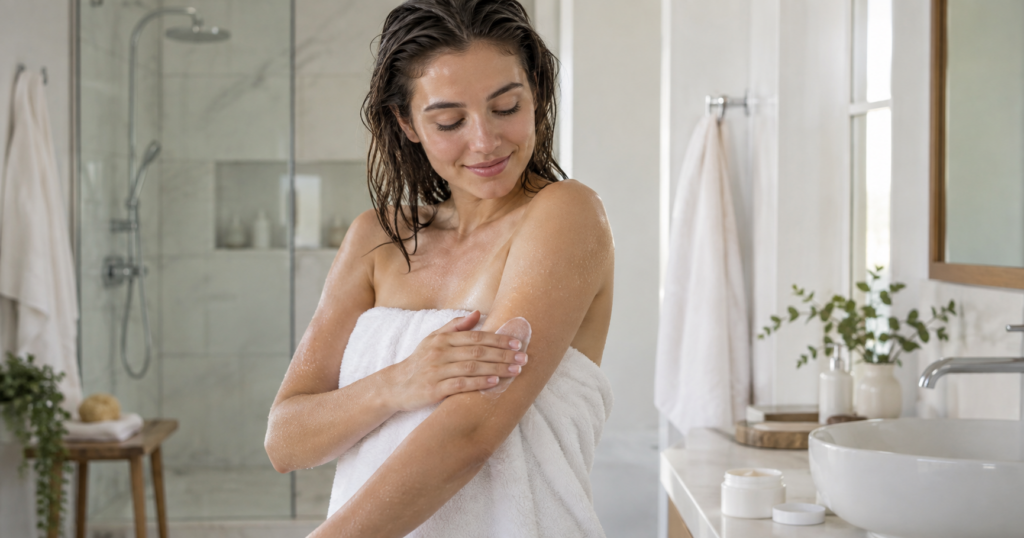
Moisturise While Your Skin Is Still Damp
If you remember only one thing from this article, make it this:
Don’t wait until your skin feels dry to apply moisturiser.
Apply it shortly after showering, while your skin is still slightly damp.
The American Academy of Dermatology recommends moisturising immediately after bathing, while Cleveland Clinic advises applying an emollient within about three minutes.
Why does timing matter?
A moisturiser doesn’t simply “give” skin moisture. Depending on its formula, it can attract water, soften rough skin, reinforce the barrier, and reduce the amount of water that escapes.
Putting it onto slightly damp skin gives the product something useful to hold onto.
Imagine closing the lid on a container while the moisture is still inside rather than waiting until half of it has evaporated.
That’s the basic idea.
Lotion, Cream or Ointment: Which One Should You Use?
Walk into a skincare aisle and suddenly moisturising your legs feels like choosing a mortgage.
Body lotion.
Body butter.
Gel cream.
Barrier balm.
Oil.
Ointment.
Serum.
Milk.
What happened to plain moisturiser?
Here’s the simple version.
Lotions tend to feel lighter and spread quickly. They’re useful when your skin is only mildly dry or when you dislike heavy textures.
Creams are richer. They’re often a better everyday choice for skin that regularly feels dry after showering.
Ointments are the heaviest and most occlusive. They can be extremely useful for stubborn dry patches, cracked heels, elbows, hands, or skin that needs stronger protection.
The American Academy of Dermatology recommends creams or ointments rather than lotions for excessively dry skin because they tend to retain moisture more effectively.
You don’t have to use the same texture everywhere.
Maybe you prefer lotion on your arms, cream on your legs, and petroleum jelly on your heels.
Perfectly reasonable.
Body care doesn’t require uniformity.
Ingredients Worth Looking for in a Dry-Skin Moisturiser
Ingredient labels can look like chemistry homework, but a few names are especially useful to recognise.
Glycerin is a humectant. It helps attract water into the outer layers of the skin.
Hyaluronic acid is another humectant frequently used in hydrating products.
Ceramides are lipids naturally found in the skin barrier. Moisturisers containing ceramides are commonly used in barrier-supportive skincare.
Shea butter acts as an emollient and can make rough skin feel softer.
Dimethicone helps reduce moisture loss while providing a smooth feel.
Petrolatum is a strong occlusive ingredient that helps reduce water loss and works especially well on very dry spots.
Urea can hydrate and soften rough, thick, scaly skin, though higher-strength products may sting irritated or cracked areas.
Mayo Clinic identifies ingredients including ceramides, glycerin, fatty acids, shea butter and urea among useful moisturiser components for dry skin. The AAD also lists ingredients such as glycerin, hyaluronic acid, dimethicone, petrolatum and shea butter.
Don’t feel compelled to find one product containing every ingredient.
That would be ingredient bingo.
A well-formulated cream you actually enjoy using consistently will usually serve you better than the theoretically “perfect” jar gathering dust because it feels awful on your skin.
What About Body Oil?
Body oil can be lovely.
But there’s a catch.
Oil is particularly good at helping seal moisture into the skin. It doesn’t always provide enough water-based hydration on its own for someone whose skin is already very dry.
So if oil alone leaves you shiny yet somehow still tight, yes, that frustrating combination exists; try applying a moisturiser first and then a small amount of oil over especially dry areas.
Another approach is applying an oil to damp skin.
Mayo Clinic notes that oils can help keep water within the skin’s surface, while petrolatum-based products provide another more occlusive choice.
This is also where personal preference matters.
Some people love body oils.
Others hate feeling like they’re marinating.
Both camps are valid.
The Three-Minute Routine for People Who Are Always Rushing
Maybe you’re reading all this thinking, “Sounds great, but I have class at eight.”
Or a train to catch.
Or two children asking for breakfast while you’re still wearing a towel.
Your routine does not need to be elaborate.
Finish your shower. Pat away excess water. Apply a fragrance-free cream or lotion over the areas that become dry most easily.
That’s it.
If your legs are the problem, prioritise your legs.
If your arms are fine but your hands and elbows crack, focus there.
On extremely busy mornings, strategic consistency beats perfection.
A pump bottle can also help. Leave it somewhere impossible to miss, beside your towel, next to your deodorant, wherever your post-shower routine naturally happens.
Tiny environmental cues work better than relying on memory at 6:30 a.m.
Skincare meets workflow management. Strange combination, surprisingly effective.
What If Moisturiser Feels Sticky Under Clothes?
This is a common reason people skip body moisturiser altogether.
Nobody wants to put on trousers and spend the next hour feeling laminated.
Try adjusting the texture rather than abandoning moisturiser.
A lighter lotion may work better during warm, humid months or before work. Save the thick cream or ointment for nighttime.
You can also use richer formulas only on areas that actually need them.
Another trick is simply applying less product and spreading it over damp skin. Cream often moves more easily over slightly damp skin, so you may not need as much as you think.
Give it a minute or two before dressing whenever possible.
If mornings are chaos, do your richer moisturising routine after an evening shower instead.
There are no prizes for suffering through a skincare texture you dislike.
Don’t Forget Your Hands, Feet and Elbows
Some parts of the body are naturally more prone to roughness.
Hands deal with repeated washing, sanitisers, dishwashing, cleaning products, weather, keyboards, gardening, baby bottles, pretty much everything.
Feet carry body weight all day and experience constant friction.
Elbows and knees regularly rub against clothing and surfaces.
So while your whole body may benefit from post-shower moisturiser, these areas sometimes need something richer.
A thick cream or petrolatum-based ointment before bed can work well for dry heels, hands, elbows, and knees.
For hands in particular, moisturise after washing whenever you can. The AAD recommends keeping a hand cream nearby and reapplying after handwashing when dryness is persistent.
A tube in your handbag or desk drawer can save you from repeatedly thinking, “I’ll do it later.”
Later is where half of skincare routines go to die.
Dry Air May Be Undoing Some of Your Work
Sometimes the shower isn’t the whole story.
Your environment matters too.
Cold outdoor air, heated indoor rooms, strong air-conditioning and low humidity can increase the feeling of dryness. A humidifier can help add moisture to dry indoor air, and both Mayo Clinic and the AAD include humidifiers among their dry-skin recommendations.
This becomes especially relevant when seasons change.
As cooler weather arrives in many regions, people often turn the shower temperature up at the same time indoor air becomes drier. That’s a rough combination for skin.
Meanwhile, in hot climates, constant air-conditioning can create its own dry indoor environment.
Your skincare routine may therefore need to shift through the year.
The lightweight lotion that feels perfect in a humid summer may suddenly seem useless when the weather cools.
Switching to a richer cream isn’t your skin “getting worse.”
Sometimes the conditions simply changed.
Does Drinking More Water Fix Dry Skin?
Hydration matters for your health.
But dry skin isn’t always a sign that you simply forgot to drink enough water.
You can carry a giant emotional-support water bottle all day and still have dry legs if your skin barrier keeps losing moisture because of long hot showers, harsh cleansers, cold weather, or inadequate moisturiser.
Think of internal hydration and skin-barrier care as related but separate issues.
Drink enough fluid for your body’s needs.
Then take care of your skin from the outside too.
No amount of motivational water-bottle stickers can replace moisturiser on a compromised skin barrier.
Post-Shower Mistakes That Quietly Keep Skin Dry
Most dry-skin routines don’t fail because someone forgot to buy a trendy ingredient.
They fail because a few ordinary habits keep cancelling out the moisturiser.
You might take a 25-minute hot shower, scrub your legs aggressively, dry yourself until your skin is bone-dry, wait half an hour, and then apply a thin scented lotion.
The lotion isn’t getting much help there.
Another common mistake is constantly changing products.
One week it’s a viral body butter. Next week it’s an exfoliating acid lotion. Then a scented oil. Then a retinol body serum.
Your skin can become irritated long before you figure out which product caused it.
When dryness is active, boring can be useful.
Gentle cleanser.
Warm water.
Shorter shower.
Fragrance-free moisturizer.
Repeat.
Once your skin feels comfortable again, you can introduce extras gradually.
What If You Have Body Acne Too?
Dry skin and body acne can exist at the same time, which makes product selection slightly trickier.
You may need moisture but dislike rich products on acne-prone areas such as the chest or back.
In those spots, try a lighter noncomedogenic moisturiser and reserve thicker products for drier areas such as your arms and legs.
Mayo Clinic suggests looking for products described as noncomedogenic or oil-free when acne is a concern.
Again, one moisturiser does not have to manage every square inch of your body.
Treat your back like your back.
Treat your shins like your shins.
Skin can behave very differently from one area to another.
What About Eczema-Prone Skin?
If you have eczema, the conversation becomes more important because barrier impairment plays a major role in the condition.
The AAD recommends gentle, fragrance-free moisturisers and emphasises applying moisturiser after bathing for eczema-prone skin.
You may also need a much simpler shower routine and richer emollients than someone dealing with occasional cosmetic dryness.
If you already have a prescribed treatment plan, follow your clinician’s instructions about when to apply medications and moisturisers. Don’t casually layer prescription treatments with every trending body-care active you see online.
Eczema deserves individualised care.
Your Clothes Can Irritate Freshly Moisturised Skin Too
Here’s a small tangent that matters more than it seems.
Sometimes what feels like “dry skin after showering” is partly irritation from what happens next.
Rough fabrics, tight clothing, scratchy wool, fragrance-heavy laundry products, or residual detergent can make already-dry skin uncomfortable.
Mayo Clinic notes that fabrics such as wool can irritate some people’s skin and suggests breathable materials such as cotton when dryness is a problem.
So if your skin seems fine after moisturising but starts itching the minute you put on a certain sweater, consider the sweater.
Not every skincare problem originates inside a skincare bottle.
A Simple Morning Shower Routine for Dry Skin
Imagine a typical weekday.
Your alarm went off twice.
You’re already thinking about work, breakfast, messages, school runs, deadlines or lectures.
This isn’t the morning for a body-care ceremony.
Take a brief warm shower.
Use a mild cleanser mainly where you need it.
Rinse.
Pat your skin until it’s damp rather than dripping.
Apply moisturiser to dry-prone areas straight away.
Then, if exposed skin will be outdoors during daylight, apply broad-spectrum sunscreen with SPF 30 or higher where appropriate. The AAD recommends SPF 30 or above as part of protecting dry skin from sun exposure.
The whole thing can be quick.
Consistency is the useful part.
And at Night? You Can Go Richer
Evening is a good time for heavier textures because you don’t immediately have to pull office trousers, skinny jeans, or tights over freshly moisturised legs.
After showering, apply a richer cream.
Use ointment or petroleum jelly on stubborn spots.
If your heels are rough, give them extra attention.
If your hands are dry, moisturise before bed.
Then leave the products alone long enough to do their job.
Not glamorous.
Very effective.
And sometimes effective skincare is delightfully boring.
When Dry Skin Isn’t Just Ordinary Dryness
Most mild post-shower dryness improves when you change your shower and moisturising habits.
But don’t keep treating significant symptoms as a cosmetic inconvenience.
Dry skin can crack, itch and sometimes bleed. Persistent excessive dryness can also be associated with skin conditions such as eczema or psoriasis and, less commonly, other medical problems.
Consider seeing a healthcare professional or dermatologist if your skin remains very dry despite consistent care, becomes painful, develops deep cracks, bleeds, looks infected, causes significant itching, or burns and stings when you apply ordinary moisturiser.
The AAD specifically advises seeking dermatologic care when excessive dryness continues despite recommended self-care or when products cause burning, stinging or irritation.
Sometimes your skin needs more than another body butter.
Getting proper treatment can save months of guessing.
Frequently Asked Questions About Dry Skin After Showering
Why does my skin get flaky immediately after a shower?
Hot water, long showering, harsh cleansing, scrubbing and inadequate moisturising can all contribute. Water evaporating from poorly protected skin may leave the surface feeling tighter and drier.
Should I put lotion on wet or dry skin?
Apply moisturiser to slightly damp skin, not soaking-wet skin and not skin that has been sitting completely dry for half an hour. Applying it soon after bathing helps trap water in the skin.
Is body lotion enough for very dry skin?
Sometimes, but not always. Very dry skin often responds better to creams or ointments because they generally provide stronger moisture retention than lighter lotions.
Can showering every day cause dry skin?
Daily showering doesn’t automatically cause dryness, but frequent long, hot showers combined with strong cleanser can contribute. Mayo Clinic recommends limiting bathing to once daily and keeping showers around five to ten minutes when managing dry skin.
Is petroleum jelly good after a shower?
It can be especially helpful on very dry patches because petrolatum creates an effective barrier that reduces moisture loss. Apply a thin layer to damp skin or over moisturiser where extra protection is needed.
Why does my moisturiser sting after showering?
Stinging may mean your skin barrier is irritated or cracked, though ingredients in the product may also be responsible. If products repeatedly burn or sting, stop experimenting and speak with a healthcare professional or dermatologist.
Should I exfoliate flaky skin after a shower?
Not automatically. If the skin is already irritated, itchy, cracked or inflamed, aggressive exfoliation can worsen the problem. Focus first on gentle cleansing and moisturising.
The Bottom Line: Don’t Let Your Shower Steal Your Moisture
Preventing dry skin after a shower isn’t really about buying more skincare.
It’s mostly about protecting what your skin already has.
Use warm rather than very hot water.
Keep showers reasonably short.
Cleanse gently.
Ease up on aggressive scrubbing.
Pat rather than rub.
And moisturise while your skin is still slightly damp.
Those steps sound almost too basic, don’t they?
That’s precisely why they’re easy to overlook.
You can own a beautifully organised shelf full of ceramides, oils, serums and body butters, but if every shower strips your skin and your moisturiser goes on 30 minutes later, you’re making the job much harder than it needs to be.
Give your skin a gentler shower and a faster dose of moisture afterwards.
For many people, that simple change is where softer, calmer, more comfortable skin begins.