
Walk down the bath aisle and something funny happens. A task as basic as washing your body suddenly feels like a major skin-care decision.
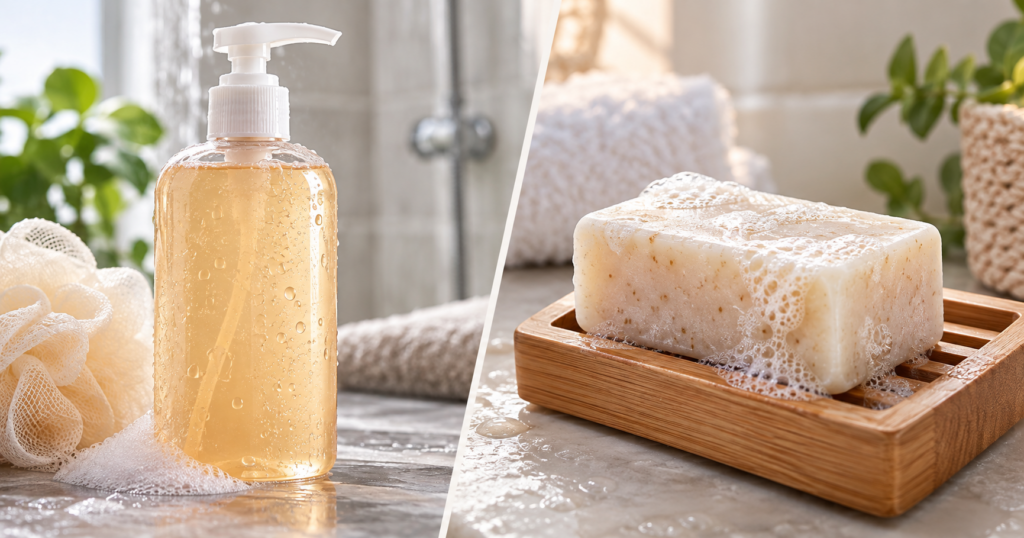
There are creamy body washes promising softer skin. Clear gels made for “deep cleansing.” Bars packed with shea butter, oatmeal, charcoal, goat milk, or mysterious botanical blends. Then there are dermatologist-style cleansing bars that don’t technically behave like traditional soap at all.
So, body wash vs. bar soap: which one is actually better for your skin?
The short answer is slightly annoying but useful: it depends more on the formula than the format.
A well-made cleansing bar may be much gentler than a heavily fragranced body wash. Meanwhile, a mild, fragrance-free body wash may feel far better on dry or eczema-prone skin than a traditional alkaline soap bar.
That distinction matters.
If your skin feels tight the minute you step out of the shower, gets itchy after bathing, breaks out across your back and chest, or somehow feels both oily and irritated, your cleanser may be part of the problem.
And no, feeling “squeaky clean” isn’t always the goal.
Sometimes squeaky clean is your skin saying, “Well, there went my protective oils.”
Let’s sort it out.
The Quick Answer: Body Wash or Bar Soap?
For many people with dry, sensitive, or eczema-prone skin, a mild, fragrance-free body wash or synthetic detergent cleanser, often called a syndet, may be the gentler choice.
For people with normal or resilient skin, either a good bar cleanser or body wash can work perfectly well.
If you prefer bars because they’re simple, compact, less messy, and usually need less packaging, you don’t automatically have to give them up. The trick is knowing whether you’re buying traditional soap or a gentler cleansing bar.
That’s where most of the confusion starts.
Wait, A Cleansing Bar Isn’t Always “Soap”
We casually call almost every solid cleanser soap.
Chemically, though, they’re not all the same.
Traditional soap is produced when fats or oils react with an alkali. This process creates fatty acid salts that clean by helping oil, sweat, dirt, and other debris wash away.
It works. Very well, actually.
The problem is that traditional soap tends to be alkaline.
Human skin naturally has a mildly acidic surface. Research reviews place healthy skin roughly within a pH range of 4 to 6, while traditional soaps may sit much higher, often around pH 8.5 to 11. Synthetic detergent cleansers can be formulated closer to the skin’s natural range.
That doesn’t mean one wash with traditional soap ruins your skin.
Skin is tougher than social media sometimes makes it sound.
Repeated exposure to harsh cleansing, though, can contribute to dryness, tightness, irritation, and disruption of the outer skin barrier, especially if your skin is already sensitive.
Then we have syndet bars.
“Syndet” simply means synthetic detergent. These cleansing bars use different surfactants from traditional soap and can be formulated at a lower pH. DermNet notes that syndets generally cause less dryness and are less likely to irritate sensitive skin than traditional soap.
So when someone says, “Bar soap destroys your skin,” the statement is too broad.
A harsh traditional soap bar and a mild syndet bar may look almost identical sitting beside your shower. Your skin may experience them very differently.
Your Skin Barrier Is Doing More Work Than You Think
To understand why cleanser matters, picture the outer layer of your skin like a brick wall.
Skin cells are the bricks.
Lipids—including ceramides, cholesterol, and fatty acids- act a bit like the mortar holding that wall together.
That barrier helps keep needed water inside while limiting the entry of irritants from outside.
Cleansing is necessary because sweat, excess oil, sunscreen, dirt, environmental particles, dead skin cells, and odour-producing substances build up on the skin.
Water alone doesn’t remove everything effectively.
That’s why cleansers contain surfactants.
Surfactants help water interact with oil and grime so both can rinse away. Very handy.
The catch? A surfactant that removes oil from yesterday’s sunscreen can also interact with oils in your skin barrier.
That’s why cleanser formulation matters so much.
A review of soap and syndet cleansers found that traditional soap can cause greater lipid removal, pH changes, and barrier disruption, while milder syndet systems can clean with less interference to the outer skin structure.
Think of it like cleaning a good non-stick pan.
You want the leftovers gone. You don’t need to sand down the pan every evening.
Skin works much the same way.
So Why Does Body Wash Often Feel Gentler?
Body washes have a major formulation advantage: they’re liquids.
That gives formulators room to combine cleansing agents with ingredients that improve slip, hydration, texture, and after-wash feel.
A body wash might contain glycerin, oils, fatty alcohols, ceramides, oat ingredients, humectants, or other skin-conditioning ingredients alongside its surfactants.
Some formulas produce a thick foam.
Others barely foam at all.
And despite what years of shampoo commercials trained us to believe, more foam doesn’t necessarily mean cleaner skin.
A rich cloud of bubbles can feel luxurious at 6:30 a.m. before work, but lather is partly a sensory feature. Your cleanser doesn’t need to turn your bathroom into a bubble machine to remove sweat and grime.
This is especially relevant if your skin feels dry after every shower.
The American Academy of Dermatology recommends gentle cleansers for dry skin and even suggests using cleanser mainly where it’s needed rather than coating the entire body in heavy lather.
That can feel strange if you grew up believing every centimetre needs aggressive scrubbing.
But think about your lower legs on an ordinary office day.
Are they truly dirty enough to require the same cleansing intensity as your underarms after a humid commute?
Probably not.
The Downside of Body Wash? The Bottle Can Hide a Lot
Here comes the mild contradiction.
Body wash can be gentler.
Body wash can also be surprisingly harsh.
A liquid format tells you almost nothing about how your skin will react.
Some body washes contain strong cleansing systems, lots of fragrance, essential oils, exfoliating acids, physical scrub particles, dyes, or combinations of ingredients your skin simply doesn’t enjoy.
A wash marketed as “refreshing,” “detoxifying,” “energising,” or “deep cleansing” may sound fantastic after a sweaty day.
Your skin doesn’t read marketing copy, though.
It responds to chemistry.
If you shower and immediately notice tightness, itching, burning, flaking, or that slightly shiny-yet-dehydrated look, pay attention.
Your cleanser may be removing more than you need it to.
And Bar Soap? It Has Some Very Real Advantages
Bar cleansers don’t deserve the villain role they sometimes get.
They’re practical.
A bar is easy to travel with. It doesn’t leak into your gym bag. It usually lasts a good while. It takes up almost no space in a small student bathroom. There’s no pump failing when you’re already late for work.
For families, one simple bar cleanser can also reduce the army of half-empty bottles slowly taking over the shower ledge.
And bars often need less plastic packaging than conventional bottled body washes.
For someone trying to simplify her routine, that matters.
There’s another advantage: you can find gentle bars.
Modern syndet cleansing bars can be formulated closer to the skin’s natural pH and may be appropriate even for dry or sensitive skin. Research comparing traditional soap and syndet technology consistently shows that what the bar is made from matters more than its rectangular shape.
So don’t judge a cleanser by whether it comes in cardboard or a pump bottle.
Read a little deeper.
Dry Skin? This Is Where the Difference Becomes Obvious
Dry skin tends to give immediate feedback.
You wash.
You rinse.
Then your arms feel tight before you’ve even found your towel.
Maybe your shins look slightly ashy. Your elbows feel rough. By bedtime, your legs itch.
If that sounds familiar, aggressive cleansing isn’t helping.
For dry skin, look for a mild cleanser, liquid or bar, that is fragrance-free and made for dry or sensitive skin.
The AAD recommends gentle, fragrance-free skin-care products and notes that deodorant soaps and heavily fragranced products can be too irritating for dry, sensitive skin.
You may also notice words such as moisturising, gentle, sensitive skin, soap-free, or pH-balanced on suitable products.
Those words aren’t guarantees. Still, they’re useful clues.
And here’s the part people often overlook: your cleanser is only half the story.
A scalding 20-minute shower followed by no moisturiser can defeat even a lovely gentle body wash.
Warm water is kinder than very hot water, and shorter showers generally place less stress on dry skin. The AAD recommends limiting bathing time for dry skin and applying moisturiser while the skin is still damp.
That tiny post-shower habit may do more for chronically dry legs than constantly switching cleanser brands.
Sensitive Skin Needs Less Drama
Sensitive skin is a funny label because it can mean many things.
Some people flush easily.
Some sting when almost any fragranced product touches their body.
Others deal with eczema, allergies, shaving irritation, or unexplained patches that appear whenever they experiment with something new.
For reactive skin, boring is often beautiful.
A simple fragrance-free cleanser can be a far safer daily companion than something scented like tropical punch, vanilla cashmere, midnight jasmine, and “ocean energy” all at once.
Fragrance is a common concern in irritated and eczema-prone skin. Dermatologists regularly recommend choosing products specifically labelled fragrance-free.
And here’s a label-reading quirk worth remembering.
Unscented isn’t necessarily the same as fragrance-free.
An unscented product may contain ingredients used to mask another smell. The AAD advises people with eczema or sensitive skin to look specifically for “fragrance-free.”
It’s one of those tiny shopping details that sounds fussy until your skin spends three days itching.
What About Eczema?
If you have eczema, the body wash-versus-bar-soap debate becomes less about personal preference and more about barrier preservation.
Eczema-prone skin tends to lose moisture more easily and react more strongly to irritants.
The AAD recommends mild, fragrance-free cleansing and short baths or showers with warm rather than hot water for atopic dermatitis.
Cleveland Clinic guidance similarly favours mild liquid cleansers for eczema over many traditional soap bars because some bars contain cleansing systems that can remove too much oil and moisture.
But remember our earlier distinction.
A syndet bar isn’t necessarily traditional soap.
So if you love bars, you may not have to abandon them. A dermatologist-friendly, fragrance-free syndet bar may suit you well.
The best test is boring but reliable: how does your skin behave?
Less itching?
Less tightness?
Fewer flaky patches?
No burning?
That’s useful data.
If your eczema is persistent, infected, painful, oozing, or getting worse despite gentle care, that’s a dermatologist conversation rather than a shopping-aisle experiment.
Oily Skin Doesn’t Need to Be Punished
People with oily skin often fall into the “stronger must be better” trap.
It makes sense emotionally.
If your chest or back feels oily, you want something powerful enough to cut through it.
But harsh cleansing can leave skin irritated without fixing the reason you’re oily.
A gentle body wash or cleanser is usually a better daily starting point.
If you’re also dealing with body acne, then the active ingredient may matter much more than whether the cleanser comes as a bar or liquid.
The AAD notes that benzoyl peroxide washes can help with mild to moderate back acne, while gentle cleansing and avoiding abrasive scrubs are also important.
Salicylic acid is another common acne ingredient and can help unclog pores.
Now, don’t turn your shower into a chemistry lab.
If you use an acne wash, piling a harsh scrub, exfoliating glove, strong fragrance, and aggressive soap on top of it can leave your skin furious.
Treatment should treat.
Your remaining routine should usually stay fairly calm.
Normal Skin? Congratulations. You Have More Freedom
If your skin rarely feels dry, itchy, irritated, or congested, you don’t need to manufacture a problem.
Use the cleanser you enjoy.
A decent body wash is fine.
A gentle bar is fine.
If your skin feels comfortable after washing and stays comfortable through the day, that’s a pretty strong clue your cleanser is doing its job.
Skin care doesn’t need to feel difficult to count as good skin care.
That matters for anyone balancing lectures, deadlines, meetings, nursery runs, grocery shopping, emails, and the daily question of what on earth everyone is going to eat tonight.
Sometimes the best routine is the one you can repeat without thinking.
The Ingredients Matter More Than the Pretty Bottle
Skin-care labels are crowded.
You can stand there reading an ingredient list and feel as though you’ve accidentally enrolled in organic chemistry.
You don’t need to memorise everything.
Start with a few practical signals.
For dry skin, ingredients such as glycerin, ceramides, petrolatum, certain oils, hyaluronic acid, oatmeal, and other humectant or emollient ingredients may help support a more comfortable after-wash feel.
The AAD lists glycerin, hyaluronic acid, dimethicone, mineral oil, petrolatum, shea butter, and several other ingredients as useful in products aimed at dry skin.
Keep perspective, though.
A cleanser stays on your body for a short time.
Don’t pay a huge premium simply because a body wash contains a trendy ingredient you’d normally expect in a serum.
A rinse-off product doesn’t behave like a leave-on cream.
If a basic gentle cleanser keeps your skin comfortable, you’ve already won.
Spend your attention, and perhaps your money, on a good moisturiser that actually stays on your skin.
“Natural” Doesn’t Automatically Mean Gentler
This one catches a lot of people.
A handmade soap wrapped in brown paper, decorated with dried lavender, and described as botanical can look incredibly wholesome.
It may also be quite alkaline.
Likewise, essential oils smell natural because they are natural. That doesn’t mean every skin type tolerates them.
Your skin doesn’t award bonus points for rustic packaging.
Traditional soap chemistry stays traditional soap chemistry whether the bar comes from a luxury boutique, a supermarket, or a weekend craft market.
That doesn’t mean handmade soap is bad.
Some people use it for years with no trouble.
It simply means “natural” and “gentle” aren’t synonyms.
Does Bar Soap Spread Germs?
This question tends to appear the moment someone imagines a wet soap bar sitting in a shared bathroom.
Yes, microorganisms can be found on used bars.
But that doesn’t automatically mean they’re transferred to your skin in a meaningful way during normal washing.
An older experimental study deliberately contaminated soap bars with high levels of bacteria and found no detectable transfer of the test organisms to participants’ hands after washing.
For an ordinary household, the bigger practical issue is storage.
Don’t leave your bar drowning in a puddle of water.
Use a draining soap dish and allow the bar to dry between showers.
It lasts longer, feels less mushy, and your bathroom looks a little less chaotic.
Small win.
Your Loofah May Be Doing More Than Your Cleanser
Here’s a useful side road.
People spend ages comparing body washes and bars, then scrub themselves with the same damp loofah hanging in the shower for weeks.
That’s worth reconsidering.
For acne-prone skin in particular, dermatologists advise against aggressive scrubbing tools because friction and irritation can worsen breakouts.
Your hands are often enough for daily washing.
A soft, clean washcloth can work too if your skin tolerates it and you launder it regularly.
You don’t need to polish your body like you’re restoring an old dining table.
Dead skin will shed.
Your cleanser will clean.
Your skin barrier would quite like to remain attached.
But I Love Fragranced Body Wash
Fair.
Scent is emotional.
A warm vanilla shower after a miserable commute can feel comforting. A citrus wash can make a rushed morning feel slightly more awake. Sometimes skin care is also ritual, and ritual matters.
If your skin tolerates fragrance, you don’t necessarily need to fear it.
The concern becomes more important when you have eczema, dermatitis, frequent itching, unexplained irritation, or a history of reacting to fragranced products.
If that’s you, fragrance-free is usually the safer direction.
And if you use perfume anyway, here’s a thought: your cleanser doesn’t need to perform three jobs.
Let your body cleanser clean.
Let your moisturizer moisturize.
Let your perfume smell good.
Your shower gel doesn’t need a résumé.
Does More Expensive Mean Better?
Not reliably.
There are excellent affordable cleansers and expensive luxury cleansers.
Price can reflect packaging, fragrance development, branding, imported ingredients, advertising, texture, or simply the position a company wants in the market.
None of those guarantee that your skin barrier will be happier.
A simple pharmacy cleanser can outperform a beautiful spa bottle for someone with sensitive skin.
Meanwhile, if you have normal skin and adore the sensory feel of an expensive wash, that’s fine too.
Skincare is allowed to be enjoyable.
Just don’t confuse price with dermatological necessity.
Body Wash Wins on Convenience, Sometimes
For busy households, pumps are handy.
One hand. One press. Done.
That’s useful when you’ve got a toddler outside the shower asking seventeen questions, an early lecture, a meeting in 25 minutes, or exactly four minutes before someone else needs the bathroom.
Body wash can also be easier to share hygienically because no one directly handles the product inside the bottle.
And body wash works well when you need a specialised formula, such as an acne wash, moisturising cleanser, or medicated cleanser recommended by a clinician.
The downside?
Bottles pile up.
Pumps break.
Product gets wasted.
Travel gets messy.
And somehow there’s always a nearly empty bottle that nobody is willing to throw away.
Bar Cleansers Win on Simplicity
Bars are the minimalist colleague of the bathing world.
No pump.
No bottle.
No elaborate setup.
You can place one in a draining dish and get on with your day.
They’re particularly handy for travel, gym bags, student accommodation, and anyone trying to reduce bathroom clutter.
A concentrated bar may also last longer than expected because you’re not squeezing a large blob into your hand each shower.
Still, storage matters.
A bar that remains wet will soften and disappear faster.
Give it air.
Your soap deserves boundaries too.
So, Which One Should Busy Women Actually Buy?
Forget the idea that there has to be one universal winner.
Start with your skin.
If you have dry or sensitive skin, a mild fragrance-free body wash or syndet cleanser is a sensible starting point.
If you love bar cleansers, look for a gentle syndet or moisturising bar rather than assuming every traditional soap will suit you.
If you have eczema, prioritise mild, fragrance-free cleansing and follow your dermatologist’s guidance if your condition isn’t well controlled.
If you have body acne, consider acne-directed ingredients such as benzoyl peroxide or salicylic acid rather than endlessly switching ordinary soaps.
If your skin is normal and comfortable, choose what fits your budget, routine, and personal preference.
And whatever you choose, don’t ignore your shower habits.
A mild cleanser can’t fully compensate for very hot water, aggressive scrubbing, long showers, and skipping moisturiser when your skin is already dry.
A Better Shower Routine Doesn’t Need 14 Products
There’s been a strange shift in skin care where even showering can start to sound like a project plan.
Pre-cleanse.
Cleanse.
Exfoliate.
Polish.
Treat.
Shave.
Mask.
Oil.
Serum.
Cream.
Mist.
You can relax.
For many people, a solid routine is simpler.
Use warm rather than very hot water. Clean the areas that actually need cleaning. Rinse well. Pat your skin instead of attacking it with the towel. Then moisturise while the skin is still slightly damp if you’re prone to dryness.
Cleveland Clinic and the AAD both recommend warm showers, gentle cleansing, and moisturizing afterward to help limit dryness and support the skin barrier.
That’s not glamorous advice.
It works precisely because it’s ordinary.
When Your Cleanser Is Probably Too Harsh
Your skin tends to communicate.
Sometimes quietly. Sometimes like a fire alarm.
If you repeatedly notice stinging, itching, tightness, flaking, burning, rough patches, or redness after bathing, your cleansing routine deserves a review.
Try changing one thing first.
Maybe switch from a fragranced traditional soap to a fragrance-free mild cleanser.
Maybe stop using boiling-hot water.
Maybe retire the scratchy shower brush.
Maybe use less product.
Give your skin a chance to settle before replacing everything on the shelf at once.
If symptoms continue despite gentle care, or you develop cracking, bleeding, persistent rashes, painful acne, oozing, swelling, or signs of infection, see a dermatologist or other qualified healthcare professional.
Sometimes what looks like “dry skin from soap” is eczema, allergic contact dermatitis, psoriasis, folliculitis, acne, or another condition that needs proper treatment.
Body Wash vs. Bar Soap: The Final Verdict
So, what’s better for your skin?
Neither body wash nor bar soap wins simply because of its format.
A gentle body wash can be excellent for dry and sensitive skin.
A well-formulated syndet bar can be excellent too.
A strongly fragranced body wash can irritate skin.
A traditional alkaline soap bar can leave some people feeling dry and tight.
The smarter question isn’t, “Is liquid better than solid?”
It’s:
What is this cleanser made from, and how does my skin feel after I use it?
That question cuts through a lot of marketing noise.
For dry, sensitive, or eczema-prone skin, start with something mild, fragrance-free, and designed to protect comfort rather than produce maximum foam.
For normal skin, you have more flexibility.
For acne-prone skin, match the cleanser to the skin problem instead of chasing that extra-clean feeling.
And remember: cleansing is supposed to remove what doesn’t belong on your skin without making your skin itself feel like the enemy.
If you step out of the shower feeling clean, comfortable, and not desperate for lotion within 30 seconds, your cleanser is probably doing a pretty decent job.
Sometimes skin care really can be that simple.