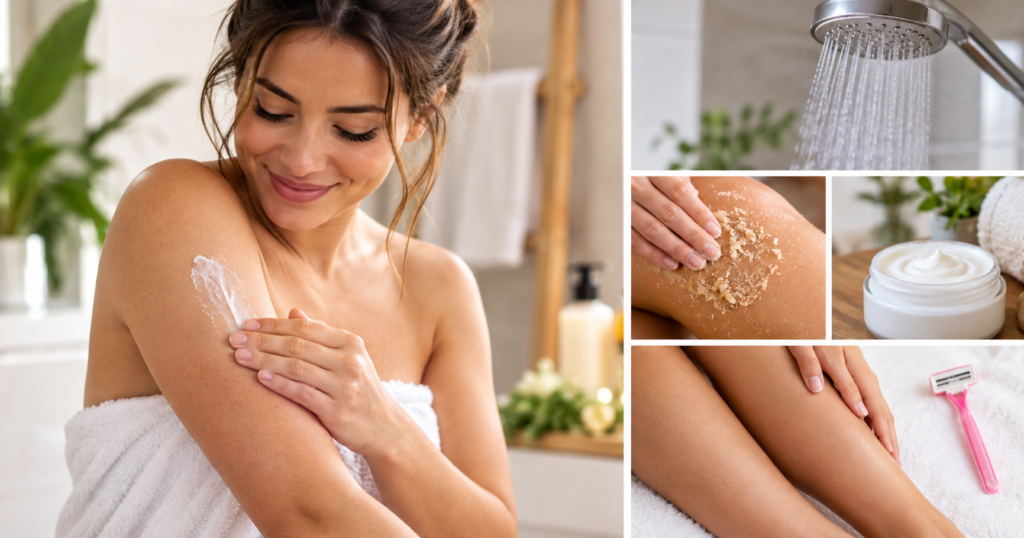

You run your hand over your upper arms or thighs, and there it is again: that rough, grainy texture that refuses to disappear.
Maybe the bumps are tiny and skin-colored. Maybe they’re red. Maybe your legs feel smooth right after shaving, only to become prickly and irritated a day later. Or perhaps your skin simply has that persistent “sandpaper” feel no matter how much lotion you use.
Rough, bumpy skin is frustrating partly because the instinctive solution seems obvious: scrub harder.
That can be exactly the wrong move.
Skin texture often improves when you treat it more gently, not more aggressively. The real goal isn’t to polish your body like a kitchen countertop. It’s to loosen excess dead skin, keep the skin barrier comfortable, reduce irritation around hair follicles, and give your routine enough time to work.
And yes, that last part matters. Skin can be stubborn.
The good news? You usually don’t need a 10-product body-care routine.
You need the right few steps, repeated consistently.
First, What Does “Rough, Bumpy Skin” Actually Mean?
Rough skin isn’t one specific condition.
Several things can create similar texture, which explains why the body scrub that worked beautifully for your friend might leave your skin looking angrier.
One very common cause is keratosis pilaris, often casually called “chicken skin” or “strawberry skin,” although those terms can describe slightly different concerns.
Keratosis pilaris causes tiny, rough bumps, most often on the upper arms, thighs, cheeks, or buttocks. The bumps develop when keratin, a protein found naturally in your skin, builds up and plugs the openings of hair follicles. It’s harmless and isn’t contagious.
The texture can feel a little like permanent goosebumps.
Then there’s simple dryness. When the outer skin barrier loses water, the surface can become flaky, tight, scaly, itchy, and uneven. Extremely dry skin can even crack.
Shaving introduces another possibility.
Hair removal can irritate follicles and contribute to razor bumps or folliculitis-like breakouts. Friction from tight clothing, sweat, shaving, waxing, or repeated rubbing can also irritate hair follicles.
And sometimes rough patches come from eczema, contact irritation, acne, psoriasis, or another skin condition.
That’s why context matters.
Tiny painless bumps on the backs of your arms are different from suddenly developing painful, pus-filled bumps after shaving. A dry elbow is different from a spreading itchy rash.
You don’t need to diagnose every bump in the bathroom mirror. But you do need to notice what your skin is telling you.
The Biggest Mistake? Trying to Scrub the Texture Away
You know what feels strangely satisfying?
Taking a gritty scrub to rough skin and feeling instantly smoother.
Unfortunately, that immediate smoothness can fool you.
Aggressive scrubbing creates friction. If your skin is already dry, inflamed, or irritated around the follicles, more friction can make matters worse.
The American Academy of Dermatology recommends gentle exfoliation for keratosis pilaris and specifically warns that hard scrubbing can irritate the skin and worsen the condition. The NHS gives similar advice: gentle exfoliation may help, but harsh scrubs and excessive rubbing should be avoided.
So no, you don’t have to throw away every washcloth you own.
Just stop treating exfoliation like punishment.
A soft cloth used lightly is very different from spending five minutes scrubbing one patch of skin because you’re determined to make the bumps disappear before Saturday.
Skin rarely responds well to desperation.
Start in the Shower. Because Your Shower Can Help or Hurt
If rough skin is bothering you, take a look at your shower routine before buying another treatment.
Long, steaming showers feel wonderful after an exhausting day. Your skin may disagree.
Hot water can contribute to dryness, and dermatologists commonly recommend shorter showers with warm water for dry or rough skin. The American Academy of Dermatology advises keeping showers or baths around five to ten minutes when treating dry skin, while its keratosis pilaris guidance also recommends avoiding lengthy hot bathing.
Think comfortably warm rather than lobster-boil hot.
Next, reconsider how much cleanser you’re using.
You don’t necessarily need heavily fragranced soap rubbed across every inch of your body twice a day. If your skin is dry or sensitive, a gentle fragrance-free cleanser may be kinder.
AAD guidance for dry skin recommends mild, fragrance-free products and notes that some deodorant soaps can be too harsh for dry, sensitive skin.
Pay attention to the wording on the label too.
“Fragrance-free” is generally more useful for sensitive skin than “unscented,” because an unscented product can still contain ingredients used to mask odours.
Your shower routine doesn’t need to feel clinical.
Use your normal products where your skin tolerates them. But if your upper arms, thighs, or legs are permanently rough, scaling back fragrance and aggressive cleansing on those areas may be worth trying.
And when you step out?
Don’t scrub yourself bone-dry with the towel.
Pat.
Your skin will survive the extra five seconds.
Then Comes the Important Part: Exfoliation Without the Drama
When rough texture is caused by dead skin buildup around follicles, exfoliating ingredients can help loosen that buildup.
These are sometimes called keratolytics.
Don’t let the jargon scare you. It basically means ingredients that help soften or shed excess keratin and dead surface cells.
Dermatologists commonly use ingredients such as lactic acid, glycolic acid, salicylic acid, urea, and sometimes topical retinoids to improve the appearance of keratosis pilaris.
Here’s how the main choices differ:
- Lactic acid and glycolic acid: Alpha hydroxy acids, or AHAs, that help loosen dead surface cells. Lactic acid can be especially useful in body lotions because it combines exfoliating action with hydration.
- Salicylic acid: A beta hydroxy acid that can help clear dead material around pores and follicles. It often appears in body washes and smoothing creams.
- Urea: One of the quiet workhorses of rough-skin care. Depending on concentration and formulation, it can hydrate while also helping soften thick, rough skin.
- Retinoids: Vitamin A derivatives can increase cell turnover and help reduce plugged follicles, but they can also cause irritation and dryness. Prescription versions should be used under appropriate medical guidance. Pregnancy and nursing also require special consideration; Mayo Clinic notes that healthcare professionals may recommend delaying topical retinoid therapy during pregnancy or nursing.
Notice something?
You do not need all four.
Using lactic acid, salicylic acid, glycolic acid, a retinoid, a gritty scrub, an exfoliating glove, and whatever viral peeling product appeared on your feed this week isn’t an advanced routine.
It’s an irritated-skin starter pack.
Start with one main smoothing ingredient.
Give your skin a chance to respond.
So, How Often Should You Exfoliate Rough Skin?
This is where social media has made body care more confusing than necessary.
More exfoliation does not automatically mean faster results.
Some products are formulated for regular use. Others are stronger. Your tolerance matters too.
A sensible starting approach is using your chosen exfoliating body product a few times each week, then adjusting based on how your skin responds and according to the label directions.
If you develop burning, persistent stinging, unusual redness, peeling, tenderness, or worsening dryness, back off.
AAD guidance specifically recommends stopping keratolytic treatment for a few days if the skin becomes dry or irritated.
That little pause can save you from spending the next week repairing a skin barrier you accidentally annoyed.
Also, don’t confuse tingling with success.
A product does not need to hurt to be effective.
Moisturizer Isn’t the Boring Step. It’s Half the Strategy.
People with rough skin sometimes become so focused on exfoliation that moisturising turns into an afterthought.
Big mistake.
Keratosis pilaris tends to become more obvious when skin gets dry. Mayo Clinic notes that the bumps can worsen during seasonal periods with low humidity and drier skin.
Moisturiser helps soften that rough surface while supporting the skin barrier.
Timing makes a difference too.
Dermatologists recommend applying moisturiser shortly after bathing, while the skin still holds some water. For keratosis pilaris specifically, the AAD recommends applying moisturiser within about five minutes after bathing.
So instead of getting out of the shower, scrolling your phone for 25 minutes, making tea, answering a message, and then remembering your lotion…
Moisturise first.
Tea can wait.
For persistently rough skin, creams and ointments often provide more moisture than thin lotions. Helpful moisturising ingredients may include glycerin, dimethicone, petrolatum, mineral oil, hyaluronic acid, shea butter, lactic acid, or urea.
Again, you don’t need them all.
A plain fragrance-free cream can be surprisingly effective when you actually use it every day.
Consistency beats a bathroom shelf full of half-used products.
A Simple Routine for Rough, Bumpy Skin
If your calendar already contains lectures, deadlines, commuting, work meetings, school runs, grocery shopping, and the nightly question of what everyone is going to eat, body care cannot become another full-time job.
Keep it simple.
Morning
If you shower in the morning, use warm water and a mild cleanser.
Pat your skin dry rather than rubbing.
Apply your moisturising or smoothing body cream while the skin is slightly damp.
If exposed areas are going to see daylight, finish with broad-spectrum SPF 30 or higher. Dermatologists recommend sun protection as part of dry-skin care, and it becomes especially sensible when you use exfoliating products or are trying to prevent uneven marks from lingering.
Done.
Evening
After bathing, apply your exfoliating body treatment on the nights you use it.
If the treatment isn’t moisturising enough by itself, follow with a plain cream once it has settled comfortably on your skin.
On your non-exfoliation nights, simply moisturise.
That’s your routine.
Not glamorous. Not seven steps.
But repeatable—and repeatable routines tend to beat complicated routines that last nine days.
What About Those Bumps on Your Upper Arms?
Upper arms are classic keratosis pilaris territory.
If the bumps are small, painless, persistent, and feel like gooseflesh or fine sandpaper, KP may be one possibility. Mayo Clinic notes that keratosis pilaris commonly occurs on the upper arms, thighs, cheeks, and buttocks.
Try combining gentle cleansing with a moisturiser containing urea or lactic acid.
You may also use another suitable exfoliating ingredient, such as salicylic or glycolic acid, according to the product directions and your tolerance.
What usually doesn’t help?
Picking.
Those tiny plugs can be tempting. You see one, squeeze it, inspect it, then suddenly you’ve been standing in front of the mirror performing amateur dermatology for 15 minutes.
Picking creates unnecessary inflammation and can leave marks that take far longer to fade than the original bump.
Hands off.
Rough Thighs and “Strawberry Legs” Need a Little Detective Work
Bumpy thighs can also be related to keratosis pilaris, but rough-looking legs may involve several things at once.
Dryness.
Visible follicles.
Hair regrowth.
Ingrown hairs.
Shaving irritation.
Follicular plugging.
That combination can create the dotted appearance commonly nicknamed “strawberry legs.”
This is where changing your shaving technique can matter almost as much as changing your lotion.
AAD dermatologists recommend softening hair before shaving, using a moisturising shaving cream, and shaving in the direction the hair grows to reduce razor bumps.
Shaving at the end of your shower can help because the hair and skin have had time to soften.
And please use a decent razor.
Dragging a tired blade repeatedly over the same area is basically an invitation for irritation.
Try not to keep passing over one patch because you found three rebellious hairs.
Your skin remembers every pass even when your patience doesn’t.
If Hair Removal Keeps Making the Bumps Worse
People often assume that bumps after shaving automatically mean keratosis pilaris.
Not necessarily.
Shaving, waxing, plucking, tight clothing, heat, moisture, and friction can damage or irritate follicles. Folliculitis may look like an acne-style breakout around hair follicles.
If bumps appear after hair removal, changing your technique may help.
Give irritated skin time to recover. Avoid repeatedly shaving inflamed areas if you can.
AAD guidance notes that when shaving, plucking, or waxing causes folliculitis, stopping the triggering hair-removal practice for a period may allow the follicles to recover.
If your bumps become painful, pus-filled, warm, swollen, widespread, or persistent, don’t keep throwing acids at them.
That’s dermatologist territory.
Rough Skin on the Buttocks? Yes, We Need to Talk About It
Nobody discusses this at brunch, but bumpy skin on the buttocks is extremely common.
Keratosis pilaris can appear there. Friction, sweat, prolonged sitting, workout clothing, and inflamed follicles can also contribute to texture.
If you spend much of your day sitting at a desk, studying, commuting, or driving, think about the environment around the skin—not only the products on it.
Tight leggings plus sweat plus hours of sitting can create more friction than your follicles appreciate.
Change out of sweaty clothing when you can.
Wear breathable fabrics.
Wash after heavy exercise.
AAD notes that tight clothing rubbing against damp, warm skin can damage follicles and contribute to folliculitis.
Then keep treatment boring: gentle cleansing, a suitable smoothing treatment, moisturiser, and patience.
Your skin does not require a weekly archaeological excavation with a body brush.
Dark Marks Can Outlast the Original Bumps
This is an important part of the conversation, particularly for deeper skin tones.
Sometimes the texture improves, but the evidence stays behind.
Inflammation from bumps, ingrown hairs, scratching, or picking can leave discolouration that remains visible long after the original irritation has calmed.
That’s another reason to avoid squeezing and aggressive scrubbing.
You’re not only trying to flatten today’s bump. You’re trying to prevent tomorrow’s mark.
Sun protection helps too, especially on exposed arms and legs.
And if pigmentation is significant or isn’t fading, a dermatologist can recommend treatments appropriate for your skin tone without creating unnecessary irritation.
The “Skin Cycling” Idea Makes More Sense for the Body Than You Think
Face-focused skin cycling became popular online because it permitted people to stop stacking every active ingredient on the same night.
There’s a useful lesson there for body care.
You can have treatment nights and recovery nights.
For example, you might use your smoothing lotion on certain evenings and stick to a plain moisturiser on others.
The exact schedule depends on the product.
The important part is that your skin gets a chance to remain comfortable.
If Monday’s exfoliation leaves you sore on Tuesday, applying even more acid Tuesday night because the calendar says so isn’t discipline.
It’s poor feedback management.
Your skin is giving you data.
Use it.
Rough Skin Often Gets Worse When the Weather Changes
Have you ever noticed that your arms suddenly feel rougher during colder or drier months?
There’s a reason.
Keratosis pilaris can become more noticeable when humidity drops, and the skin becomes dry.
Indoor heating can add another layer of dryness.
During drier seasons, you may need a richer body cream, more frequent moisturising, shorter showers, and less frequent exfoliation.
A cool-mist humidifier can also help when indoor air feels very dry; the AAD includes humidifiers among measures that can help prevent or relieve dry skin.
During hotter, humid months, your problem may shift.
Sweat and friction become more relevant, especially around the thighs, buttocks, underarms, or anywhere tight clothing sits against the body.
Your routine doesn’t have to stay identical for 12 months.
Skin changes with weather, clothing, hormones, stress, hair removal, travel, and life.
Adjust without starting from zero.
Products That Smell Amazing Aren’t Always Your Skin’s Best Friend
This one hurts a little.
Body care has become wonderfully indulgent. Vanilla shower oils, tropical body butters, perfume mists, shimmering creams—it’s basically dessert for your bathroom shelf.
But irritated or very dry skin may tolerate fragrance poorly.
Dermatologists generally recommend fragrance-free products when treating dry or sensitive skin.
That doesn’t mean fragrance is universally terrible.
It means that when you’re troubleshooting stubborn roughness, removing unnecessary irritants can make the experiment cleaner.
Think like a project manager for two weeks.
Simplify.
Observe.
Then decide what your skin actually tolerates.
If your skin becomes noticeably calmer when you switch to fragrance-free body care, that tells you something useful.
Why Your Expensive Body Scrub May Be Doing Absolutely Nothing
Price and effectiveness are not the same thing.
A beautiful jar with sea salt, essential oils, rose petals, gold lettering, and a wooden spoon can look fabulous beside your bathtub.
It may still be the wrong product for follicular roughness.
When keratin is plugging a follicle, chemical exfoliating ingredients such as lactic acid, glycolic acid, salicylic acid, or urea may be more useful than simply sanding the skin surface. These are among the ingredients dermatologists commonly recommend for keratosis pilaris.
Physical exfoliation can still have a place when it’s gentle, and your skin tolerates it.
Just don’t assume rougher scrub equals smoother skin.
Skin isn’t woodwork.
Give Your Routine More Than a Weekend
One of the hardest things about treating textured skin is that progress can feel slow.
You moisturise twice.
Nothing happens.
You use your smoothing cream for four nights.
Still bumps.
Then TikTok introduces you to a new bottle and the old one gets pushed behind the shampoo.
That product hopping makes it difficult to know what works.
According to the American Academy of Dermatology, people treating keratosis pilaris may need around four to six weeks before deciding that a treatment plan isn’t producing enough improvement. Maintenance is often needed afterwards because the condition can return when treatment stops.
That doesn’t mean you should tolerate irritation for six weeks.
Irritation is feedback.
But if your skin feels comfortable, give the routine time.
Take a photo at the beginning if you want an objective comparison. Texture can improve slowly enough that you don’t notice the change when you stare at your arms every morning.
Can You Completely Get Rid of Keratosis Pilaris?
Not always.
And that distinction matters.
Keratosis pilaris is harmless and may improve over time, but treatments generally manage its appearance rather than permanently eliminating the tendency to develop bumps. Mayo Clinic notes that the condition may persist for years even with treatment, while the AAD stresses the importance of maintenance once the skin improves.
So think management, not perfection.
You may reach the point where your skin feels significantly smoother and then maintain that result with treatment a few times each week.
That is success.
You don’t need poreless, airbrushed arms.
Real skin has texture.
The goal is healthier, calmer skin, not making your body resemble a filtered advertisement.
When Rough, Bumpy Skin Needs Professional Help
Most mild roughness can be managed with gentle skin care.
Still, not every bump belongs in a DIY routine.
See a doctor or dermatologist if the area becomes painful, severely itchy, inflamed, infected-looking, rapidly spreading, or begins producing pus. Persistent bumps that aren’t responding to reasonable home care also deserve a professional look.
A dermatologist can distinguish keratosis pilaris from folliculitis, eczema, acne, psoriasis, and other conditions that may look similar.
For stubborn keratosis pilaris, dermatologists may also prescribe stronger treatments or consider laser and light-based procedures for certain concerns, including persistent redness or discolouration.
Sometimes the smartest skin-care purchase is an appointment.
Frequently Asked Questions About Rough, Bumpy Skin
What is the fastest way to smooth rough, bumpy skin?
There isn’t a reliable overnight fix. A good routine combines gentle cleansing, controlled exfoliation with ingredients such as lactic acid, salicylic acid, glycolic acid, or urea, and regular moisturising. Keratosis pilaris treatment may take several weeks before noticeable improvement appears.
Should I exfoliate bumpy skin every day?
Not automatically.
Frequency depends on the formula, strength, body area, and your skin’s tolerance. Follow the product instructions and reduce frequency if you develop burning, peeling, excessive dryness, or irritation.
Is rough, bumpy skin always keratosis pilaris?
No.
Dryness, razor bumps, folliculitis, acne, eczema, psoriasis, ingrown hairs, and irritation can all affect texture. If you’re unsure what you’re treating, especially when bumps are painful or inflamed, see a dermatologist.
Does moisturising really help keratosis pilaris?
Yes, especially when dryness makes the bumps more obvious. Dermatologists commonly recommend moisturising creams containing ingredients such as urea or lactic acid and applying moisturiser soon after bathing.
Are hot showers bad for bumpy skin?
Very hot, long showers can worsen dryness. Warm or lukewarm water and shorter showers are generally friendlier to dry, rough skin.
Can shaving make rough skin worse?
It can.
Shaving may irritate follicles and contribute to razor bumps or folliculitis. Softening the hair first, using shaving cream, shaving with the direction of growth, and avoiding repeated passes can reduce irritation.
Should I pick keratosis pilaris bumps?
No.
Picking and scratching create extra irritation and may increase the chance of lingering marks.
Which is better for rough skin: salicylic acid or lactic acid?
Both can be useful.
Lactic acid mainly works as an alpha hydroxy acid that loosens dead surface cells while also supporting hydration. Salicylic acid can work well around clogged follicles. Your skin type and tolerance may determine which feels better.
You don’t need both immediately.
Can body lotion alone fix rough skin?
If simple dryness is driving the texture, a good moisturiser may make a big difference. If keratin buildup is contributing to persistent follicular bumps, a product containing a keratolytic ingredient may provide additional smoothing.
Your Rough-Skin Routine Doesn’t Need to Be Complicated
If you remember only one thing, make it this:
Stop fighting your skin. Start supporting it.
Use warm rather than scorching water.
Cleanse gently.
Choose one sensible exfoliating ingredient rather than throwing five acids at the problem.
Moisturise while your skin is still slightly damp.
Pay attention to shaving and friction.
Protect exposed skin from the sun.
And give the routine enough time to prove itself.
Rough, bumpy skin can be persistent, especially when keratosis pilaris is involved. That doesn’t mean you’re doing everything wrong. Some skin simply needs ongoing maintenance.
The goal isn’t perfectly polished skin every second of every day.
It’s skin that feels softer, stays comfortable, and requires less fighting.
And really, isn’t that what a good body-care routine should do?